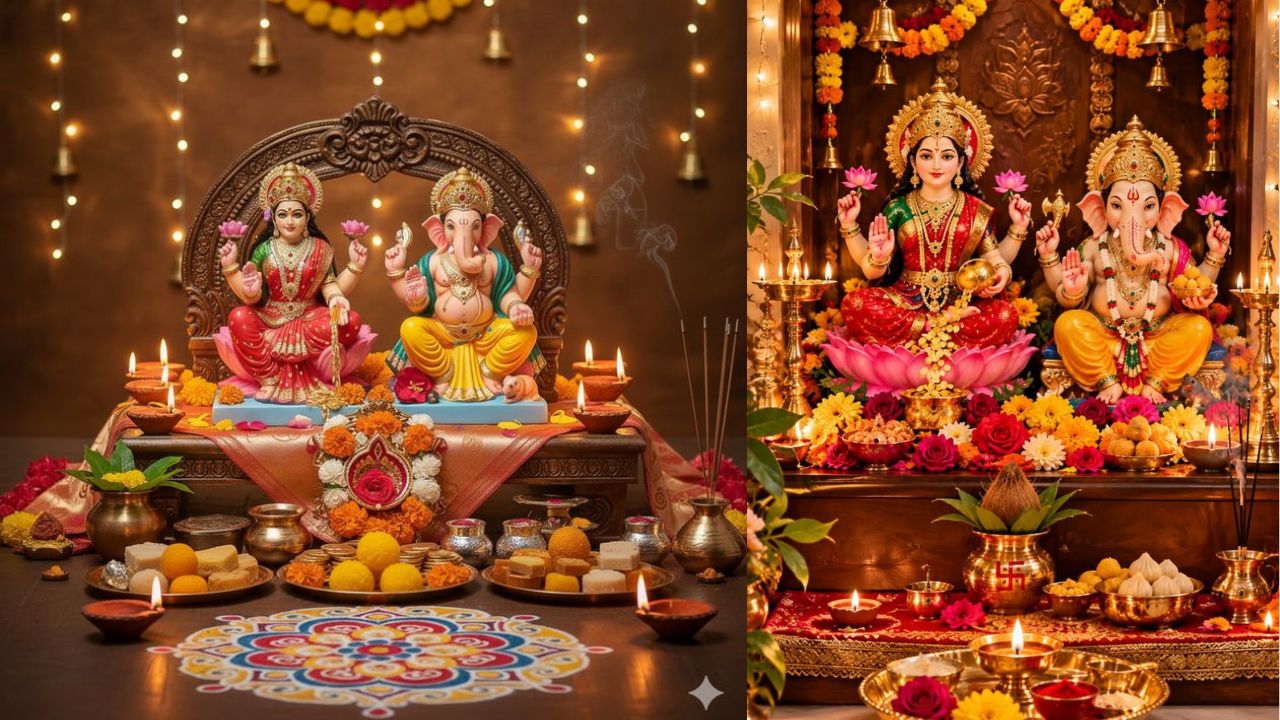
Lakshmi Puja Muhurat 2026: Check the city-wise timings for worshipping Goddess Lakshmi and Lord Ganesha. (Img: Pinterest)
New Delhi: Diwali 2026 is being celebrated across India on Sunday, with devotees preparing to worship Goddess Lakshmi and Lord Ganesha during the auspicious evening muhurat. The most-awaited religious observance of Deepawali, Lakshmi-Ganesh Puja, is performed during Pradosh Kaal, with the precise timings varying across cities according to local sunset calculations and Hindu astrological considerations.
According to the reported Drik Panchang schedule, the Lakshmi Puja muhurat in New Delhi will begin at 5:54 PM and conclude at 7:50 PM. Devotees in Mumbai can perform the rituals between 6:27 PM and 8:27 PM, while the auspicious window in Bengaluru will extend from 6:17 PM to 8:20 PM. In Chennai, the puja timing is 6:07 PM to 8:09 PM, while Kolkata will observe the earliest listed window, beginning at 5:20 PM.
As Diwali coincides with Kartik Amavasya, devotees traditionally perform Lakshmi Puja during the evening to seek blessings for wealth, prosperity, financial stability, happiness and well-being. Here is the complete city-wise schedule, along with the Amavasya Tithi, Pradosh Kaal significance, auspicious Choghadiya timings and the Lakshmi mantra for Diwali 2026.
Diwali, also known as Deepawali, is being observed on November 8, 2026, corresponding to Kartik Amavasya in the Hindu lunar calendar. According to the reported Panchang calculations, Amavasya Tithi commenced at 11:27 AM on November 8 and will continue until 12:31 PM on November 9. Although the lunar tithi extends into the following day, the principal Diwali festivities and Lakshmi-Ganesh Puja are being observed on November 8.
Kartik Amavasya holds special religious significance in Hinduism, as devotees associate the occasion with the worship of Goddess Lakshmi, the deity of wealth, abundance and prosperity. Lord Ganesha is worshipped alongside her as the remover of obstacles and the deity of wisdom, auspicious beginnings and success.
The auspicious timing for Lakshmi Puja differs across geographical locations because sunset, local planetary positions and the duration of astrological periods vary from one city to another. For devotees in the Delhi-NCR region, including New Delhi, Noida and Gurugram, the reported Lakshmi Puja window begins at approximately 5:54 PM to 5:55 PM.
In Mumbai and Pune, the auspicious period begins later, at 6:27 PM and 6:24 PM, respectively. Bengaluru's muhurat extends until 8:20 PM, while devotees in Kolkata can begin their prayers from 5:20 PM.
Pradosh Kaal is an important evening period in Hindu religious traditions, beginning after sunset and lasting approximately two hours and 24 minutes. Its exact duration and timing depend on the local sunset, which explains why Lakshmi Puja muhurat differs between cities.
On Diwali, Pradosh Kaal is considered particularly auspicious for worshipping Goddess Lakshmi. The period is associated with spiritual positivity, divine blessings and the invocation of prosperity.
The most favourable Lakshmi Puja window is traditionally determined by considering the overlap between Pradosh Kaal and Sthir Lagna, or a fixed ascendant. Vrishabha Lagna, also known as Taurus ascendant, is particularly significant for Lakshmi worship because it is a fixed zodiac sign.
According to Hindu astrological beliefs, performing the puja during Sthir Lagna is considered favourable for invoking stability, wealth and lasting prosperity. The recommended Lakshmi Puja muhurat may therefore be shorter than the complete Pradosh Kaal, as it is calculated by considering the most favourable astrological alignment.
Apart from the principal Lakshmi Puja muhurat, devotees can also refer to the reported Choghadiya timings for planning religious activities throughout the day and night. Choghadiya is a traditional Hindu timekeeping system that divides the day and night into auspicious and inauspicious periods. It is commonly consulted for selecting favourable windows for puja, religious ceremonies and other important activities.
Lakshmi Puja is among the most important religious observances of Diwali. Hindu devotees worship Goddess Lakshmi to seek prosperity, abundance, financial well-being and harmony within the household.
Goddess Lakshmi is revered as the divine embodiment of wealth, fortune, fertility and material as well as spiritual prosperity. Her worship on Kartik Amavasya is traditionally associated with the hope of welcoming happiness, success and positive energy into the home.
Lord Ganesha is worshipped alongside Goddess Lakshmi because he is regarded as Vighnaharta, the remover of obstacles, and the deity of wisdom and auspicious beginnings. The traditional puja begins with cleaning and decorating the home, preparing the worship area and arranging the idols or photographs of Goddess Lakshmi and Lord Ganesha.
Devotees light diyas, offer flowers, fruits, sweets, incense and traditional naivedya, and perform prayers according to their family customs and religious traditions. Many households also worship account books, business ledgers and financial instruments during Diwali, particularly among business communities, as the festival symbolises prosperity, new beginnings and financial growth.
Rangoli, decorative lighting, earthen lamps and floral arrangements further enhance the festive atmosphere, while families exchange sweets and gifts and seek blessings from elders.
Devotees can chant the following mantra while worshipping Goddess Lakshmi during Diwali: ॐ ह्रीं श्रीं लक्ष्म्यै नमः।
A traditional invocation dedicated to Goddess Lakshmi. The mantra is a devotional invocation expressing reverence and surrender to Goddess Lakshmi.
Om represents the primordial cosmic sound and the Supreme Divine. Hrim is traditionally associated with divine energy, spiritual power and Maya, while Shrim is regarded as the Lakshmi bija mantra, symbolising wealth, auspiciousness, abundance and prosperity.
The concluding expression Lakshmyai Namah signifies salutations to Goddess Lakshmi. Devotees may chant the mantra according to their individual capacity and devotional practice, focusing on purity of intention, gratitude and spiritual concentration.

