A question gripping the nation is whether air pollution is responsible for deaths in India. While the Ministry of Environment denies any direct link between air pollution and mortality, the Indian Council of Medical Research says more than 1.24 million people died due to polluted air.
Conflicting government views on Air Pollution
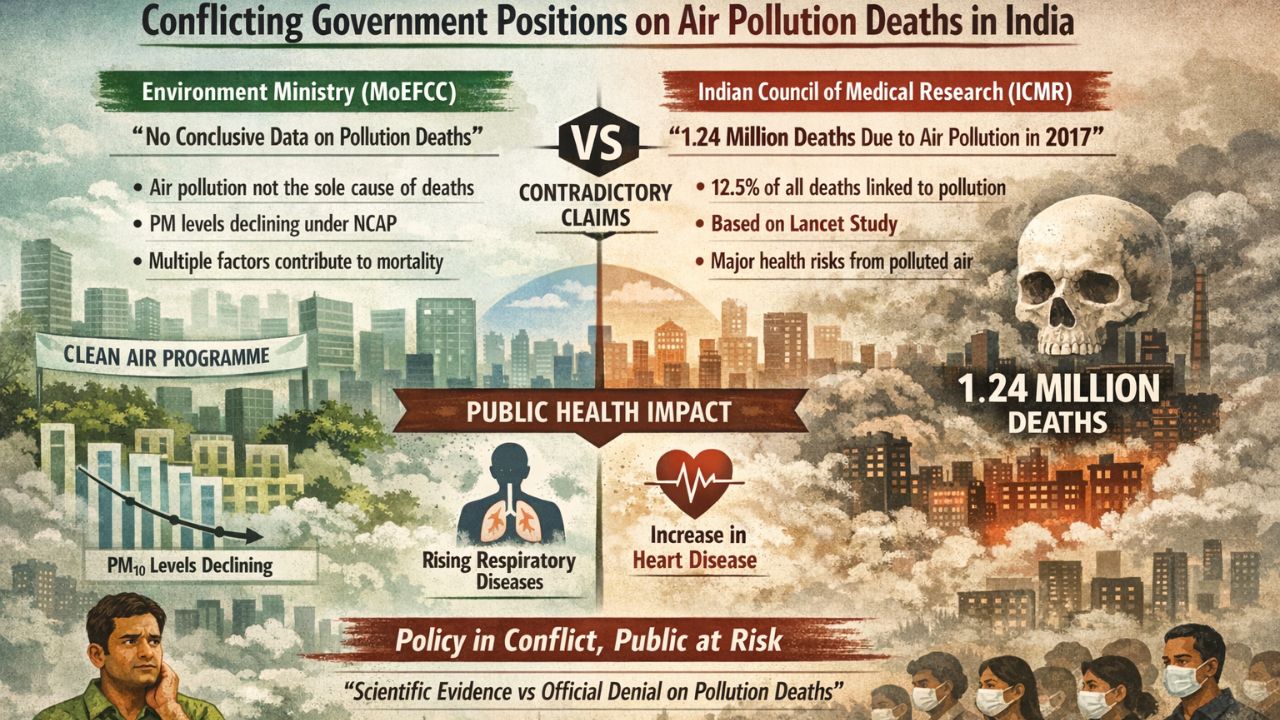
New Delhi: A serious contradiction has emerged within the Indian government over whether air pollution directly causes deaths in the country. Two key government bodies—the Ministry of Environment, Forest and Climate Change (MoEFCC) and the Indian Council of Medical Research (ICMR)—have given sharply different answers, raising concerns about policy clarity and public health accountability.
In a recent reply to Parliament, the MoEFCC stated that there is no conclusive data in India that proves deaths occur exclusively due to air pollution. The ministry argued that air pollution cannot be directly linked as the sole cause of death because multiple factors usually contribute to mortality.
Air Pollution Spike: Ghaziabad again emerges as India’s most polluted city, GRAP enforced
It also highlighted that particulate matter (PM10) levels have declined in several cities since the launch of the National Clean Air Programme (NCAP), suggesting that pollution control efforts are working.
In contrast, the ICMR—India’s top medical research agency under the health ministry—gave a much stronger assessment. In response to an RTI query, ICMR stated that 1.24 million deaths in India in 2017, or 12.5% of all deaths that year, were caused by air pollution.
This estimate includes deaths from both ambient air pollution (outdoor pollution) and household air pollution (such as indoor smoke from solid fuels).
ICMR clarified that its figures are not guesses or anecdotal claims. They are based on modelling-based scientific research, conducted in collaboration with the Public Health Foundation of India (PHFI) and the Institute for Health Metrics and Evaluation (IHME).
The findings were published in 2018 in the prestigious medical journal The Lancet Planetary Health, as part of the Global Burden of Disease (GBD) Study 2017.
CREA Study Flags Severe Air Quality Crisis in Nearly 44% Indian Cities
According to the study, air pollution contributed to deaths from heart disease, stroke, chronic lung disease, and other serious illnesses. Importantly, over 51% of these deaths occurred in people below 70 years, indicating a significant impact on India’s working-age population.
Environmental activist Amit Gupta, who filed the RTI, expressed concern over the conflicting positions taken by two central ministries. He said such contradictions are alarming given that air pollution is widely recognized as a major health crisis.
Supporting this concern, recent government data shows a steady rise in respiratory disease deaths in Delhi, increasing from 7,432 in 2022 to 9,211 in 2024. Meanwhile, cardiovascular diseases—also linked to air pollution—remain the leading cause of death in the capital.
The disagreement highlights a deeper policy problem. While scientific and medical evidence points to air pollution as a major killer, official environmental policy appears hesitant to acknowledge this link directly.
Half of India’s cities choking as air pollution reaches alarming levels: CREA Report
This gap could weaken urgent action, slow reforms, and undermine public trust at a time when pollution levels remain dangerously high in many Indian cities.


