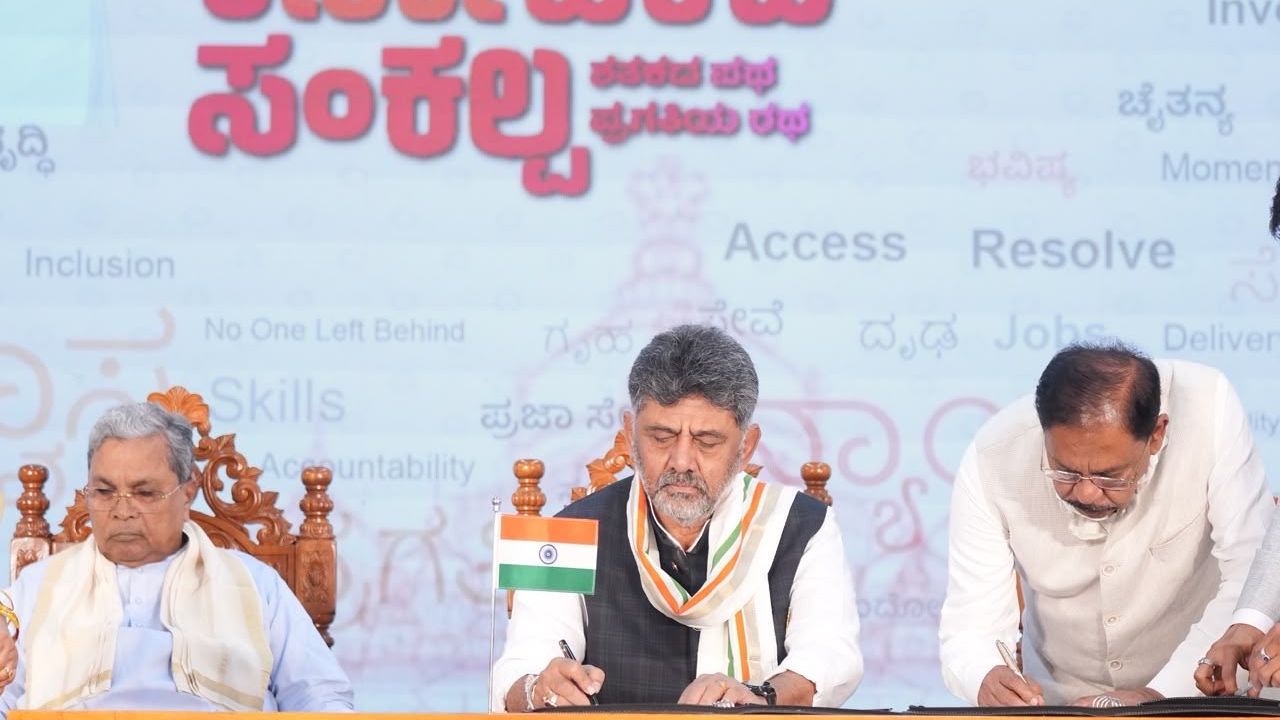
DK Shivakumar unveils Karnataka’s post-100-day development roadmap (Img: X/CMofKarnataka)
Bengaluru: As the Karnataka government completes its first 100 days, Chief Minister D K Shivakumar has outlined an ambitious development roadmap for the state. He has promised to combine welfare measures with job creation, industrial expansion, agricultural reforms, technological innovation and improved public services.
The government said its next phase of work would focus on converting the benefits of its five Guarantee programmes into broader economic opportunities, with particular emphasis on youth employment, farmer incomes, infrastructure, education, healthcare and development beyond Bengaluru. It also reaffirmed its commitment to Scheduled Castes, Scheduled Tribes, Other Backward Classes, minorities and other historically disadvantaged communities.
A major component of the roadmap is the proposed Chief Minister’s Jobs Mission, which the government says will strengthen Karnataka’s employment ecosystem. It has issued orders to fill more than 72,000 vacant government posts, with the recruitment notification process underway.
The government also plans to establish 10,000 Bharat Jodo Youth Sanghas across the state, 6,000 in gram panchayats and 4,000 in cities and towns. The clubs will promote sports, culture, social harmony, skills, entrepreneurship and leadership. Each club is proposed to receive an annual grant of Rs 10 lakh, with a yearly allocation of Rs 1,000 crore for the mission.
Under the proposed Udyoga Nidhi scheme, companies creating jobs in 11 identified least-developed districts will receive an incentive of Rs 2,500 per month for every new worker, for two years. The programme aims to support one lakh jobs, subject to prescribed wage and sector conditions.
The government also proposes Yuva Udyoga Setuve, an online employment exchange connecting job seekers, private employers and educational institutions, while a Job-Linked ITI programme will link 100 government ITIs with anchor industries.
Agriculture is another major focus. The proposed CM Raita Chaitanya Digital Agri-tech Mission will use drone and satellite imagery to collect crop-related data, monitor agricultural conditions and provide real-time information to farmers and policymakers. The system is also intended to connect farmers with market price information.
Under Mukhyamantri Negilayogi, farmers owning up to three acres will be able to access locally available farm machinery, including tractors, harvesters, tillers and drones, with a 50% subsidy up to Rs 4,500 a year.
The government also plans an Agri-Export Mission to strengthen agricultural exports by improving grading, certification, branding and marketing. Mangoes, pomegranates, ragi and other millets, rice and toor dal have been identified for emphasis.
A Comprehensive Rainfed Agriculture Policy is also proposed, focusing on water conservation, climate-resilient technologies, soil restoration and sustainable farming systems. Other initiatives include the Karnataka Protein Mission covering poultry, livestock and fisheries, and Tegada Siri, under which landowners would be encouraged to grow valuable trees on roadside land, with 70% of revenue from their sale going to them.
The government said investments worth Rs 43,214 crore had been approved through the single-window system during the first 100 days. It plans to offer enhanced incentives for industries setting up in industrially backward taluks to encourage more balanced regional growth.
Among the proposed industrial initiatives are a new aerospace and defence policy, a digital industrial land bank and a new textile policy. The government also plans a Jeans Park in Ballari, including infrastructure such as a common effluent treatment plant.
Another major proposal is an Advanced Manufacturing Cluster in the Doddaballapura region near Kempegowda International Airport. The proposed 4,000-plus-acre manufacturing valley is aimed at high-value sectors such as electronics, aerospace and precision manufacturing. The government said Rs 20,000 crore in investment has already been committed and that the cluster is expected to create one lakh jobs.
The roadmap also places artificial intelligence at the centre of Karnataka’s technology strategy. The government proposes to establish what it describes as India’s first and largest government AI university on a 100-acre campus in Bengaluru, with regional campuses in Kalaburagi, Belagavi, Hubballi-Dharwad, Mangaluru and Mysuru.
An AI Hub for startups and AI-led companies, a state AI policy and the introduction of AI education from Class VI are also planned. Karnataka has further proposed green data centres, a Drone Testing and Innovation Centre and an Electric Vehicle Centre of Excellence.
In healthcare, the government has promised to fill vacant posts of doctors, nurses and other clinical staff in district and taluk hospitals within a year. It plans to strengthen 100 taluk hospitals with diagnostic facilities, laboratories and digital X-rays, while introducing tele-ICU services across taluk hospitals.
A proposed Karnataka Specialty Care Tech Grid would connect hospitals through digital records, laboratories and referral systems. The government also plans medical colleges in most districts through public-private partnerships.
Education initiatives include reserving 75% of the existing 15% rural quota for professional courses for students who studied from Classes I to X in government rural schools. The government proposes to establish 1,000 Karnataka Public Schools as centres of educational excellence and provide online coaching for competitive examinations.
The roadmap also seeks to spread economic activity across Karnataka. Five Global Technology Centres are proposed in Kalaburagi, Belagavi, Hubballi-Dharwad, Mangaluru and Mysuru under the Beyond Bengaluru mission.
The government has also announced plans for a Coastal and Malnad Tourism Policy, five tourism projects in the regions, and initiatives to improve air quality.
On governance, the proposed Praja Seva Department will oversee an upgraded grievance redressal platform, CM Connect, using AI to improve processing and accountability. Namma Seve, or Seva One, is proposed as a unified AI-powered platform for government services.
The proposed Karnataka Data Exchange and Ecosystem Platform, or K-Deep, would integrate government datasets to facilitate data sharing and improve coordination.
Another major initiative, Bhu Guarantee, aims to provide digitised and geo-referenced land and property records, including updated agricultural RTCs and expanded e-Khata coverage.
For urban mobility, the government has proposed a Karnataka Mobility Grid, along with a unified One Bengaluru and One Karnataka Mobility App integrating metro and bus services and enabling bus booking across the state.
The government has framed these initiatives as part of a broader “Karnataka Model of Development”, combining welfare, employment-oriented growth, infrastructure, technology and regional development. The stated objective is to build a state in which development extends beyond Bengaluru while ensuring that welfare and economic opportunities reach a wider section of the population.

