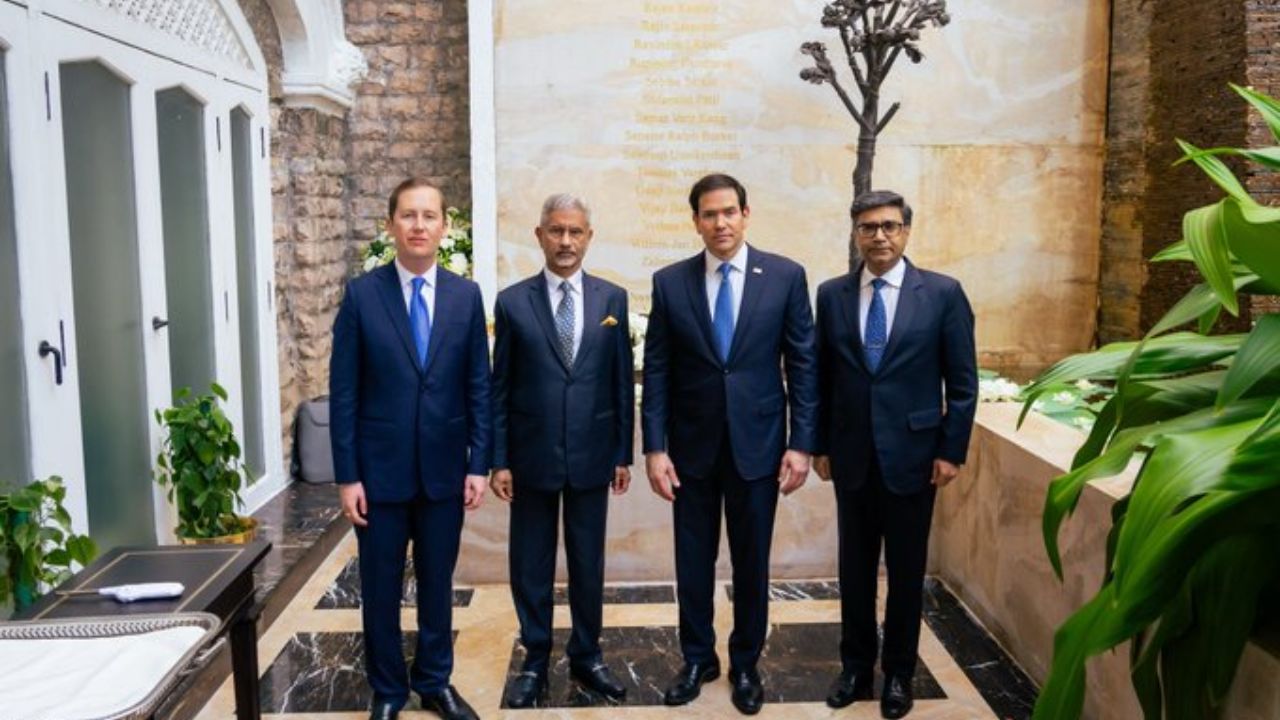
EAM S Jaishankar and US Secretary of State Marco Rubio at the 26/11 memorial at Mumbai’s Taj Hotel (Img: X)
New Delhi: External Affairs Minister S Jaishankar used a poignant moment at Mumbai’s Taj Mahal Palace Hotel on Tuesday to remind US Secretary of State Marco Rubio of the horrors of the 26/11 terror attacks and the threat posed by Pakistan-sponsored terrorism. As Rubio paid tribute to the victims, Jaishankar introduced him to Sunil Kudyadi, the hotel’s security chief who was present during the siege and helped coordinate rescue efforts.
Kudyadi recounted how Lashkar-e-Taiba terrorists entered the hotel and held it hostage for nearly 60 hours. The exchange came at a time when the Donald Trump administration has been seeking to strengthen its commercial and strategic engagement with Pakistan, a country India has repeatedly accused of supporting cross-border terrorism.
The 2008 Mumbai attacks killed 166 people, including six American nationals. The Taj was among the principal targets, with hundreds of guests and staff caught in the violence.
After Rubio laid a wreath at the 26/11 memorial, Jaishankar allowed Kudyadi to describe the events in his own words.
"He was the security person in charge," Jaishankar told Rubio while introducing him.
Also Read: Trump Signals Possible India-US Trade Deal Soon, Hints at New Terms
Rubio asked how the attackers had entered the building. Kudyadi explained, "They came in the middle of the night. They went up to the sixth floor from the kitchen," describing how the gunmen moved through the hotel.
Jaishankar pointed out that several people had been killed in the kitchen. The siege continued for nearly 60 hours, during which 31 Taj employees and trainees lost their lives.
"They barricaded them," Jaishankar said, referring to the operation to contain the terrorists and bring the situation under control.
The attackers arrived at the hotel at around 9 pm on November 26, 2008. For two nights and three days, guests and employees endured a terrifying ordeal as the gunmen moved through the corridors, shooting people and setting parts of the building ablaze. Hotel staff remained behind to help guests escape, despite the danger.
Kudyadi emerged as one of the lesser-known heroes of the siege. Although unarmed, he used his intimate knowledge of the sprawling hotel to guide police personnel and commandos, including members of the Marine Commandos (MARCOS), through its complex layout.
He remained inside during the operation, helping rescuers navigate the building amid gunfire and explosions. His guidance was considered crucial to the rescue effort and the operation to neutralise the attackers.
Also Read: Jaishankar, Rubio Discuss Trade, Energy and Defence as India-US Ties Take Centre Stage
Former Union Home Secretary Ram Pradhan, who headed the committee that investigated the attacks, described Kudyadi as an "unsung hero". Pradhan noted that security personnel would have faced significant difficulties navigating the hotel without his assistance.
Jaishankar’s decision to let a survivor of the siege brief Rubio carried diplomatic significance, particularly as Washington seeks closer ties with Islamabad. The interaction placed the human cost of the attacks at the centre of discussions between the two countries.
At an event organised by the US to mark the 250th anniversary of American independence, Jaishankar underlined India’s expectations of its partners.
"We expect our partners to show zero tolerance for terrorism," the Union Minister said.
"We are clear on the right to defend ourselves against terrorism," he added.
In an interview with Indian news channel, Rubio defended the US decision to maintain relations with Pakistan, arguing that engagement gives Washington an opportunity to influence Islamabad’s conduct.
"Pakistan is a country we have to have a relationship with. It is a country that possesses nuclear weapons. It is a country that, from a geographical standpoint, we need to be able to interact with them," Rubio said.
Also Read: India-US Trade Pact Nears Finish Line, Rubio Says; Signals Talks on Venezuelan Oil
He argued that diplomatic engagement could help Washington discourage actions that concern India.
"It could be a positive thing because if we have a relationship, and we can speak to them (Pakistan)... it puts us in a position to help discourage the kinds of things that India is worried about," Rubio said.
However, he also made Washington’s position on terrorism clear.
"We are against terrorism anywhere in the world. We are against anybody who sponsors terrorism," he said.

