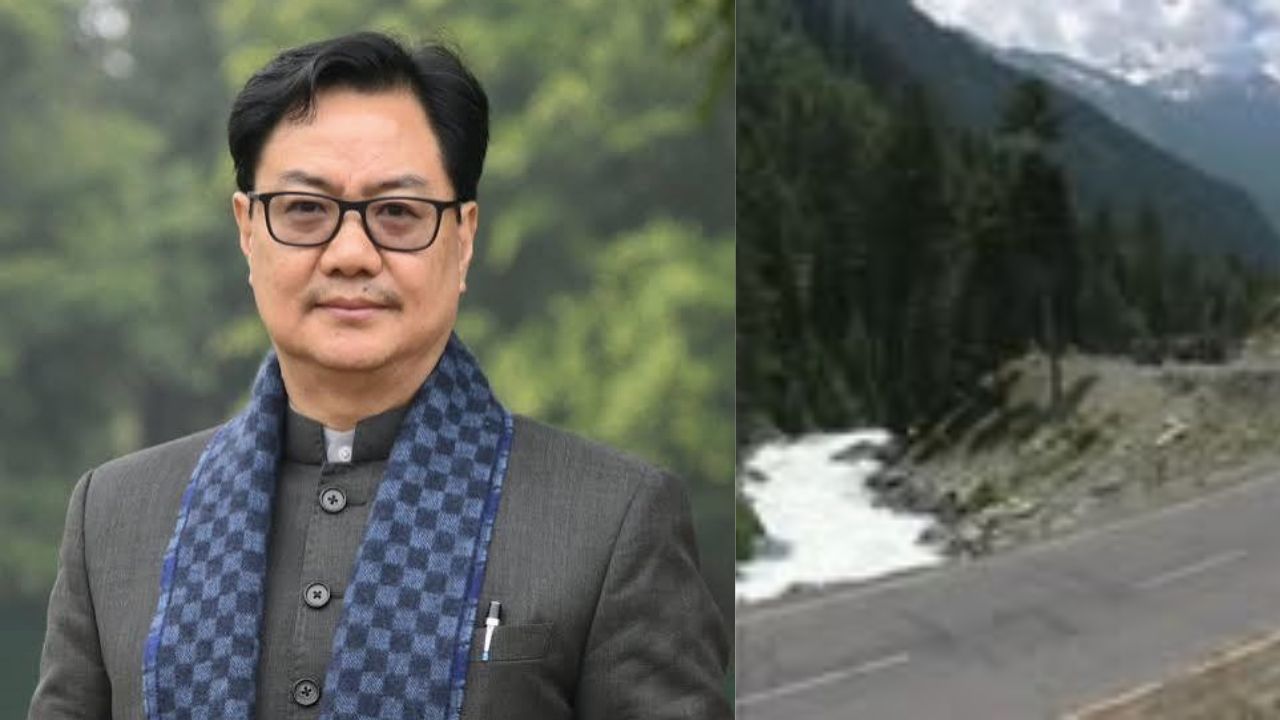
The BJP-Congress face-off intensifies as AI-generated disinformation triggers a fresh national security debate. Rijiju demands an apology from Congress. (Img: X)
New Delhi: Union Parliamentary Affairs Minister Kiren Rijiju on Tuesday launched a scathing attack on the Congress after the Indian Army debunked a digitally manipulated video falsely claiming that Chinese forces had taken control of strategic areas in Arunachal Pradesh.
The Minister accused the opposition party of circulating fabricated content that could undermine public confidence in the armed forces. Rijiju demanded a public apology from the Congress, alleging that the video tarnished the Indian Army’s image and echoed narratives hostile to India.
The controversy centres on a viral clip that falsely attributed remarks about Chinese control over Asaphila, Longju and Taksing in Arunachal Pradesh to Lieutenant General Girish Kalia. The video further alleged that Indian troops had been denied essential supplies, presenting the fabricated claims as though they were an admission by a senior military officer.
The Indian Army’s official fact-checking unit has categorically rejected the claims, identifying the footage as digitally altered and the purported remarks as fabricated.
The BJP’s response followed the circulation of the disputed video and a Congress social media post alleging that China had captured the three areas in Arunachal Pradesh. Congress leader Ritu Choudhary shared the claim on X, linking the alleged territorial developments to concerns over military deployment and logistical support.
Rijiju subsequently accused the Congress of spreading an AI-generated video that misrepresented the Army’s position on the sensitive India-China border. He called on the opposition party to apologise to the nation, arguing that the circulation of fabricated military statements was a serious matter with implications for national security and the credibility of India’s armed forces.
The political dispute has brought renewed attention to the risks of amplifying unverified military claims during a period of heightened sensitivity along the Line of Actual Control (LAC). However, the central factual point remains clear: the Indian Army has denied that the officer made the statements attributed to him in the viral clip.
The Army’s fact-checking unit clarified that the video had been manipulated to attribute false statements to Lieutenant General Girish Kalia. It said the clip used synthetic-generated information to create the misleading impression that a senior officer had disclosed Chinese control over Indian territory and a disruption in supplies to Indian troops.
The original footage dates back to October 27, 2023, when then Major General Girish Kalia, who was serving as General Officer Commanding of the 28 Infantry Division, addressed a press briefing in Kupwara, Jammu and Kashmir.
That briefing concerned infiltration attempts across the Line of Control, rather than developments along the India-China border in Arunachal Pradesh. According to the Army, the officer reported that 10 infiltration attempts had been foiled, 27 terrorists had been eliminated, and weapons and narcotics had been recovered.
The original briefing contained no statement that China had taken control of Asaphila, Longju or Taksing. It also included no claim that Indian forces had been denied essential supplies. The viral version therefore combined authentic military footage with fabricated remarks to construct a false narrative about territorial losses and operational difficulties.
The episode illustrates how genuine footage can be repurposed through digital manipulation to make a fabricated claim appear credible. When the person featured is a senior military officer and the subject concerns a disputed border, such content can spread rapidly before the original context is established.
The controversy has emerged amid reports of face-offs between Indian and Chinese troops at multiple points along the LAC in Arunachal Pradesh. On October 22, Indo-Tibetan Border Police Director General Shatrujeet Kapoor said face-offs had occurred at several locations along the frontier since at least July. Reports had also emerged of Chinese troops allegedly denying Indian personnel access to certain patrolling points in the Taksing area.
The LAC is not mutually demarcated on the ground by India and China, and differing perceptions of the boundary have contributed to recurring friction. Against this backdrop, false claims about territorial control, troop movements and logistical constraints can heighten public anxiety and distort perceptions of the security situation.
The existence of border tensions, however, does not validate every viral claim about Chinese incursions or Indian military setbacks. Each assertion requires independent verification, particularly when it relies on videos without a traceable original source or attributes sensitive statements to military officials.
The latest episode also underscores the distinction between genuine security concerns and manipulated material designed to exploit them. The Army’s clarification directly addresses the authenticity of the viral video; it does not, by itself, establish that every separate claim circulating online is part of a coordinated campaign.
The disputed video is among several misleading posts involving India’s armed forces and the China border that have recently been flagged by fact-checkers. In another case, footage of an Indian security forces drill in Devanahalli near Bengaluru was presented online as evidence that Chinese soldiers were frisking Indian personnel in Arunachal Pradesh.
A fact-check published on October 25 traced the clip to a counter-terrorism exercise conducted in Karnataka in May 2026. A longer version of the footage had appeared on YouTube on May 15, and a shopkeeper whose establishment was visible in the video confirmed that he had recorded it in Devanahalli. The footage depicted an Indian drill, not a confrontation between Indian and Chinese troops.
Another misleading claim alleged that an Indian soldier had been shot in the head by an unidentified gunman in Ladakh. The Army’s fact-checking account rejected the claim, stating that no such incident had occurred and that the circulated image appeared to show personnel from the Indo-Tibetan Border Police.
Videos of protests in Arunachal Pradesh on October 23 against the proposed Siang Upper Multipurpose Project were also reportedly misrepresented as demonstrations against the Indian Army. The distinction matters because footage of a local protest can be stripped of its original context and used to manufacture an entirely different political or security narrative.
In a separate case, a video of Chinese commercial vehicles near Nathu La in Sikkim was portrayed as proof of an unauthorised Chinese entry into Indian territory. The Ministry of Electronics and Information Technology flagged the misleading campaign on October 26, explaining that the footage showed commercial vehicles at a designated border-trade point where movement is permitted under established bilateral arrangements. The ministry identified 12 social media handles that had circulated the content during the specified period.
Another manipulated clip falsely attributed remarks to retired Lieutenant General Manoj Kumar Katiyar, suggesting that he had warned Arunachal Pradesh could become India’s next major military flashpoint. The Army clarified that the original footage came from a media interaction at Chandimandir in Panchkula on March 30, 2026, where Katiyar discussed Operation Sindoor, Operation Rahat, operational preparedness and other Western Command initiatives.
The Army also flagged footage of a Kazakhstan Special Operations Forces exercise that was being circulated with claims of an India-China confrontation in the Taksing region. The recurring pattern involves authentic or unrelated footage being paired with fabricated captions, false locations or digitally altered remarks to suggest military developments that the original material does not establish.
The repeated circulation of misleading military content has raised concerns about a possible psychological operation, or psyop, aimed at influencing public perception of India’s border security. Some of the accounts involved have been described by the Indian Army’s fact-checking unit as Pakistan-linked. However, the available evidence does not conclusively establish that the latest wave of posts is being directed through a coordinated operation by China and Pakistan.
Psychological warfare and cognitive warfare seek to influence how people interpret events, assess threats and make decisions. In the digital information environment, these efforts can involve fabricated videos, manipulated images, misleading narratives and the amplification of existing political divisions. The objective may be to erode trust in institutions, create uncertainty or shape perceptions without a direct military confrontation.
China’s broader information-influence capabilities have been examined by researchers and security analysts, particularly in the context of Taiwan. A 2022 study published in the Journal of Global Security Studies explored how online disinformation can operate alongside military pressure and other influence tactics. A 2025 analysis by the Australia-based United States Studies Centre also discussed cognitive warfare as a means of weakening an adversary’s resolve and influencing strategic decision-making.
The issue has gained prominence beyond the India-China border. In the aftermath of Operation Sindoor, a US congressional commission alleged that Chinese-linked accounts circulated AI-generated images and video-game visuals as supposed evidence of aircraft losses, including claims targeting the French-made Rafale fighter. India acknowledged losing some aircraft during the operation but disputed claims that Pakistan had shot down a Rafale.
These cases demonstrate how military events can become the raw material for competing information campaigns. Nevertheless, evidence of false or manipulated posts should not automatically be treated as proof of direct state sponsorship. Establishing responsibility for a coordinated psychological operation requires evidence about the accounts, networks, intent and links between those distributing the content.
Artificial intelligence and accessible video-editing tools have lowered the barriers to creating convincing synthetic content. A genuine military briefing can be altered to make an officer appear to announce territorial losses, while unrelated exercises can be relabelled as evidence of an active confrontation. The presence of familiar uniforms, recognisable locations or authentic footage can make such material appear credible to viewers who encounter it without context.
The consequences extend beyond political point-scoring. False claims about territorial control can fuel public alarm, damage trust in official institutions and complicate communication during a sensitive security situation. They can also force authorities and journalists to devote resources to correcting fabricated narratives while genuine developments compete for public attention.
The latest controversy has therefore become both a political dispute between the BJP and Congress and a reminder of the need for rigorous verification in national-security reporting. While Rijiju has demanded an apology from the Congress, the Army’s fact-check establishes that the remarks attributed to Kalia in the viral video were fabricated.
Social media users should check whether a video has been published by an official military account or a credible news organisation, and look for the original recording before accepting its accompanying caption. The date, location, uniforms, insignia, visible landmarks and language used in a clip can provide clues about whether the footage is being presented accurately.
Reverse-image searches, longer versions of videos and official fact-checks can help identify recycled footage. Users should also distinguish between a confirmed military statement, a media report citing unnamed sources and an allegation made by a political account.
Most importantly, emotionally charged claims about territorial losses, troop casualties or restrictions on military movement should not be shared as established facts without reliable corroboration.
The immediate facts in the Rijiju-Congress controversy are clear: the Indian Army has debunked the viral video, traced the original footage to a 2023 briefing in Kupwara and denied that the officer made the claims about Chinese control of Arunachal Pradesh. The political demand for an apology continues, while the wider question of whether the recent disinformation activity reflects a coordinated foreign-backed operation remains unproven.

