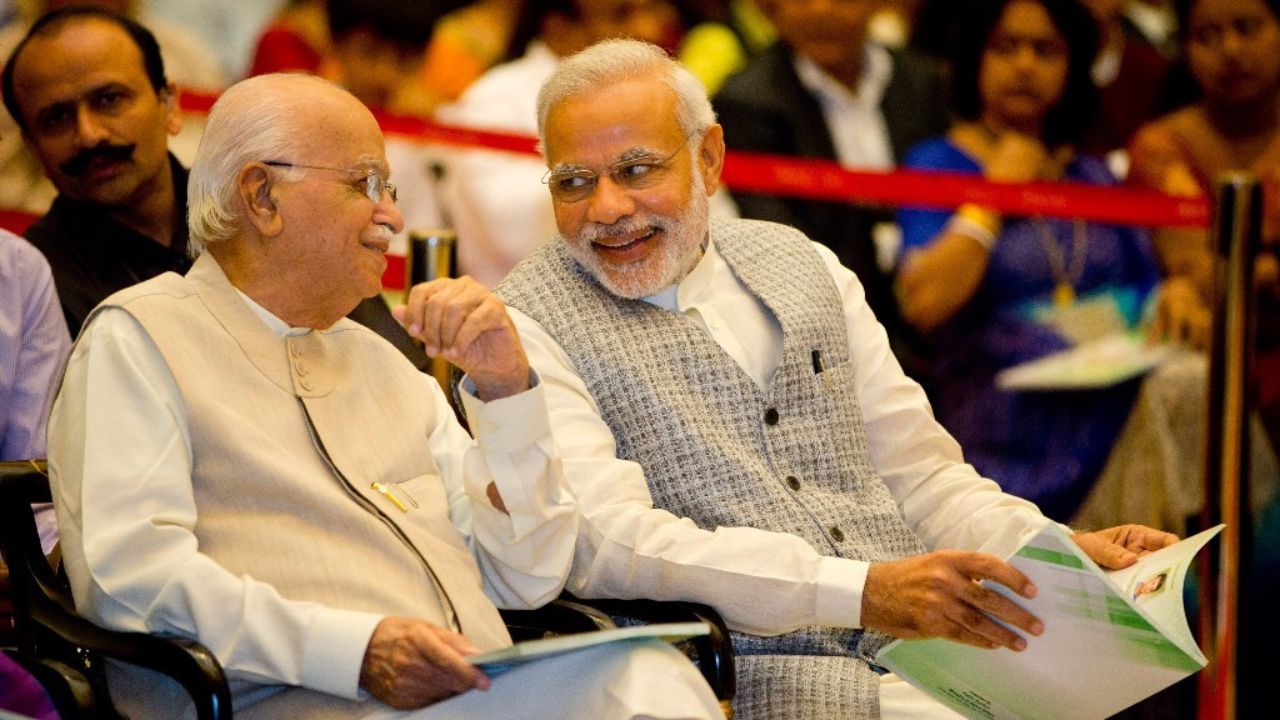
PM Modi recalls LK Advani's role during the Emergency and his contribution to protecting democratic institutions. (Img: X)
New Delhi: Prime Minister Narendra Modi paid a heartfelt tribute to veteran BJP leader and Bharat Ratna awardee Lal Krishna Advani on his 99th birthday, highlighting his contribution to Indian politics, the BJP’s growth and the Ram Temple movement.
In a special birthday message, Modi recalled Advani’s political journey, his association with former Prime Minister Atal Bihari Vajpayee, his role during the Emergency and his contribution to strengthening India’s national security. Advani has now entered the hundredth year of his life, marking a significant milestone in the journey of one of India's most influential political leaders.
Advani’s birthday coincides with Diwali this year, a festival closely associated with Lord Ram and the tradition of lighting diyas. The occasion also comes at a time when the political legacy of the Bharatiya Jana Sangh and the Rashtriya Swayamsevak Sangh (RSS) is receiving renewed attention.
Modi highlighted the significance of the 75th anniversary of the Jana Sangh, the 125th birth anniversary of its founder Dr Syama Prasad Mookerjee and the recent centenary celebrations of the RSS.
Born on November 8, 1927, on Dev Deepawali, Advani witnessed some of the most defining events in modern Indian history. His early life changed dramatically during the Partition of India in 1947, when he had to leave his home in Sindh and move to India.
Despite the hardships of displacement, Advani rebuilt his life and political career without bitterness. According to Modi, this ability to start afresh and overcome difficult circumstances remained a defining feature of his personality. The same determination was visible in his efforts to strengthen the Jana Sangh and later establish the BJP as a major political force.
Modi highlighted Advani’s contribution to the organisational expansion of the BJP and its emergence as a major alternative in Indian politics. During Advani’s tenures as BJP president, the party achieved significant electoral milestones.
In the 1989 Lok Sabha elections, the Congress saw its parliamentary strength fall sharply from around 400 seats to below 200. In 1996, the BJP emerged as the single largest party in the Lok Sabha for the first time.
Advani played an important role in developing the party's organisational structure, strengthening its ideological foundation and preparing generations of party workers, popularly known as karyakartas.
Modi identified ideological clarity and intellectual sharpness as two of Advani’s most important leadership qualities. His speeches, political writings, interviews and contributions to party resolutions reflected his understanding of national issues and political developments.
He also recalled Advani’s criticism of what he described as pseudo-secularism in Indian politics, an issue that became an important part of the BJP’s ideological and political positioning over the years.
Advani began his political career as an RSS pracharak and initially worked in different parts of Rajasthan. He subsequently moved to Delhi, where he developed a close political association with Atal Bihari Vajpayee.
The partnership between Advani and Vajpayee became one of the most significant political relationships in post-Independence India. Despite their different personalities and leadership styles, the two leaders worked together for several decades and played a central role in transforming the Jana Sangh into the BJP.
Modi described their association as an example of cooperation between two senior political leaders who worked towards a common ideological objective without allowing personal competition to weaken their partnership.
After moving to Delhi, Advani became actively involved in strengthening the Jana Sangh at a time when the national capital was still dealing with the social and political consequences of Partition. In 1967, he became Chairman of the Delhi Metropolitan Council. During this period, he worked alongside Vijay Kumar Malhotra, who served as the Chief Executive Councillor.
His parliamentary career began in 1970, marking the beginning of a long association with India's legislative institutions. Advani earned recognition for his parliamentary interventions and contributions to debates on national affairs. He subsequently served as a Member of Parliament, Leader of Opposition in both Houses and Union Minister.
Despite his responsibilities in Parliament and party organisation, he regularly travelled across the country to interact with people and strengthen the BJP's grassroots network.
Modi also recalled his personal association with Advani during the 1991 Lok Sabha elections, when the veteran leader contested from two constituencies, including Gandhinagar in Gujarat. Advani had a longstanding connection with Gujarat. His father had settled in Kutch after Partition, and Advani had also represented Gujarat in the Rajya Sabha.
Modi, who was then involved in the BJP's organisational activities, recalled helping prepare Advani's election papers and assisting him during the campaign. Gandhinagar subsequently became one of Advani's strongest political bases, with voters repeatedly electing him to the Lok Sabha. Modi also recalled voting for Advani as a resident of the constituency and praised the attention he gave to local issues and public responsibilities.
The Emergency imposed in India in June 1975 was one of the most important turning points in Advani's political career. During the 1975-77 Emergency, he emerged as a prominent Opposition leader and was among those who challenged restrictions on civil liberties, democratic institutions and constitutional freedoms.
His experiences during imprisonment were documented in his book A Prisoner's Scrap-Book. One of its sections, titled A Tale of Two Emergencies, examined similarities between developments in India after June 1975 and the political situation in Nazi Germany in 1933.
The Emergency period also strengthened Advani's position as a leading voice in the Opposition movement against the Congress government.
Following the formation of the Janata Party government in 1977, Advani became Union Minister for Information and Broadcasting. His tenure in the ministry was widely regarded as significant, particularly in the context of restoring democratic functioning and institutional independence after the Emergency.
Apart from his role in building the BJP, Advani held several important positions in the Union government. He served as India's Home Minister and later became Deputy Prime Minister. His tenure in the Home Ministry was marked by a strong focus on internal security, counterterrorism and strengthening the country's security infrastructure.
He played an important role in improving the institutional capabilities of India's security agencies and addressing the challenges faced by security personnel. His firm position against terrorism also contributed to the government's push for stronger anti-terror legislation and a more comprehensive national security framework.
Advani's administrative experience and political leadership made him one of the most influential figures in the National Democratic Alliance (NDA) government.
One of the most defining chapters of Advani's political journey was the Somnath-to-Ayodhya Rath Yatra in 1990. The nationwide political mobilisation, which began from Somnath in Gujarat and was aimed at building support for the Ram Temple movement in Ayodhya, became a turning point in Indian politics.
The Rath Yatra generated widespread public participation and brought the Ram Janmabhoomi issue to the centre of national political discourse. It also significantly expanded the BJP's political influence across several parts of the country. Modi recalled his involvement in the planning and execution of the Yatra, including his presence at Somnath when the campaign began.
He highlighted the physical and organisational challenges involved in the journey, which required extensive travel, long working hours, public interaction and considerable endurance. Advani's determination and ability to maintain focus throughout the campaign were among the qualities that stood out.
The Yatra also witnessed major political developments, including Advani's arrest in Bihar. Following the arrest, the BJP withdrew support from the Chimanbhai Patel-led government in Gujarat.
The developments reflected the party's position on the Ram Temple movement and its commitment to the ideological issues associated with the campaign. Years later, the construction of the grand Ram Temple in Ayodhya became a reality, marking a historic development for the movement that had shaped Indian politics for decades.
Modi also highlighted Advani's personal qualities, including his simplicity, discipline, intellectual curiosity and commitment to public life. He recalled an incident following the Navnirman Movement when Advani visited Junagadh in Gujarat and stayed there for a month as an ordinary party worker. During this period, he focused on strengthening the BJP's organisation ahead of the Assembly elections, in which the Congress suffered a major political setback.
According to Modi, Advani's conduct reflected the importance of honesty, discipline and probity in public life. Apart from politics, Advani has maintained a strong interest in books, newspapers, cinema and theatre. He is known for his extensive reading habits and close attention to newspaper coverage.
His interest in cinema and theatre also made him an enthusiastic film critic. His understanding of India's political and cultural history is reflected in his autobiography My Country, My Life, which documents his experiences and observations across several decades.
Despite leaving Sindh during Partition, Advani maintained a strong connection with his cultural roots and Sindhi heritage. One of his important initiatives was promoting the Sindhu Darshan Puja near Leh in Ladakh. The event was aimed at highlighting the historical, cultural and civilisational importance of the Indus River and preserving the traditions associated with Sindhi identity.
Modi recalled attending one such puja with Advani and former Defence Minister George Fernandes. The initiative reflected Advani's continued interest in India's cultural diversity, historical heritage and civilisational traditions.
Modi also acknowledged the contribution of Kamla Advani, describing her as a constant source of strength and support throughout the veteran leader's public and political life. He noted that Advani's remarkable journey could not be discussed without recognising the role played by his family, particularly Kamla Advani, in supporting him through the demanding years of political service.
In recognition of his extraordinary contribution to Indian politics and public life, the Government of India conferred the Bharat Ratna, the country's highest civilian honour, on LK Advani in 2024. From his early days as an RSS pracharak to his role in building the Jana Sangh and BJP, Advani's political career has covered several defining phases of independent India.
He has served as BJP president, Union Minister for Information and Broadcasting, Home Minister, Leader of Opposition and Deputy Prime Minister. His contribution to the BJP's organisational growth, the Ram Temple movement, parliamentary democracy and national security remains an important part of contemporary Indian political history.
As Advani enters the hundredth year of his life, Modi has wished him good health and a long life, expressing hope that his experience, discipline and political journey will continue to inspire future generations.

