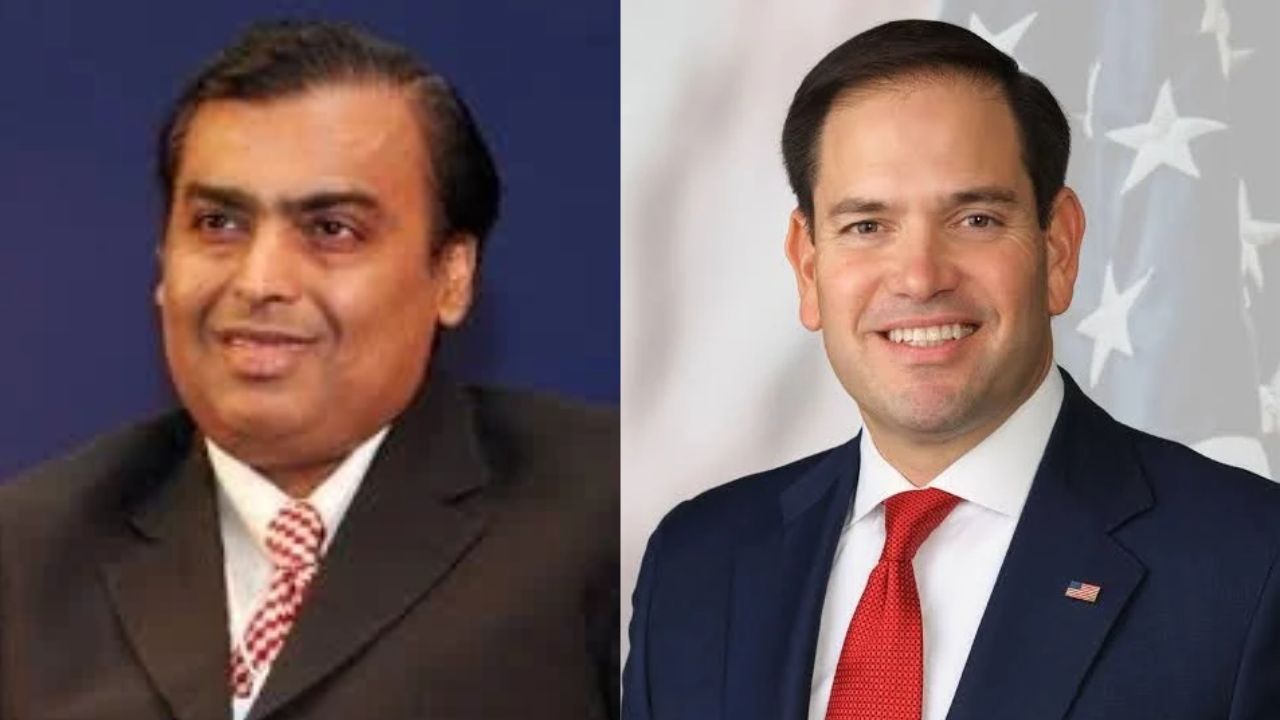
The US Secretary of State’s visit to Gujarat places Reliance Industries’ refining capabilities at the centre of Washington’s efforts to explore Venezuelan oil cooperation. (Img: X)
Jamnagar: US Secretary of State Marco Rubio’s visit to Jamnagar has placed Mukesh Ambani’s Reliance Industries at the centre of Washington’s evolving energy diplomacy, with discussions expected to explore Venezuelan crude processing, oil production and investment opportunities. The visit comes amid disruptions to international energy shipments, pressure on fuel supplies and efforts to deepen India-US commercial ties.
The engagement also carries wider implications for global oil markets, India’s refining industry and bilateral trade negotiations, as Washington seeks to diversify crude supplies and attract private-sector investment into Venezuela’s petroleum sector.
US Secretary of State Marco Rubio arrived in Jamnagar, Gujarat, on Wednesday, October 21, 2026, for a visit to Reliance Industries’ sprawling refining complex and a scheduled meeting with chairman and managing director Mukesh Ambani.
The visit follows Rubio’s arrival in Mumbai a day earlier, where he held discussions with External Affairs Minister S. Jaishankar. His India itinerary has brought energy security, trade, investment, defence and critical technologies into focus, with the Jamnagar engagement highlighting the growing role of private industry in bilateral economic diplomacy.
Local authorities, police personnel and Reliance’s security team implemented extensive security arrangements ahead of the high-profile visit.
Rubio’s engagement with Reliance comes as the US explores whether Indian refining capacity and commercial expertise can support its efforts to increase Venezuelan crude production and expand the availability of oil in international markets.
Venezuelan crude is generally heavy or extra-heavy, making specialised refining infrastructure important for processing it efficiently. Refineries equipped to handle these grades can offer additional commercial outlets for Venezuelan production, provided that pricing, logistics, regulatory requirements and applicable sanctions permit the trade.
Reliance has previously maintained commercial links with Venezuela and ranks among the country's significant international crude buyers. Washington is seeking to understand what opportunities exist to expand production, attract investment and connect additional supplies with capable refiners.
The US has indicated that it wants Venezuelan oil output to rise from approximately 1.2 million barrels per day to 1.5 million barrels per day. Reaching that level would require investment in production facilities, infrastructure, operational capacity and export logistics, alongside reliable access to buyers.
Rubio’s visit signals Washington’s interest in engaging an Indian company with extensive experience in processing different grades of crude. However, the visit should not be interpreted as confirmation of a new purchase agreement or investment commitment unless the parties formally announce one.
Reliance’s Jamnagar complex is among the world’s largest and most sophisticated single-site refining facilities, with a reported combined processing capacity of approximately 1.4 million barrels of crude oil per day. Its advanced configuration enables it to process a broad range of crude grades, including heavy and extra-heavy varieties.
This capability gives the facility a strategic advantage when global buyers seek alternatives to conventional crude supplies. Refining economics depend not only on the price of crude but also on its composition, transportation costs, processing requirements and the value of the finished products.
For Washington, cooperation with Reliance could potentially help connect Venezuelan crude with established refining infrastructure. For India, the discussions highlight the commercial importance of its downstream petroleum industry and its ability to support international energy supply chains.
Fuel availability and refinery economics have become important considerations for the Trump administration. The supplied reporting puts US diesel prices above $6 per gallon, equivalent to roughly Rs 155 per litre at the conversion cited in the report. Such prices can increase operating costs for freight companies, farmers, trucking businesses and other diesel-intensive sectors.
The administration is seeking to strengthen fuel availability and contain energy costs ahead of the November 3 midterm elections. Additional crude supplies and greater refining flexibility could form part of that effort, although the impact on retail diesel prices would depend on global benchmarks, refining margins, distribution costs and domestic market conditions.
The reports also highlight continued US purchases of Russian diesel despite Washington’s broader efforts to encourage India to diversify its oil sourcing. This illustrates the complexities of energy markets, where price, availability and refining requirements can influence purchasing decisions alongside geopolitical considerations.
Reliance could potentially supply refined petroleum products to international markets if commercial conditions support such trade. However, any suggestion that its participation would automatically resolve a US fuel shortage or reduce pump prices would be premature.
Venezuela possesses substantial petroleum reserves, but increasing production requires capital investment, functioning infrastructure, technical expertise and dependable export channels. The US is seeking to expand output and encourage participation by companies capable of supporting the country's oil industry.
The supplied reports describe Washington as exercising control over aspects of Venezuela’s oil sales following the reported capture of former president Nicolás Maduro in January 2026. The precise legal and administrative arrangements governing Venezuelan petroleum exports require confirmation from official sources.
For Reliance, any expanded engagement would depend on the commercial viability of additional crude purchases, the applicable legal framework, payment arrangements, shipping availability and compliance with relevant sanctions requirements.
According to global trade intelligence firm Kpler, India imported approximately 257,000 barrels of Venezuelan oil per day in September, with Reliance accounting for around 76% of those purchases, as reported in the supplied material. If verified, these figures would underline the company's importance as a buyer of Venezuelan crude and help explain Washington’s interest in engaging directly with the Indian refiner.
The US has also encouraged India to purchase more Venezuelan oil, while the supplied reports indicate that Indian state-owned refiners have not followed the same purchasing pattern. The distinction between private-sector commercial decisions and government-owned companies’ procurement strategies is important in understanding the wider energy relationship.
The Jamnagar engagement also comes against the backdrop of a proposed refinery project in Texas involving Reliance Industries. In March 2026, US President Donald Trump reportedly described the investment as a $300 billion deal and announced plans for what was presented as the first new US refinery in approximately five decades.
The scale, structure and implementation status of the proposed investment require careful distinction from a completed project. A presidential announcement does not, by itself, establish that all financing, construction, regulatory approvals and final investment decisions have been completed.
Nevertheless, the proposal highlights the growing commercial dimension of India-US energy ties. A major Indian investment in US refining infrastructure could potentially support employment, industrial activity, fuel production and long-term commercial cooperation, depending on the final project structure and execution.
For Washington, attracting Indian capital into strategic energy infrastructure could strengthen economic links with a major Asian partner. For Reliance, overseas refining investments could offer opportunities to diversify its industrial footprint and participate more directly in international energy markets.
The Jamnagar visit comes amid concerns about disruptions to international oil shipments associated with regional conflict, including instability affecting routes around the Strait of Hormuz and the Red Sea.
The Strait of Hormuz is a critical transit corridor for seaborne petroleum exports from the Gulf, while the Red Sea and the Bab el-Mandeb Strait connect important shipping routes between the Indian Ocean and the Mediterranean. Disruptions in either region can increase freight costs, insurance premiums and delivery times, with consequences for refiners and energy-importing economies.
Against this backdrop, access to a wider range of crude suppliers and the ability to process different oil grades can become strategically valuable. Diversification, however, does not eliminate geopolitical risks: alternative supplies must still be economically competitive and transportable through reliable routes.
Rubio has framed energy cooperation in national-security terms, reflecting Washington’s concern that fuel shortages and price volatility can affect economic stability as well as foreign policy. The reported discussions with Reliance fit into this wider debate over supply resilience, industrial capacity and the strategic importance of petroleum.
The visit is taking place at a sensitive stage in bilateral relations. India and the United States have faced disagreements over tariffs, immigration policy, energy purchases and their differing assessments of regional security developments, including last year’s India-Pakistan military confrontation.
The supplied reporting also refers to a proposed US legislative measure involving additional tariffs on countries purchasing Russian oil and to concerns about immigration rules affecting Indian technology professionals. It further states that Trump announced a temporary pause on an immigration-related measure on October 16, arguing that the change would benefit the United States.
These issues have complicated the relationship even as both governments continue working towards a potential bilateral trade agreement. Cooperation on energy, investment and technology could provide practical incentives for closer economic engagement, although commercial agreements alone cannot resolve every strategic disagreement.
Rubio’s schedule, which includes Mumbai and Jamnagar rather than focusing exclusively on New Delhi, has prompted discussion about the role of India’s major commercial centres in bilateral diplomacy.
Geopolitical analyst Robinder Sachdeva of the ImageIndia Institute has argued, according to the supplied material, that the itinerary reflects an emphasis on corporate agreements, industrial partnerships and business-to-business engagement. Political commentator Pratap Bhanu Mehta has offered a more cautious interpretation, suggesting that greater attention to commercial centres should not be mistaken for a substitute for sustained political and strategic engagement with New Delhi.
Both perspectives highlight a central question: can expanding commercial interdependence provide a durable foundation for India-US relations despite differences over tariffs, immigration and foreign policy?
The Jamnagar engagement is part of Rubio’s second visit to India in 2026, following an earlier trip in May. During that visit, he met Prime Minister Narendra Modi and External Affairs Minister S. Jaishankar and participated in a Quad foreign ministers’ meeting.
Rubio also visited the Taj Mahal in Agra with his wife, Jeanette, during the earlier trip. The latest visit places greater emphasis on economic diplomacy and corporate engagement, with energy cooperation among the principal areas of interest.
The discussions come as both countries seek progress on trade and investment even while managing differences in other policy areas. Energy cooperation offers an avenue for practical collaboration because it links commercial opportunities with supply security and industrial development.
Before concluding his India engagements, Rubio is also expected to meet prominent Indian business leaders, including Adani Group chairman Gautam Adani and Tata Group chairman N. Chandrasekaran, according to the supplied reports.
The anticipated discussions are expected to cover opportunities to expand bilateral trade, attract investment and strengthen business ties. Such meetings would broaden the commercial dimension of the visit beyond petroleum refining and Venezuela.
Engagement with major Indian conglomerates could also provide opportunities to discuss infrastructure, manufacturing, technology and other sectors in which investment decisions have implications for employment, supply chains and industrial competitiveness.
The central question is whether the visit will translate into tangible commercial outcomes, such as additional Venezuelan crude purchases, new investment commitments or expanded refining and petroleum-product trade.
For India, a greater role in global refining could reinforce its position as a key processor and supplier of petroleum products. For Reliance, any expanded Venezuelan oil business would need to meet commercial objectives while complying with applicable regulations. For the United States, the potential benefits include broader supply options, investment partnerships and a stronger commercial relationship with India.
The outcome will depend on the terms of any agreement, the evolution of global oil prices, the legal framework governing Venezuelan crude and the reliability of international shipping routes. Until formal announcements establish specific commitments, the visit should be viewed as an important diplomatic and commercial engagement rather than evidence that a deal has already been finalised.
Rubio’s Jamnagar visit nevertheless illustrates how energy security is becoming a more prominent part of India-US diplomacy. With global supply chains exposed to geopolitical shocks and both countries seeking new investment opportunities, the discussions could offer a useful indication of the direction in which their economic relationship is heading.

