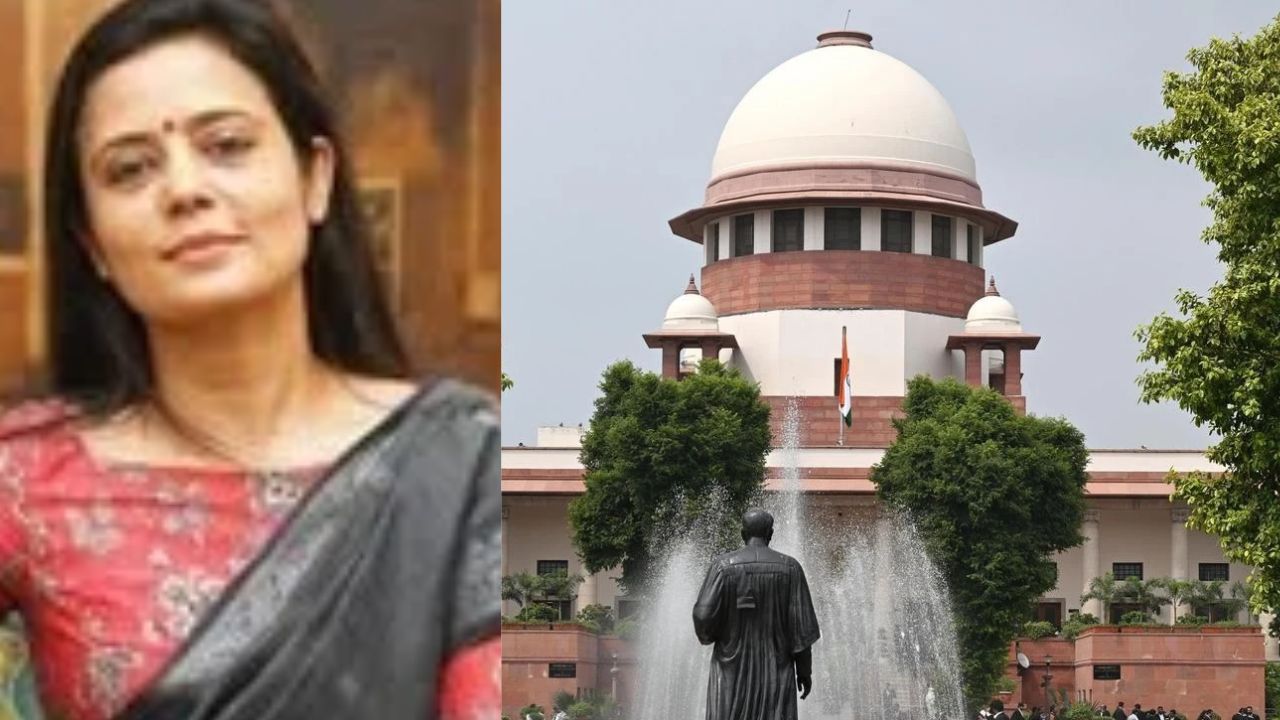
The Supreme Court has relaxed the advance-notice requirement for TMC MP Mahua Moitra’s visits to the Krishnanagar Circuit House. (Img: Pinterest)
New Delhi: The Supreme Court on Friday relaxed the advance-notice requirement for Trinamool Congress MP Mahua Moitra to access the Krishnanagar Circuit House in West Bengal, holding that she need inform the district administration only a day before her proposed visit. The Court also called for a standard operating procedure (SOP) governing the allotment of government guest houses and circuit houses to Members of Parliament and other eligible public functionaries.
The Bench of Chief Justice of India (CJI) Surya Kant and Justice Joymalya Bagchi modified a September 1 communication issued by the Nadia district administration, which required MPs and MLAs to provide three to four days’ advance notice before seeking accommodation at government guest houses and circuit houses.
The order came while the Court was hearing Moitra’s plea alleging that she had been asked to vacate the Krishnanagar Circuit House late at night on August 14, despite having been allotted a room.
“These are not issues which, in fact, should come to the Court. Probably what we require is only a small SOP,” CJI Surya Kant observed during the hearing.
The Bench indicated that access to government accommodation should be governed by a uniform procedure that takes into account the availability of rooms and the applicable order of precedence. CJI Surya Kant emphasised that accommodation could be provided in accordance with protocol once the district administration received advance intimation.
The Court accordingly directed that the September 1 communication be modified to permit Moitra to inform the administration one day before her visit. The arrangement is subject to the availability of accommodation and the applicable protocol.
Solicitor General Tushar Mehta, appearing for the West Bengal government, submitted that the earlier communication was intended to streamline logistical arrangements and was not specifically directed at Moitra. He denied that the MP had been evicted, stating that the Circuit House was undergoing maintenance and that alternative government accommodation had been offered to her.
Mehta explained that last-minute requests for accommodation could create difficulties when rooms were already occupied, although officials made efforts to accommodate eligible persons wherever possible.
Senior Advocate Gopal Sankaranarayanan, appearing for Moitra, countered that the MP had obtained accommodation at the Circuit House on just three to four hours’ notice for approximately a decade. He argued that the subsequent communication had effectively altered the established arrangement following the August incident.
Mehta subsequently offered to withdraw the communication and replace it with a general SOP applicable to all eligible public representatives. The Bench endorsed the need for a uniform framework based on availability and precedence under the relevant protocol. CJI Surya Kant also observed that the dispute could have been avoided through mutual courtesy, remarking, “Courtesy and respect are to be earned, not demanded.”
Moitra had approached the Supreme Court after alleging that Nadia district officials directed her to vacate the Circuit House on the night of August 14, despite her having secured accommodation there. She claimed that a crowd had assembled outside the premises while she was being asked to leave.
The incident prompted concerns over the treatment of an elected representative visiting her constituency and the circumstances in which government accommodation could be denied or withdrawn. The Nadia district administration subsequently issued the September 1 communication prescribing advance notice for MPs and MLAs seeking accommodation in government guest houses and circuit houses.
The State government maintained before the Court that the communication was a general administrative measure and did not single out Moitra.
The Bench also considered Moitra’s allegations that the Nadia district administration had failed to cooperate in implementing development works under the Members of Parliament Local Area Development Scheme (MPLADS) in her Krishnanagar constituency.
Sankaranarayanan submitted that 18 projects had remained stalled since May 2026 and that officials had attributed the delays to administrative workload arising from the Special Intensive Revision of electoral rolls. He argued that the lack of cooperation was impeding Moitra’s ability to discharge her responsibilities as an elected representative.
Mehta opposed the Court intervening directly in the dispute, contending that disagreements over development works could arise between MPs and State administrations controlled by different political parties.
The Bench clarified that it would not adjudicate the merits of the MPLADS implementation dispute. Instead, it requested the Nadia district administration to examine Moitra’s representations and take appropriate action. It also indicated that she could approach the jurisdictional High Court if she remained aggrieved.
The Supreme Court’s order thus provides immediate relief on the advance-notice requirement for Moitra’s accommodation while leaving the wider administrative grievances to be addressed through the appropriate channels.

