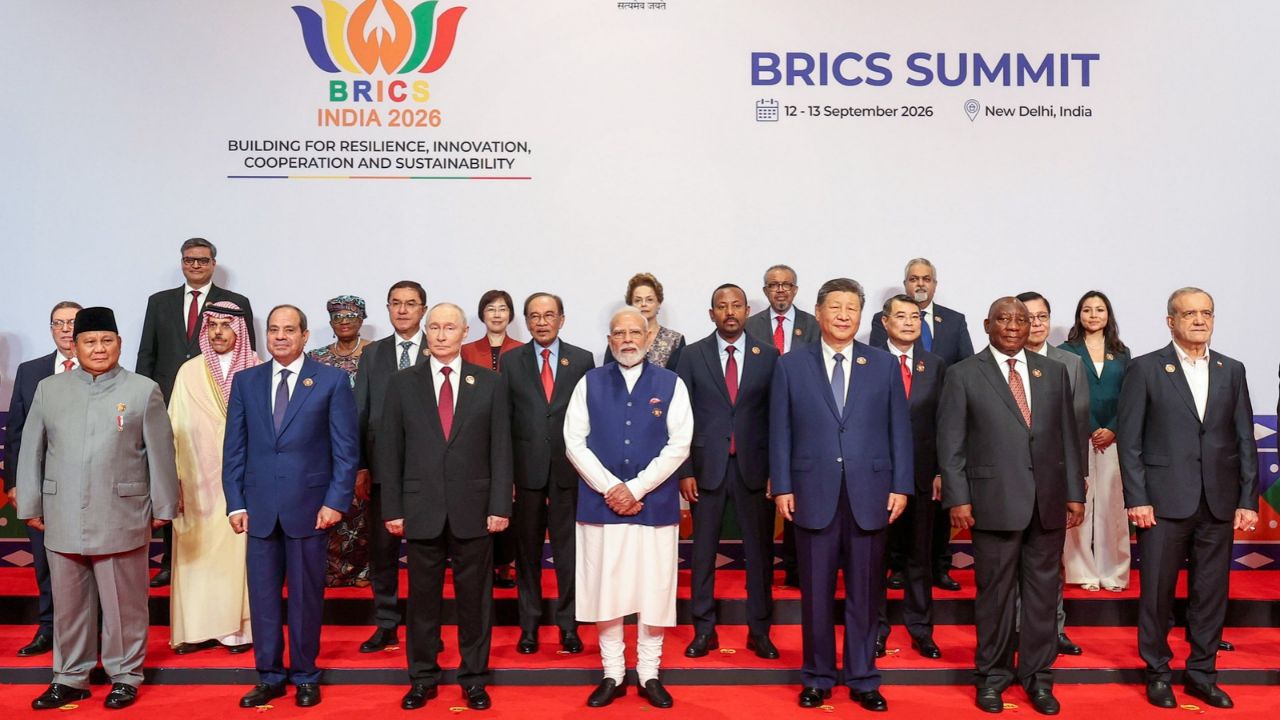
PM Modi delivers a major warning on technology and critical minerals at BRICS Summit 2026 (Img: IANS)
New Delhi: Prime Minister Narendra Modi on Sunday issued a major warning at the BRICS Summit 2026, saying the weaponisation of technology and critical minerals could hinder global progress and prosperity. The message has gained significance as countries compete for control over advanced technologies, rare earth resources and strategic supply chains.
The warning came during the concluding session of the 18th BRICS Summit, hosted by India, where leaders also backed new initiatives covering healthcare preparedness, logistics, startups, digital agriculture, clean energy and sustainable development.
Prime Minister Narendra Modi brought the two-day BRICS Summit in New Delhi to a close with a call for greater cooperation, resilience and inclusive growth among emerging economies.
Thanking participating leaders for their contribution, Modi said the discussions at the summit had added greater depth and breadth to BRICS cooperation. He said the New Delhi Declaration would provide direction for the grouping’s future work.
With BRICS entering its third decade, the Prime Minister stressed that the world now expects concrete results rather than only ideas and commitments.
The concluding session was attended by several prominent leaders, including Chinese President Xi Jinping, Russian President Vladimir Putin and Iranian President Masoud Pezeshkian.
The most significant geopolitical message from Modi’s address centred on technology and critical minerals. The Prime Minister warned that the weaponisation of these strategic assets could obstruct shared development and prosperity.
The concern is particularly important because modern economies increasingly depend on advanced technology and a stable supply of minerals required for high-value industries.
Critical minerals and rare earth elements are essential for electric vehicles, batteries, renewable energy systems, electronics, telecommunications, semiconductors and defence equipment.
At the same time, advanced technologies have become closely linked to economic competitiveness and national security. Restrictions on technology transfers, export controls and access to strategic resources can therefore have consequences far beyond individual countries.
Modi called for a more inclusive approach to technology adoption so that developing economies are not left behind by a widening technological divide.
The Prime Minister’s remarks assume additional significance amid growing international concerns surrounding critical mineral supply chains and access to advanced technology.
China plays a major role in global critical mineral processing and rare earth supply chains. At the same time, major economies are competing to secure alternative sources, develop domestic processing capabilities and reduce dependence on concentrated supply networks.
Against this backdrop, Modi’s call for inclusive access to technology and resilient supply chains places BRICS at the centre of a larger debate over economic security and strategic resources.
The issue is no longer limited to trade. Critical minerals have become closely connected with industrial policy, clean energy, defence preparedness, semiconductor manufacturing and geopolitical influence.
Modi identified resilience, innovation, cooperation and sustainability as the four major pillars of India’s BRICS presidency. He pointed to geopolitical conflicts, pandemics, climate disasters and supply-chain disruptions as examples of how crises in one part of the world can affect people and economies elsewhere.
The Prime Minister stressed the importance of identifying risks early, preparing for disruptions and responding quickly. For BRICS economies, building resilient supply chains is increasingly important because interruptions in energy, food, minerals, technology or transportation can create inflationary pressure and affect economic growth.
Healthcare preparedness was another major area of cooperation at the summit. The BRICS nations agreed on an Integrated Early Warning System aimed at improving prevention and response to infectious diseases.
The initiative is designed to strengthen information sharing and preparedness so that emerging health threats can be detected and addressed more quickly. The summit also advanced Early Warning Data Integration Guidelines for disaster management, creating another layer of cooperation among member countries during emergencies.
The focus reflects lessons from the COVID-19 pandemic, which demonstrated how quickly a health crisis can spread across borders and disrupt economies.
Supply chain resilience was another major priority during the summit. The BRICS Logistics Supply Chain Cooperation Framework is aimed at making trade and transportation networks more reliable and resilient.
The initiative comes at a time when geopolitical tensions, conflicts, shipping disruptions and protectionist trade measures have increased pressure on international supply chains. For emerging economies, stable logistics networks are critical for maintaining exports, imports, manufacturing and access to essential goods.
India also pushed innovation as a key pillar of BRICS cooperation. The BRICS Incubator Network will connect startups and incubators across member countries, potentially creating opportunities for technology partnerships, investment and cross-border innovation.
India also proposed the BRICS Startup Innovation Fund to support scalable and technology-driven solutions. The broader objective is to ensure that innovation generated within BRICS economies can move beyond individual markets and contribute to wider economic development.
Technology cooperation is also moving into the agriculture sector. The BRICS Network on Digital Agriculture is expected to connect artificial intelligence, geospatial technology and digital public infrastructure with the needs of farmers.
Such technologies can help improve agricultural planning, monitoring, resource management and access to digital services. For developing economies where agriculture remains a major source of employment, digital transformation could become an important tool for improving productivity and strengthening rural resilience.
Modi also stressed that BRICS cooperation should not remain restricted to governments. India has promoted initiatives designed to involve entrepreneurs, farmers, researchers, women, young people and ordinary citizens.
Through BRICS CONNECT, the focus has been placed on skills, employability, workforce participation, social security and capacity building. The BRICS MSME Cooperation Portal is intended to help small businesses gain access to knowledge, finance and new markets.
This approach could make BRICS cooperation more visible at the grassroots level, particularly for businesses and workers in emerging economies.
Urban development and clean energy were also part of India’s BRICS agenda. The BRICS Urban Mobility Hub has been established to facilitate the exchange of best practices among cities.
The initiative comes as rapidly growing cities across emerging economies face challenges involving congestion, pollution, public transport and sustainable urban expansion. In the energy sector, India highlighted smart grids and energy storage as important technologies for the clean energy transition.
The BRICS Digital Centre of Excellence for Smart Grids and Energy Storage is expected to support more reliable, efficient and accessible clean energy systems.
Sustainability remained one of the central themes of the summit. Modi emphasised that economic development and environmental protection should complement each other rather than being treated as competing priorities.
For BRICS nations, the issue is particularly important because many emerging economies are simultaneously dealing with rising energy demand, urbanisation, climate risks and the need for faster economic growth. The challenge is to expand infrastructure and industrial capacity while reducing environmental damage and improving climate resilience.
Another major theme of Modi’s address was the growing importance of the Global South. The Prime Minister said developing countries increasingly see BRICS as a platform where their experiences and concerns receive greater attention.
India’s approach has been to promote solutions developed with developing countries rather than solutions imposed on them. This could strengthen BRICS as an alternative platform for discussions on global governance, trade, finance, technology, energy and development.
The New Delhi Declaration adopted at the summit provides a broad roadmap for future BRICS cooperation. The declaration addresses international security, economic cooperation, global development, supply chains and major geopolitical challenges.
It also reflected concerns over conflicts and tensions in the Middle East, while stressing the need for restraint and humanitarian considerations. The declaration supported a lasting two-state solution to the Israeli-Palestinian conflict and called for greater international support for Palestine.
It also raised concerns over unilateral economic sanctions and growing protectionism, including tariff measures and trade barriers that can disrupt global supply chains.
The significance of Modi’s message extends beyond the 11-member grouping. The global economy is increasingly dependent on a relatively limited number of countries for critical minerals, advanced components and strategic technologies. This concentration creates vulnerabilities for industries ranging from electric vehicles and renewable energy to defence and semiconductor manufacturing.
For India, diversifying supply chains, expanding domestic capabilities and improving access to strategic resources are increasingly important elements of economic and national security policy. The BRICS platform gives India an opportunity to push these concerns alongside other emerging economies.
The next challenge for BRICS will be implementation. The initiatives announced during the New Delhi Summit will need to move from declarations and frameworks to practical cooperation involving governments, businesses, startups, researchers and citizens.
China will take over the next BRICS presidency, with the grouping expected to continue discussions on economic resilience, technology, trade, energy and development.
For India, the focus will now shift towards ensuring that the initiatives launched during its presidency produce measurable outcomes and strengthen the role of the Global South in the evolving global economic order.
The larger message from New Delhi is clear: technology, critical minerals and resilient supply chains are no longer merely economic issues. They are becoming central to the global contest for growth, security and geopolitical influence.

