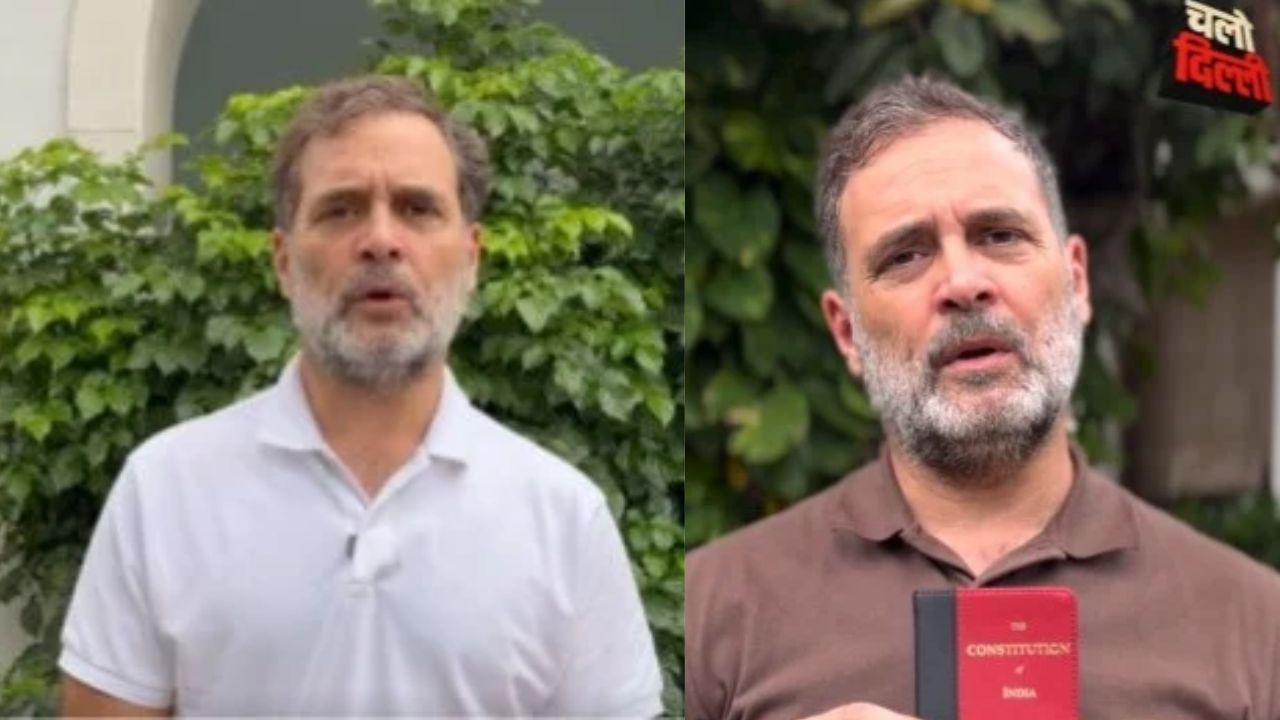
Lok Sabha Lop Rahul Gandhi announces Supreme Court march on October 12 over allegations surrounding the SIR voter-list revision. (Img: X)
New Delhi: Congress leader and Leader of Opposition in the Lok Sabha Rahul Gandhi has intensified his attack on Prime Minister Narendra Modi and Union Home Minister Amit Shah over the police action against protesters in Delhi, announcing a march to the Supreme Court on Monday, October 12. The proposed demonstration is expected to bring together opposition parties, youth organisations, civil society groups and citizens opposing what they describe as electoral irregularities and the suppression of democratic dissent.
In a sharply worded message on Sunday, October 11, Rahul accused the authorities and alleged BJP supporters of assaulting young demonstrators who had gathered peacefully. He characterised the police action as an affront to democratic values and argued that the country’s youth should be able to express their concerns without intimidation.
The planned march is expected to focus on three principal demands: a halt to the Special Intensive Revision (SIR) of electoral rolls, action over alleged electoral malpractice, and the resignation of Chief Election Commissioner Gyanesh Kumar.
Rahul’s announcement followed a day of heightened security and detentions in the national capital, where police prevented Cockroach Janta Party (CJP) supporters and opposition leaders from reaching Jantar Mantar to participate in the protest.
The Congress leader alleged that young demonstrators had been assaulted by police personnel and individuals he described as BJP goons. He maintained that the protesters had come to express their concerns peacefully and accused those in power of trying to silence dissent.
Rahul also invoked the broader question of the kind of India the country should aspire to become, arguing that violence and intimidation against peaceful demonstrators were incompatible with constitutional democracy.
His intervention has given the proposed October 12 march additional political significance, placing the handling of the Delhi protests alongside the opposition’s wider campaign over electoral transparency and the functioning of constitutional institutions.
The proposed march is intended to take the protesters’ concerns to the Supreme Court, with participants planning to submit a memorandum to the Chief Justice of India.
The memorandum is expected to press for an end to alleged electoral malpractice, the suspension of the SIR exercise and the resignation of Gyanesh Kumar. The demands reflect the opposition’s contention that the electoral roll revision process and the Election Commission’s functioning require greater scrutiny and accountability.
SIR is an exercise undertaken to revise and verify electoral rolls. The process has become a major political flashpoint, with opposition parties raising concerns about its implementation and potential implications for eligible voters. The government and election authorities’ position on the process must be distinguished from the allegations being advanced by political opponents.
The planned memorandum will seek to bring these concerns before the country’s highest court. However, the march and the demands being raised by its organisers do not, by themselves, establish that electoral malpractice has occurred.
Rahul has called on opposition parties, young people, civil society organisations and citizens who support democratic principles and the Constitution to participate in the demonstration.
The proposed mobilisation is being presented as a collective effort that goes beyond individual political parties and seeks participation across gender, caste, community and state boundaries. The organisers’ stated objective is to turn the campaign into a broader public movement around electoral accountability and democratic rights.
The appeal also places particular emphasis on young protesters, whose participation in the preceding demonstrations has become central to the political dispute. Opposition leaders argue that the treatment of these demonstrators raises questions about the space available for peaceful political expression.
Rahul’s call for a united march comes amid escalating tensions between the opposition and the BJP-led government over the SIR exercise and allegations concerning the Election Commission.
In his message, Rahul also named Prime Minister Narendra Modi, Home Minister Amit Shah, National Security Adviser Ajit Doval and RSS chief Mohan Bhagwat, accusing them of being unable to silence public dissent.
He framed the planned march as a demonstration of resistance to intimidation and urged citizens not to be afraid of participating in the political process. His remarks have widened the confrontation beyond the immediate police action, bringing senior political and institutional figures into the centre of the opposition’s messaging.
The rhetoric underscores the increasingly confrontational nature of the dispute, although the allegations directed at individuals and political groups remain claims made by the opposition and should not be treated as independently established findings.
The proposed march follows an extensive security operation in Delhi on Saturday, October 10. Police prevented CJP supporters and opposition leaders from proceeding towards Jantar Mantar, while large numbers of demonstrators were detained at multiple locations.
According to the account provided by the organisers and opposition leaders, more than 7,000 protesters were detained. Those named among the detainees included CJP founder Abhijeet Dipke and leaders Saurav Das and Ashutosh Ranka. Former chief ministers Arvind Kejriwal, Mamata Banerjee, Pinarayi Vijayan and Manik Sarkar were also reportedly detained while attempting to join the protest.
More than 30,000 police and paramilitary personnel were deployed across the capital amid heightened security arrangements, reflecting the scale of the preparations to prevent the demonstrations from escalating.
The detentions have triggered a political backlash, with opposition leaders questioning the police response and the restrictions imposed on demonstrators. The precise circumstances of individual detentions and the allegations of excessive force remain matters requiring independent verification.
CJP leaders who were released from detention have vowed to continue the agitation and extend it beyond the national capital. The movement’s organisers have indicated that the protests will not end with the Delhi demonstration and could spread to other parts of the country.
CJP leader Saurav Das accused the Modi government of creating what he described as an emergency-like situation. He also alleged that protesters had been detained unlawfully, denied access to lawyers and had their mobile phones seized.
These allegations, which have not been independently established in the information available, have added to the controversy surrounding the police operation. The claims raise questions about due process and access to legal assistance, issues that may become part of the wider political and legal debate.
The organisers have maintained that the agitation will continue until they secure accountability over the issues they have raised. Their stated strategy is to broaden participation and sustain pressure beyond a single protest or location.
The Special Intensive Revision of electoral rolls has emerged as a key point of confrontation between opposition parties and the authorities. Opposition leaders have questioned the exercise and raised concerns about electoral transparency, while the demand for Gyanesh Kumar’s resignation has become a central feature of their campaign.
The opposition’s argument is that electoral processes must be transparent, verifiable and accessible to eligible voters. The political dispute has also raised broader questions about the Election Commission’s independence and public confidence in electoral administration.
At the same time, allegations of vote theft and irregularities must be assessed on the basis of verifiable evidence, official records and any relevant judicial findings. Political accusations alone do not establish wrongdoing.
The planned Supreme Court march is therefore significant not only as a street mobilisation but also as an attempt by opposition groups to bring their concerns over electoral administration and democratic accountability into sharper public focus.

