English
 English

BJP targets Rahul Gandhi over Pakistan-related foreign policy remarks. (Img: X)
New Delhi: A fresh political confrontation has erupted between the Bharatiya Janata Party (BJP) and the Congress after Leader of Opposition Rahul Gandhi characterised India as a "side player" in the evolving geopolitical order, questioning the country's diplomatic leverage and the Modi government's foreign policy orientation.
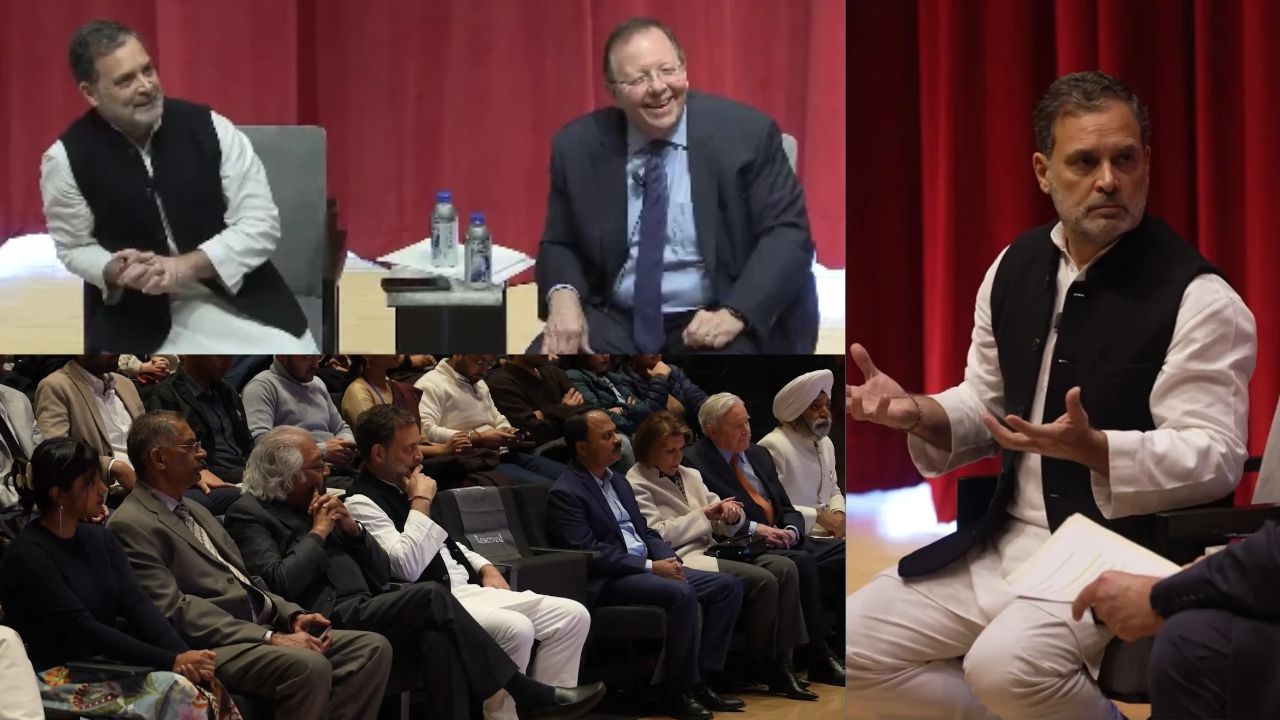
His remarks, made during an interaction at the University of Chicago in the United States, drew a blistering response from the BJP, which branded him a "Pak Fan Boy" and accused him of providing political ammunition to Pakistan by questioning India's international standing.
Gandhi expressed disquiet over Pakistan's reported involvement in facilitating negotiations between Washington and Tehran, arguing that a country of India's geopolitical weight, strategic reach and international standing should be at the forefront of consequential global conversations rather than occupying the diplomatic sidelines. The BJP, however, interpreted his criticism as an attempt to diminish India's diplomatic achievements and amplify Pakistan's relevance in international affairs.
Addressing students and faculty members at the University of Chicago, Gandhi argued that India's demographic heft, economic potential and extensive diplomatic relationships should translate into a more consequential role in shaping global developments.
"India, by its size, naturally has a global voice and India should be actively involved in global conversations. But frankly, India has become a side player," Rahul Gandhi said.
Expressing surprise over Pakistan's involvement in diplomatic efforts between the United States and Iran, he questioned India's apparent absence from the negotiations. "I'm pretty shocked that Pakistan is busy negotiating with the Iranians and the Americans, and India's just looking," he added.
The Congress leader contended that India had historically exercised considerable diplomatic autonomy, maintaining strategic partnerships with major powers without surrendering its independent foreign policy outlook. Invoking the legacy of the Non-Aligned Movement, Gandhi argued that India's earlier stature as a leading voice of the developing world had gradually receded.
He maintained that New Delhi needed to reclaim its position as an independent geopolitical actor capable of influencing international discourse rather than merely responding to developments shaped elsewhere.
The BJP swiftly mounted a political counteroffensive, accusing Gandhi of displaying an excessive preoccupation with Pakistan and portraying the neighbouring country as a benchmark for India's diplomatic engagement.
Party spokesperson Pradeep Bhandari took to social media to question the Congress leader's repeated references to Pakistan, alleging that his remarks overlooked India's diplomatic interventions and strategic engagements.
"Why is Rahul Gandhi so obsessed with Pakistan! At every global stage, Rahul acts like Pak Fan Boy! Yet again, he idolises Pakistan as a role model for him in foreign policy outreach! His love for Pakistan has made him forget that It is India which - Russia & Ukraine both acknowledged for its peace efforts - Iran waived of any Hormuz restrictions. Rahul Gandhi's love for terror state Pakistan made UPA compromise India's sovereignty at Sharmal Sheikh & not attack Pakistan post 26/11 terror attack," Bhandari posted on X.
The BJP spokesperson invoked India's engagement with Russia and Ukraine, as well as developments concerning Indian-flagged vessels in the Strait of Hormuz, to challenge Gandhi's assessment of the country's diplomatic standing.
Another BJP spokesperson, CR Kesavan, described Gandhi's comments as "most reprehensible and inexcusable", accusing him of attempting to undermine India's international credibility by portraying the country as a marginal participant in global affairs.
Kesavan maintained that India had emerged as an influential diplomatic interlocutor under Prime Minister Narendra Modi, arguing that the Congress leadership was unwilling to acknowledge the country's expanding international profile.
Beyond questioning India's participation in global negotiations, Gandhi launched a broader critique of what he characterised as the Modi government's 'excessive' reliance on personal relationships between world leaders.
Arguing that international relations are ultimately governed by structural interests, economic dependencies and geopolitical calculations, he dismissed the notion that personal rapport between heads of government could independently secure strategic advantages.
"Friendship is not the point. Who gives a damn about friendship? Do you really think that geopolitics is going to work because the guy is your friend? He's leading a structure. He's got a whole economic system under him. He's not going to make decisions based on whether he likes you or doesn't like you. So these are some of the things that disturb me," Rahul said.
He subsequently clarified that his criticism was not directed at maintaining cordial relationships with political leaders, but at allowing personal diplomacy to overshadow a coherent assessment of national interests.
"I don't have a problem with being friends with Mr Modi or being friends with leaders. Friendship is not that important. What's important is that you understand what's going on, who you are, and where you fit."
His argument centred on the distinction between personal diplomacy and strategic statecraft, suggesting that India's foreign policy must be anchored in a clear-eyed understanding of international power equations.
Gandhi's criticism of India's diplomatic positioning was accompanied by an unequivocal qualification on the prospects of engagement with Pakistan. He maintained that meaningful bilateral dialogue could not proceed while Islamabad continued to support and promote terrorism targeting India.
Responding to a question on the possibility of normalising relations with Pakistan, the Congress leader acknowledged that diplomatic engagement could eventually resume, but insisted that the security dimension remained non-negotiable.
"There is scope, but there is a major problem, and that is Pakistan’s support for and promotion of terrorism within our country. This is absolutely out of the question. It is impossible for us to accept a situation where our innocent people are being killed while we engage in talks with Pakistan. So, the moment that stops, then a conversation can potentially begin," he said.
The position reflected Gandhi's distinction between maintaining the possibility of diplomatic engagement and accepting negotiations without addressing India's security concerns.
Gandhi also articulated his position on India's relationship with Israel, arguing that bilateral cooperation, including defence procurement, should not compromise New Delhi's independent assessment of international conflicts.
He maintained that India's demographic scale, strategic priorities and national interests demanded a foreign policy framework that remained autonomous rather than being calibrated to accommodate the preferences of external powers.
"We have good relations with Israel, and we buy weapons from them. But we are a much bigger country, with a population of 1.5 billion, and our foreign policy should be based on what is good for us, not on what is good for others," he said.
While supporting continued relations with Israel, Gandhi condemned the October attacks and criticised Israel's military actions in Gaza.
The latest confrontation forms part of a broader political dispute over Gandhi's interventions during overseas engagements, where he has repeatedly questioned the government's record on democratic institutions, electoral integrity, economic inequality and employment.
Union Parliamentary Affairs Minister Kiren Rijiju challenged Gandhi's assessment of India's democratic environment, arguing that the opposition's ability to criticise the government and exercise its political rights contradicted his allegations.
Other BJP leaders have similarly accused the Congress leader of questioning constitutional institutions and India's democratic credentials on international platforms, alleging that such interventions risk damaging the country's reputation.
The University of Chicago interaction, moderated by political science professor Robert Pape, was part of Gandhi's visit to the United States. A day earlier, he had participated in an academic discussion with students and faculty members at Columbia University in New York.
The latest exchange has brought competing interpretations of India's geopolitical influence, strategic autonomy and diplomatic outreach into sharp political focus, with the Congress questioning the effectiveness of the government's foreign policy and the BJP defending India's international positioning under Prime Minister Narendra Modi.
The confrontation also underscores a larger ideological divide over the conduct of Indian foreign policy: whether New Delhi's global standing should be measured by its participation in diplomatic negotiations, its strategic partnerships or its capacity to independently shape international outcomes.