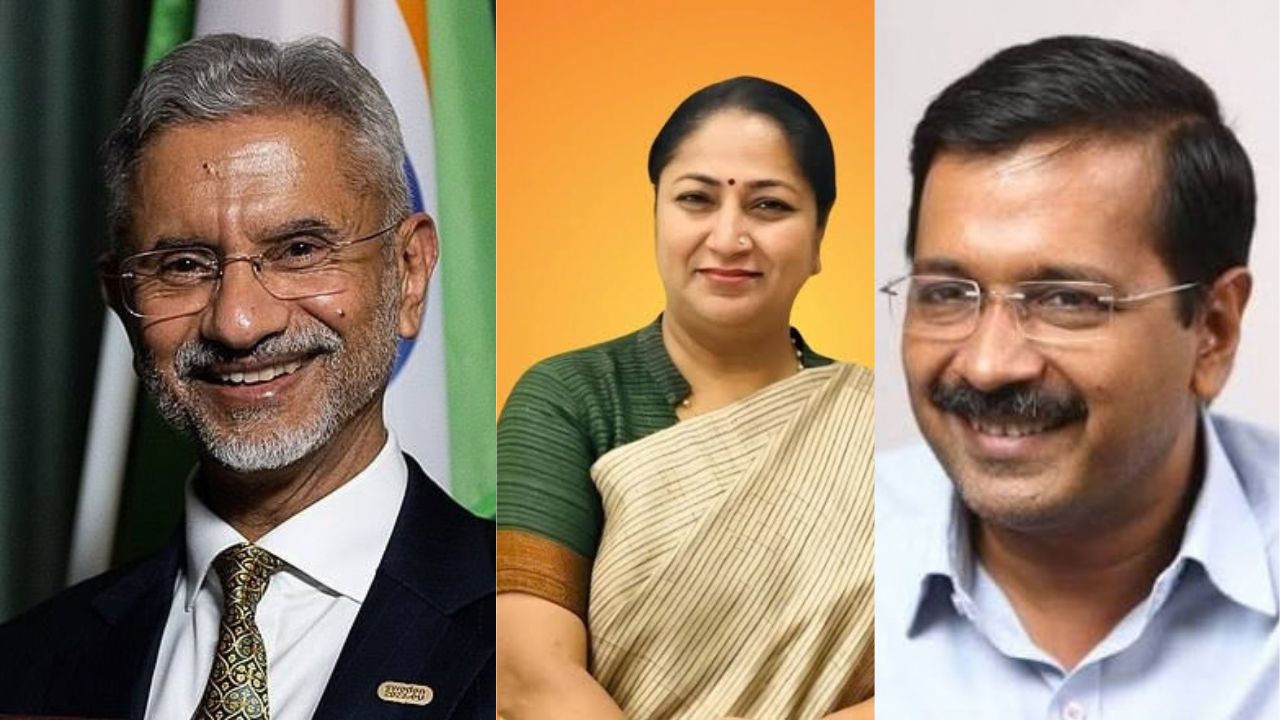
S Jaishankar, Rekha Gupta, Arvind Kejriwal and LK Advani are among prominent Delhi voters who received notices during the ongoing SIR of electoral rolls. (Image: Google)
New Delhi: Foreign Minister S Jaishankar, Delhi CM Rekha Gupta, Arvind Kejriwal, LK Advani and several other prominent names have appeared among millions of Delhi voters issued notices during the Special Intensive Revision of electoral rolls. Here is what triggered the notices and what happens next. Delhi’s ongoing Special Intensive Revision (SIR) of electoral rolls has brought several high-profile voters under scrutiny after election authorities identified discrepancies or were unable to link their details with the previous intensive revision records.
Among those who have received notices are Jaishankar, Delhi Chief Minister Rekha Gupta, former Delhi Chief Minister Arvind Kejriwal, BJP veteran LK Advani, former vice-president Jagdeep Dhankhar, Rajya Sabha MP Kapil Sibal and several senior officials and public figures. The notices fall broadly into two categories such as 'no mapping' and 'logical discrepancies'.
Election authorities have said that receiving such a notice does not itself mean that a voter's name will be deleted. The concerned elector gets an opportunity to respond and provide supporting documents before a decision is taken.
Jaishankar and his wife Kyoko Jaishankar were flagged under the 'unmapped with last SIR' category. The couple are registered voters in the Sunehri Bagh area of the New Delhi Assembly constituency. In this context, 'no mapping' indicates that an elector's current details could not be linked with the corresponding entry in the previous intensive revision record.
Delhi CM Rekha Gupta, a voter in Shalimar Bagh was flagged under the logical-discrepancy category. Officials said the issue concerned the age difference between Gupta and her parents as recorded in the relevant electoral data. Her documents were subsequently verified by election officials, and her entry was validated for inclusion in the final electoral roll.
Former Delhi CMArvind Kejriwal and members of his family also received notices. Their records were flagged because the entries could not be mapped with the previous SIR roll. Kejriwal and his family members are registered in the New Delhi constituency. Officials said the records would be processed following verification of the required facts and documents.
Importantly, the notice itself is part of the verification procedure and does not amount to an order removing the voter from the electoral roll.
Former deputy PM LK Advani, along with his daughter Pratibha and daughter-in-law Geetika, received notices under the 'no mapping' category. Their current entries could not be linked with the previous SIR records. Advani's son Jayant, however, cleared the mapping process, according to the report.
The list extends well beyond political leaders. Among the prominent names reported to have received notices are as follows
The reported reasons vary from non-mapping with previous records to mismatches involving names and family details.
'No mapping' does not by itself indicate that a voter is ineligible. It generally refers to an inability to connect the elector's current record with the relevant entry in the previous intensive revision database. This is why voters receiving such notices are being given an opportunity to provide documents and explanations to the election authorities.
The second major category covers inconsistencies identified in electoral records. These can include differences in the spelling or details of an elector's name, discrepancies involving a parent's name or unusual age gaps between family members recorded in the electoral database. The Election Commission's position is that these discrepancies require verification rather than automatically establishing that an elector is ineligible.
Election authorities identified 33,12,919 electors across the two broad categories. Of these, 13,79,785 were classified as having no mapping with the previous SIR roll, while 19,33,134 were identified under logical discrepancies. The figures are part of a much wider revision of Delhi's electoral rolls. The draft roll published on August 31 contained about 97.5 lakh electors, compared with roughly 1.45 crore on the June 30 roll.
The Election Commission has specifically clarified that receiving a notice should not be interpreted as an automatic decision to remove a person's name. Affected voters can submit their response and relevant documents to the concerned Electoral Registration Officer (ERO) or Booth Level Officer (BLO).
The ERO will consider the available material before deciding the individual case.
The notice-disposal process is scheduled to continue through October 29, while the final electoral roll is scheduled for publication on November 4, 2026. The exercise has also become the subject of legal scrutiny with the Supreme Court scheduled to hear a plea concerning transparency around the notices and the reasons given to voters.
For now, the central point is that an SIR notice is a verification step not by itself a final determination that a voter has lost eligibility. The cases involving Jaishankar, Gupta, Kejriwal, Advani and other prominent voters therefore illustrate the range of discrepancies being examined during Delhi's electoral-roll revision.

