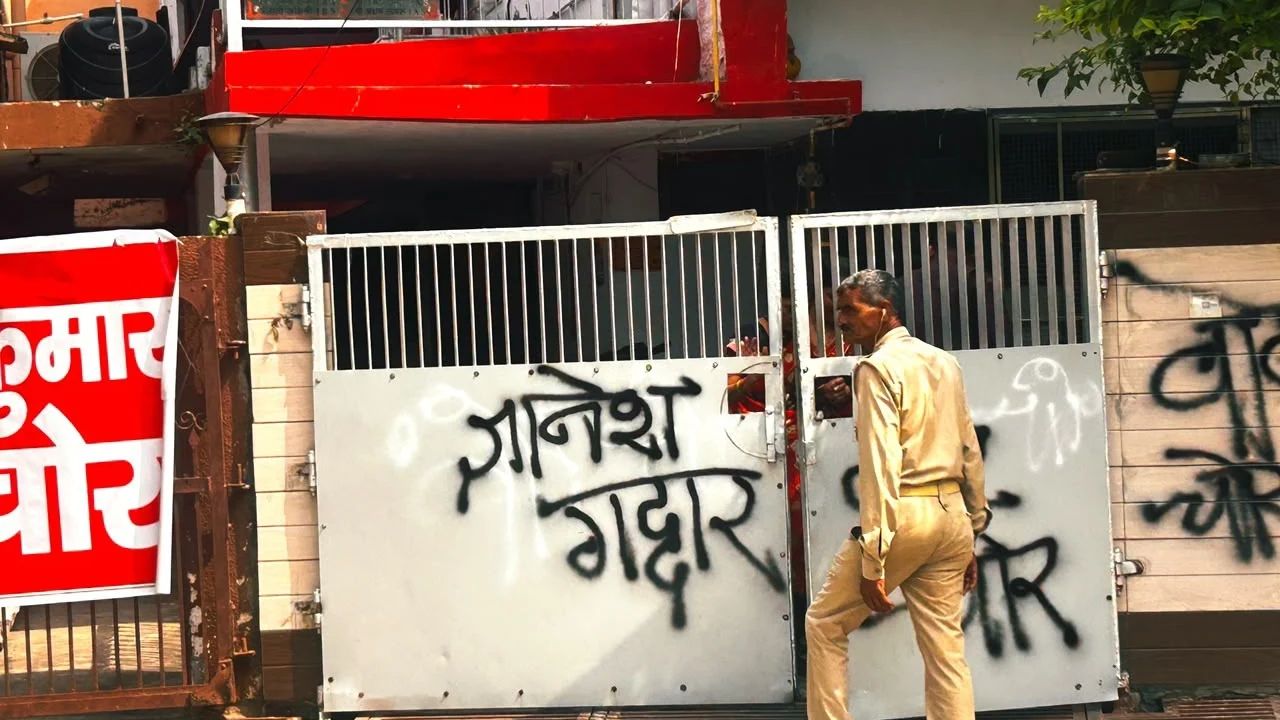
Congress protest outside CEC Gyanesh Kumar’s Agra residence sparks political storm. (Img: Dynamite News)
Agra: The controversy surrounding Chief Election Commissioner Gyanesh Kumar and the Election Commission of India (ECI) entered a new phase after Congress workers staged a protest outside his ancestral residence in Agra, escalating the political battle over the Special Intensive Revision (SIR) of electoral rolls.
The protest has intensified a larger debate over electoral transparency, voter registration procedures and the role of constitutional institutions in India’s democratic framework. The BJP responded strongly to the demonstration, accusing opposition parties of creating confusion around the Election Commission and attempting to undermine public confidence in democratic institutions.
The latest confrontation comes at a time when the Election Commission is facing political scrutiny over the SIR exercise, which involves verification and revision of electoral rolls ahead of upcoming elections.
The controversy has now moved beyond administrative discussions and entered the political arena, with parties engaging in a high-voltage war of words over electoral reforms, voter eligibility and institutional accountability.
Congress workers gathered outside Gyanesh Kumar’s Agra residence as part of protests against the Election Commission’s handling of the SIR process.
During the demonstration, protesters allegedly painted slogans on the gate and walls of the property, expressing their opposition to the Chief Election Commissioner. The protest became a major political flashpoint as visuals from the demonstration circulated widely, drawing reactions from leaders across party lines.
Police officials reached the spot after receiving information about the incident. Authorities began assessing the situation and reportedly examined available CCTV footage to identify individuals involved in the protest activity.
The demonstration was part of a broader opposition campaign questioning the functioning of the Election Commission and demanding greater transparency in electoral roll revision procedures.
The Special Intensive Revision of electoral rolls has emerged as one of the biggest political debates involving election management and voter participation.
Electoral roll revision is a routine process carried out to update voter lists, remove inaccuracies, include eligible citizens and maintain the integrity of election records. However, political parties often closely monitor such exercises because changes in voter lists can have direct implications for elections.
The opposition has raised concerns over transparency, verification procedures and possible exclusion of eligible voters. Congress leaders have argued that electoral processes must remain open, accountable and free from any perception of political influence.
The Election Commission has maintained that electoral roll revision is aimed at ensuring accurate voter databases and strengthening the election process.
Also Read: CEC Gyanesh Kumar Faces Supreme Court Challenge Over ECI Decision-Making Process
The Congress continued its criticism of the Election Commission, alleging that the SIR process requires greater scrutiny and accountability. Congress president Mallikarjun Kharge and other opposition leaders have raised questions over the functioning of the poll body and demanded answers regarding allegations linked to electoral roll management.
The BJP has rejected these allegations and launched a counterattack, defending the Election Commission’s constitutional position. BJP president JP Nadda accused opposition parties of attempting to create instability by targeting constitutional institutions. He argued that questioning independent bodies for political reasons could affect public trust in democratic systems.
The BJP leadership maintained that the Election Commission operates within the constitutional framework and follows established procedures while conducting elections and managing electoral processes.
Also Read: ‘BJP Protecting Gyanesh Kumar’: Priyanka Gandhi Says INDIA Bloc United Over ECI Row
The dispute widened into a larger debate over the independence, credibility and accountability of constitutional authorities. The Election Commission of India plays a crucial role in conducting elections, preparing electoral rolls, monitoring political parties and ensuring compliance with election laws.
Any controversy involving the poll body attracts nationwide attention because elections form the foundation of India’s democratic system.
The current SIR debate has brought several election-related issues into focus, including voter verification, electoral inclusion, booth-level processes and the relationship between political parties and constitutional institutions. The controversy has also highlighted how election-related issues can become central themes in political mobilisation and public campaigns.
The SIR controversy has also entered the legal domain after a petition was filed before the Supreme Court questioning aspects of the Election Commission’s decision-making process.
The plea has raised questions about the functioning of the multi-member Election Commission and the implementation of decisions related to electoral administration.
The legal proceedings have added another layer to the debate over Article 324 of the Constitution, which gives the Election Commission authority over elections in India.
The case has brought attention to issues such as institutional independence, collective decision-making and safeguards required for maintaining confidence in electoral institutions.
The controversy triggered widespread discussion among political parties, election observers and citizens regarding voter rights and electoral transparency. Supporters of the SIR process argue that updated voter lists are essential for preventing errors, duplicate entries and inaccuracies in election records.
Critics, however, raised concerns that the revision process must ensure that no eligible voter is excluded due to procedural difficulties or documentation-related challenges. The debate reflects a larger national conversation about balancing electoral accuracy with protecting citizens’ democratic participation.

