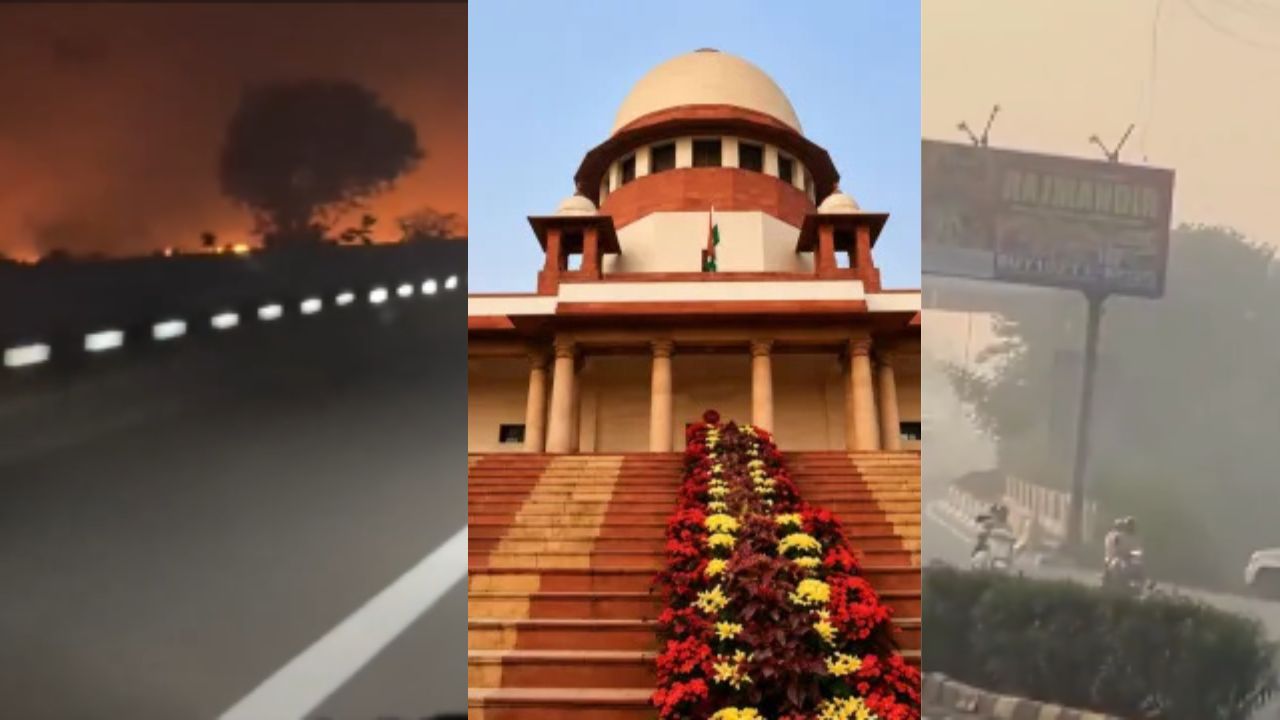
Supreme Court flags expensive Diwali gift exchanges, linking consumer-driven festivities to additional vehicular pollution in Delhi. (Img: X)
New Delhi: The Supreme Court on Friday expressed displeasure over the way Indians celebrate Diwali, especially the growing culture of exchanging expensive festive gifts, calling it a major contributor to vehicular pollution in Delhi.
With the national capital's air quality deteriorating to alarming levels and the overall Air Quality Index (AQI) approaching the severe category, the court observed that the commercialisation of festivals and the transformation of gift-giving into a social status symbol were adding to the city's annual pollution crisis.
Chief Justice of India (CJI) Surya Kant made the observations on Friday, November 6, while hearing matters concerning Delhi's worsening air pollution. He highlighted how affluent sections of society had increasingly turned the exchange of Diwali gifts into a display of wealth and social standing, resulting in additional vehicular movement and associated emissions. The court emphasised that public participation and behavioural changes were indispensable to addressing the recurring pollution emergency, particularly during the festive season.
The Supreme Court's observations came as Delhi's average AQI stood at 389 on Friday, placing the national capital perilously close to the severe pollution category. According to the Central Pollution Control Board (CPCB), air quality levels had crossed the 400-mark in several localities, indicating the intensification of the pollution crisis across the city and adjoining areas.
Delhi's pollution levels traditionally deteriorate around Diwali due to a combination of unfavourable meteorological conditions, vehicular emissions, industrial activity, construction dust, open burning and agricultural residue burning in neighbouring states. The accumulation of pollutants, particularly under stagnant atmospheric conditions, frequently pushes the region's air quality into hazardous territory.
With Diwali scheduled to be celebrated on November 8, markets across Delhi and the National Capital Region (NCR) have witnessed a substantial increase in festive footfall. The pre-Diwali shopping rush, coupled with the longstanding tradition of exchanging gifts among relatives, friends, business associates and professional networks, has intensified movement across commercial hubs and residential neighbourhoods.
During the hearing, CJI Surya Kant identified unrestricted inter-state vehicular movement as a significant challenge in monitoring and controlling pollution in the national capital. He observed that vehicles entering Delhi from different parts of the country often remain outside the effective monitoring framework, making it difficult for authorities to establish their emission compliance and overall roadworthiness.
The Chief Justice highlighted that even a vehicle entering the city for a short duration could contribute to its pollution burden. He stressed that the problem could not be assessed merely by counting the vehicles operating in Delhi, as the duration of their presence on the roads and the emissions generated during that period were equally important considerations.
The court's concern brought renewed attention to the challenges associated with regulating inter-state traffic, enforcing emission standards and ensuring compliance with pollution-control requirements across the Delhi-NCR region.
Additional Solicitor General (ASG) Aishwarya Bhati, appearing on behalf of the Centre, informed the court that authorities were implementing several measures to strengthen vehicular pollution monitoring and enforcement.
She submitted that Stage II of the Graded Response Action Plan (GRAP) had already been implemented in Delhi-NCR. The restrictions and interventions under this stage include measures such as water sprinkling to suppress road dust, intensified surveillance and stricter checks at entry points to regulate polluting vehicles.
The ASG also informed the bench that Pollution Under Control (PUC) certificates were being geotagged at the locations where emission tests were conducted. The mechanism is intended to improve transparency, strengthen verification and prevent irregularities in the certification process.
Authorities were also undertaking measures to identify and restrict visibly polluting vehicles, particularly those suspected of violating prescribed emission standards.
However, the Supreme Court indicated that enforcement measures alone would not resolve the problem unless authorities addressed the broader patterns of vehicular movement and public behaviour.
The court's observations extended beyond conventional pollution-control measures, with the Chief Justice emphasising the need to reconsider certain social practices that contribute to unnecessary vehicular movement during the festive period.
A counsel assisting the proceedings suggested that the practice of exchanging Diwali gifts could itself require reconsideration to reduce pollution associated with transportation and distribution.
Responding to the suggestion, CJI Surya Kant observed that a broader cultural transformation was necessary, particularly among affluent sections of society that had converted festive gifting into an expression of social prestige.
He indicated that people needed to reconnect with the traditional ethos of Indian festivals instead of allowing consumerism and competitive displays of wealth to dominate celebrations.
Justice Joymalya Bagchi, another member of the three-judge bench, also expressed concern over the increasing commercialisation and commodification of festivals such as Diwali.
The observations highlighted the growing tension between the traditional cultural significance of festivals and the expanding consumer-driven economy surrounding them. The court's discussion brought into focus how excessive consumption, elaborate gifting practices and the associated logistics could have wider environmental consequences.
Senior advocate Aparajita Singh, assisting the Supreme Court as amicus curiae, drew attention to the disproportionate impact of air pollution on economically disadvantaged sections of society. The issue prompted the Chief Justice to underline the need for a balanced approach that did not undermine the livelihoods of people dependent on the festive economy.
CJI Surya Kant cautioned against indiscriminately targeting traditional Diwali activities that provide seasonal employment and income opportunities to economically vulnerable communities.
He pointed out that small vendors selling earthen lamps, diyas and other traditional festive items were not responsible for generating the kind of pollution associated with excessive vehicular movement and consumption-driven practices.
The Chief Justice emphasised that the festive season was an important economic opportunity for marginalised communities, street vendors, artisans and small traders who depend on seasonal demand to sustain their livelihoods. He distinguished between traditional festive commerce and the affluent sections of society that increasingly use expensive gifts as markers of social standing.
The court's observations underscored the importance of ensuring that pollution-control strategies remain socially equitable and do not impose disproportionate economic hardships on communities with limited resources.
Before concluding the hearing, CJI Surya Kant cautioned that increasingly stringent judicial restrictions would not necessarily translate into effective pollution control without public cooperation. He observed that excessive regulatory intervention could also result in widespread non-compliance, making enforcement increasingly difficult for authorities.
The Chief Justice stressed that controlling Delhi's annual pollution crisis required collective responsibility, behavioural changes and active participation from local communities rather than relying exclusively on court-mandated restrictions.
He suggested that local councillors and Resident Welfare Associations (RWAs) should actively engage with residents and encourage environmentally responsible Diwali celebrations.
The court indicated that community-level awareness and voluntary compliance could play a crucial role in reducing pollution during the festive period. The observations placed renewed emphasis on the relationship between urban mobility, consumer behaviour, environmental governance and public accountability.
Delhi's recurring air pollution emergency has emerged as a complex public health and environmental challenge involving multiple sources of emissions, inter-state coordination issues and seasonal atmospheric conditions.
The Supreme Court's latest remarks signal that addressing the crisis may require a broader approach that goes beyond vehicle restrictions, road-dust management and regulatory enforcement to include changes in consumption patterns and social practices.
With Diwali approaching, the court's message was clear: environmental protection cannot be achieved through judicial orders alone, and citizens must become active participants in reducing the national capital's pollution burden.

