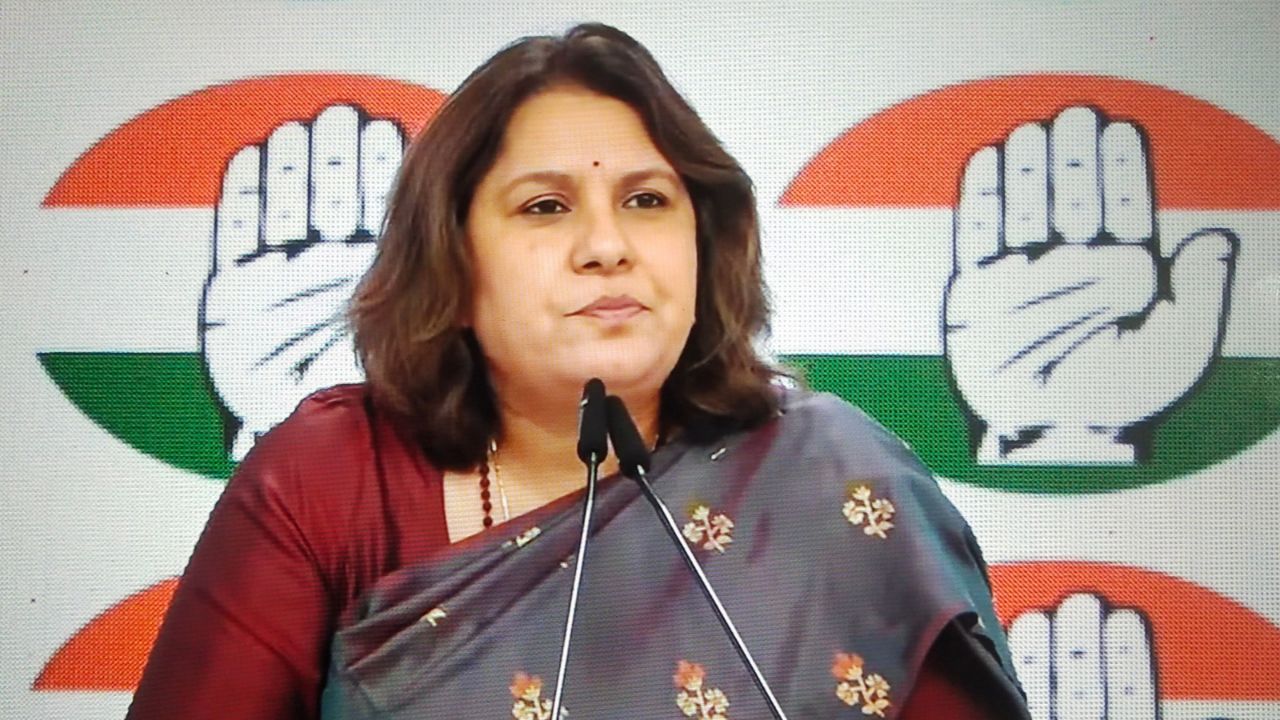
Congress spokesperson Supriya Shrinate questions Prime Minister Narendra Modi over his remarks on the party’s performance in the Legislative Council elections. (Img: X)
New Delhi: Congress spokesperson Supriya Shrinate has questioned Prime Minister Narendra Modi over his criticism of the Congress’s performance in the 2026 Legislative Council elections, citing political setbacks for the BJP in Nagpur and Varanasi. The exchange has intensified the debate over ballot-paper voting, electoral performance and the political significance of results across Uttar Pradesh, Maharashtra, Bihar and Karnataka.
The confrontation follows the BJP-led National Democratic Alliance’s victory in 16 of the 28 contested seats, while the Congress secured one seat and the Samajwadi Party won five in Uttar Pradesh. The contrasting outcomes have triggered a fresh round of political sparring, with both sides highlighting electoral results that support their respective arguments.
The political row escalated after Prime Minister Narendra Modi criticised the Congress for its poor performance in the Legislative Council elections, pointing out that the polls had been conducted using ballot papers rather than electronic voting machines.
The Prime Minister’s remarks targeted the Congress’s demand for a return to paper ballots in Lok Sabha and Assembly elections, an issue that has featured prominently in the opposition’s campaign for changes to India’s electoral process.
Responding to the criticism, Congress spokesperson Supriya Shrinate shifted the focus to the BJP’s setbacks in Nagpur, Maharashtra, and Varanasi, Uttar Pradesh. She questioned why the Prime Minister was highlighting the Congress’s seat tally without addressing the BJP’s performance in constituencies associated with his parliamentary constituency and the party’s organisational strongholds.
The Congress has sought to use these results to challenge the BJP’s broader electoral narrative. However, the overall numbers remain significant: the BJP-led NDA won 16 seats, while the Congress secured one, making the party’s performance a central issue in the political exchange.
Nagpur and Varanasi have assumed particular importance because of their political associations and the results declared in the recent MLC elections.
In Maharashtra, Congress candidate and sitting MLC Abhijit Wanjari retained the Nagpur Division Graduates’ constituency, defeating BJP nominee Sudhakar Kohale by 3,271 votes. Wanjari secured 67,231 votes against Kohale’s 63,960, delivering a setback to the BJP in a city associated with Chief Minister Devendra Fadnavis, Union Minister Nitin Gadkari and the headquarters of the Rashtriya Swayamsevak Sangh. \<Cite refs={\["turn122847search11","turn122847search12"\]}/\>
In Uttar Pradesh, the Samajwadi Party secured victories in Varanasi’s Teachers’ and Graduates’ constituencies, giving the opposition another result to cite in its criticism of the BJP. Varanasi is represented in the Lok Sabha by Prime Minister Modi, adding political significance to the outcome. \<Cite refs={\["turn122847search2","turn122847news20"\]}/\>
The two results have become important elements of the opposition’s response to the Prime Minister’s remarks. However, the Congress victory in Nagpur and the Samajwadi Party’s victories in Varanasi belong to separate parties and should be assessed individually.
Congress general secretary Jairam Ramesh also intensified the party’s response, urging the Prime Minister to examine the BJP’s electoral setbacks instead of focusing exclusively on the Congress’s performance.
Ramesh pointed to Nagpur and Varanasi, as well as other political centres including Lucknow, Prayagraj and Patna, arguing that the results should prompt the government to reflect on public sentiment and its policy priorities. He also raised concerns about inflation, unemployment and sluggish private investment, contending that these issues warranted greater attention from the Prime Minister.
The Congress has framed its response as a challenge to the BJP’s political messaging, arguing that electoral results should be considered alongside the economic concerns affecting households, jobseekers and businesses. The BJP, meanwhile, has highlighted the Congress’s limited success across the four-state contests as evidence of its organisational and electoral difficulties.
The exchange has therefore expanded beyond constituency-level results into a broader debate over governance, economic priorities and political accountability.
The ballot-paper issue remains central to the confrontation between the BJP and Congress.
The Legislative Council elections were conducted using ballot papers, and the Prime Minister used the Congress’s poor performance to question the party’s arguments about voting technology.
Shrinate challenged the political narrative surrounding the results, pointing to the BJP’s defeats in Nagpur and Varanasi. She also referred to the 2024 Lok Sabha election in Varanasi, when Modi won with a reduced margin compared with his previous victory.
Congress leaders have questioned the BJP’s position on paper ballots and challenged the Prime Minister to support the opposition’s demand for their use in future Lok Sabha and Assembly elections.
Congress MP Pawan Khera has argued that if the BJP considers election outcomes independent of the voting method, it should demonstrate that position by supporting ballot-paper voting in future contests.
These arguments form part of an ongoing political dispute. The results of Legislative Council elections alone do not establish whether EVMs influence electoral outcomes, and claims of electoral malpractice require independent evidence.
The debate nevertheless highlights how voting procedures, transparency and confidence in electoral institutions continue to feature in political exchanges between the ruling party and the opposition.
The Nagpur Division Graduates’ constituency result emerged as one of the most closely watched contests in Maharashtra.
Congress incumbent Abhijit Wanjari defeated BJP candidate Sudhakar Kohale by 3,271 votes after a prolonged counting process involving preference votes. Wanjari’s victory allowed the Congress to retain a seat in a constituency regarded as politically significant for the BJP. \<Cite refs={\["turn122847search11","turn122847search1"\]}/\>
Nagpur’s political importance extends beyond the immediate contest. The city is the home region of Fadnavis and Gadkari, both of whom campaigned for Kohale. Gadkari had also represented the graduates’ constituency as an MLC for 24 years, from July 1990 to May 2014.
The result gave the Congress an opportunity to respond to criticism of its wider electoral performance, even as its overall seat tally remained low.
The Maharashtra Congress also used a screenshot of a deleted social media post attributed to Fadnavis to criticise the Chief Minister’s earlier assessment of the party’s performance. The state unit argued that the Nagpur outcome had undermined the premature declaration of a Congress electoral failure. \<Cite refs={\["turn122847search12","turn122847search3"\]}/\>
## Varanasi MLC Results Give Samajwadi Party a Political Opening
The Samajwadi Party’s performance in Varanasi added another dimension to the controversy.
The party retained the Varanasi Teachers’ constituency and secured a victory in the Graduates’ constituency, according to the reported final results. The outcomes strengthened its position in the Uttar Pradesh Legislative Council contests and gave opposition leaders grounds to question the BJP’s performance in the Prime Minister’s parliamentary constituency. \<Cite refs={\["turn122847search2","turn122847news20"\]}/\>
The results also carry significance ahead of the 2027 Uttar Pradesh Assembly elections, although MLC contests involving teachers’ and graduates’ constituencies are not directly comparable with Assembly elections, which involve a different electorate and political dynamics.
For the Samajwadi Party, the victories provide an opportunity to highlight its regional organisation and electoral performance. For the BJP, the results represent a setback in constituencies where it sought to consolidate its position.
The Congress has cited these developments as part of its broader counterattack against the Prime Minister’s remarks, but the Samajwadi Party’s victories should not be conflated with the Congress’s own electoral tally.
The overall results explain why the Congress’s performance became the subject of criticism.
The BJP-led NDA won 16 of the 28 Legislative Council seats contested across Uttar Pradesh, Maharashtra, Bihar and Karnataka. The Congress secured one seat, while the Samajwadi Party won five seats in Uttar Pradesh. The BJP itself won 13 seats, with its allies accounting for the remaining NDA victories. \<Cite refs={\["turn122847search1","turn122847search7"\]}/\>
In Karnataka, the BJP-JD(S) alliance won all four contested seats, dealing a setback to the Congress despite its government in the state.
In Maharashtra, the opposition Maha Vikas Aghadi secured three of the five seats, while the ruling Mahayuti alliance won two. The Congress retained Nagpur, while Sharad Pawar’s Nationalist Congress Party faction secured the Pune and Chhatrapati Sambhajinagar Graduates’ constituencies. BJP candidate Kaustubh Gawade won the Pune Teachers’ constituency, and Shiv Sena candidate Kiran Sarnaik secured the Amravati Teachers’ seat. \<Cite refs={\["turn122847search11","turn122847search3"\]}/\>
Bihar also produced a mixed outcome, with the NDA winning four of eight seats. The Rashtriya Janata Dal and Prashant Kishor’s Jan Suraaj Party each secured one seat, while independent candidates won the remaining two. Jan Suraaj’s victory marked its entry into the state’s Legislative Council. \<Cite refs={\["turn122847search0","turn122847search7"\]}/\>
These results demonstrate the importance of regional alliances, candidate selection, local political networks and preference-based voting in MLC elections.
The election outcomes present two distinct political narratives.
For the BJP-led alliance, winning 16 of the 28 seats provides a strong overall result to cite in response to opposition criticism. The Congress’s single-seat tally, alongside its losses in Karnataka, highlights challenges in converting its state-level governing position into success in these particular contests.
At the same time, the Congress’s victory in Nagpur and the Samajwadi Party’s wins in Varanasi provide the opposition with specific constituencies to highlight. The outcomes have complicated the political messaging surrounding the results, particularly because the Prime Minister’s criticism came before the Nagpur contest had been fully resolved.
The implications should be considered in context. MLC elections involve specialised electorates, including registered graduates and teachers, and use preference-based voting procedures in relevant constituencies. Their outcomes can reveal local organisational strengths and candidate-specific support, but they do not necessarily predict results in general elections.
The BJP and Congress are likely to continue using the results to reinforce their competing arguments over electoral performance, while the ballot-paper debate remains a point of political disagreement.

