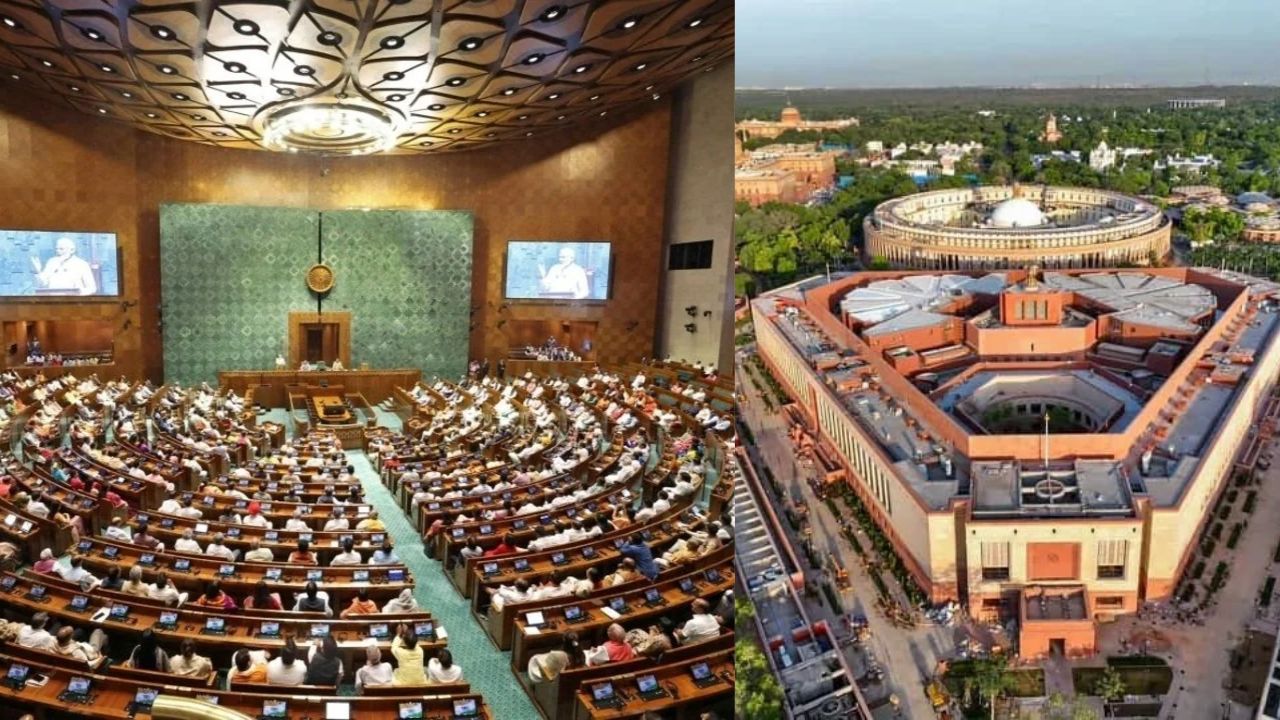
Parliament's special sitting could determine the next phase of women's reservation and Lok Sabha expansion. (Img: X)
New Delhi: The Centre is preparing a fresh legislative push to operationalise 33 per cent reservation for women in Parliament and state legislatures, alongside a major expansion of the Lok Sabha from its existing 543 elected seats to potentially 850. The proposed constitutional amendments, linked to a nationwide delimitation exercise, are expected to dominate the special sitting of Parliament beginning November 30, as the BJP-led NDA government seeks to secure the numbers required to advance the politically significant reform package.
The proposed changes could fundamentally reshape India's parliamentary representation, constituency boundaries and electoral arithmetic ahead of the 2029 Lok Sabha elections. The government's reported strategy involves increasing parliamentary representation across states while creating the legislative framework necessary to implement women's reservation.
Parliamentary Affairs Minister Kiren Rijiju has announced that the Lok Sabha will reconvene on November 30, while the Rajya Sabha will meet from December 2 to transact essential government business. Although the special sitting has been described as a one-day session in some reports, the legislative proceedings could extend over the subsequent days, with the proposed business expected to remain a major focus.
According to reports, the Union Cabinet is likely to consider the proposed Delimitation Bill on November 28. The government is also expected to explore the Constitution (131st Amendment) Bill, 2026, which could provide the constitutional basis for restructuring parliamentary representation and facilitating the implementation of the women's quota.
At the centre of the proposed legislative package is an ambitious plan to expand the strength of the Lok Sabha by approximately 50 per cent across states. Under the reported formula, the existing 543 elected parliamentary constituencies could increase to approximately 815 or 816. The proposed constitutional framework is also expected to raise the maximum permissible strength of the Lower House from 550 to 850.
The distinction between the proposed ceiling and the projected number of elected seats is significant. While 850 would constitute the maximum permissible strength under the proposed framework, the uniform 50 per cent expansion formula would translate into approximately 815-816 elected seats.
The expansion is being linked to the implementation of 33 per cent reservation for women in the Lok Sabha and state Legislative Assemblies. The proposed arrangement is intended to provide additional representational capacity while accommodating the constitutionally mandated reservation.
The exercise would require the establishment of a Delimitation Commission, an independent statutory body responsible for redrawing constituency boundaries and determining the allocation of parliamentary seats in accordance with the applicable constitutional and legislative provisions.
Delimitation is particularly consequential because it determines the geographical boundaries of constituencies, the number of representatives allocated to different regions and the demographic distribution of electoral representation.
The reported proposal also envisages freezing the number of parliamentary seats for the next 25 years, although the precise legal and constitutional provisions governing such a freeze will become clearer once the legislative text is formally placed before Parliament.
The proposed legislative intervention is expected to revive the implementation debate surrounding the 33 per cent reservation for women, which was provided for under the Constitution (106th Amendment) Act, 2023, popularly known as the Nari Shakti Vandan Adhiniyam.
The legislation provides for reserving approximately one-third of seats for women in the Lok Sabha, state Legislative Assemblies and the Delhi Legislative Assembly. However, its implementation has been linked to the completion of a subsequent census and delimitation exercise.
The government's renewed push seeks to accelerate the process and create the necessary institutional and constitutional framework to make the reservation operational ahead of the 2029 general elections.
The proposed changes could substantially alter the composition of India's elected legislatures by increasing women's participation in the lawmaking process and expanding the overall number of parliamentary constituencies.
However, the linkage between delimitation and women's reservation remains politically contentious. While there is broad political support for greater representation of women, Opposition parties have questioned the sequencing, constitutional implications and potential regional consequences of the proposed exercise.
The most contentious aspect of the proposed delimitation exercise concerns the distribution of parliamentary seats among states. Southern states, particularly Tamil Nadu, Kerala, Karnataka, Andhra Pradesh and Telangana, have expressed apprehensions that a population-based delimitation exercise could disproportionately benefit states with higher population growth.
The concern arises from the demographic divergence between southern and northern states. Several southern states have made considerable progress in population stabilisation, while some northern states continue to have substantially larger populations.
Opposition parties fear that a conventional population-based redistribution could reduce the relative parliamentary influence of southern states, potentially altering the federal balance within India's legislative architecture. To address these concerns, the government has reportedly considered a uniform 50 per cent increase in parliamentary seats across states.
According to a Press Information Bureau release dated April 16, 2026, Union Home Minister Amit Shah had explained that under the proposed 50 per cent expansion model, the combined Lok Sabha representation of southern states would increase from 129 to 195 seats, while their overall share would remain close to 24 per cent.
The proposed formula is intended to accommodate demands for greater parliamentary representation without significantly disturbing the existing inter-state distribution of political influence. Nevertheless, regional parties are seeking explicit constitutional guarantees rather than relying solely on assurances regarding the proposed allocation formula.
The Dravida Munnetra Kazhagam (DMK), which has 22 members in the Lok Sabha, has emerged as an important regional stakeholder in the government's efforts to secure support beyond the National Democratic Alliance.
The Tamil Nadu-based party has indicated that it could consider supporting the proposed legislation if the Centre provides a constitutional guarantee that the state's existing proportion of parliamentary representation will not be diluted.
The DMK has maintained that it does not oppose increasing the overall strength of the Lok Sabha. Its principal objection concerns any delimitation mechanism that could penalise states for successfully implementing population-control measures.
The party is also seeking clarity on whether the proposed uniform 50 per cent increase in parliamentary seats across states would receive explicit legislative and constitutional protection. DMK's position is particularly significant given the requirement for a special majority to pass constitutional amendments. Its 22 Lok Sabha MPs could become influential in determining the legislative outcome if the government faces resistance from other Opposition parties.
The Sharad Pawar-led Nationalist Congress Party (NCP-SP) has also emerged as a potentially important player in the evolving parliamentary negotiations. The party has eight members in the Lok Sabha and has issued a three-line whip directing all its MPs to remain present in the House during the special sitting scheduled from November 30 to December 4.
The directive, issued by Shirur MP Amol Kolhe, underlines the importance of the legislative business expected during the period and instructs members to remain present and support the party's position on matters coming up for discussion and decision.
Although the whip does not explicitly refer to the proposed delimitation legislation or direct MPs to vote in favour of the government's amendments, it has intensified speculation about the party's possible position. NCP-SP working president Supriya Sule has indicated that the party could consider supporting the proposal if the government adopts a uniform 50 per cent increase in Lok Sabha seats across all states.
She has also highlighted the growing difficulties faced by parliamentarians in effectively representing increasingly large constituencies. A substantial expansion of the Lower House, according to this line of argument, could improve representative capacity and strengthen the relationship between elected representatives and their constituents. The party's current position is noteworthy because it had opposed the government's earlier attempt to advance a delimitation-linked constitutional amendment in April.
Beyond the DMK and NCP-SP, the BJP-led government is reportedly exploring support from additional political formations to strengthen its numbers in Parliament. Breakaway factions of the Trinamool Congress and the Eknath Shinde-led Shiv Sena are among the political groups whose support could prove relevant during the legislative proceedings.
Members who separated from the Trinamool Congress have reportedly indicated their willingness to support the proposed delimitation legislation. The Shiromani Akali Dal, which has one representative in the Lok Sabha, is also among the parties whose position could attract attention.
The government's outreach reflects the importance of securing support beyond the NDA, particularly because constitutional amendments require a substantially higher threshold than ordinary legislation.
The BJP is also seeking to present the proposed expansion and women's reservation as a major institutional reform, with potential implications for electoral representation, gender participation and parliamentary governance.
The Congress and several other Opposition parties have continued to oppose the government's decision to link the implementation of women's reservation with the delimitation exercise. The Opposition has maintained that it supports the principle of reserving 33 per cent of legislative seats for women but disagrees with the proposed mechanism and the timing of its implementation.
Its principal concern is that a population-based delimitation exercise could substantially alter the distribution of parliamentary representation among states, particularly affecting southern states that have achieved significant progress in population stabilisation.
Opposition parties have also questioned the government's approach to introducing the proposed constitutional amendments and have demanded greater transparency regarding the proposed allocation formula, the methodology for constituency redistribution and the safeguards for federal representation.
The political disagreement, therefore, extends beyond the reservation of seats for women and touches upon the larger question of India's federal structure and the balance of political power between states.
The proposed expansion could also have implications for the relative strength of the two Houses of Parliament. According to an analysis by PRS Legislative Research, increasing the Lok Sabha's strength from 543 to approximately 815 while retaining the Rajya Sabha's maximum strength at 250 would alter the existing numerical relationship between the two Houses.
The Lok Sabha-to-Rajya Sabha strength ratio would increase from approximately 2.2:1 to 3.3:1. Such a change could have implications for parliamentary functioning, legislative scrutiny and the relative numerical composition of the two chambers, although their constitutional powers and functions would continue to be governed by the Constitution.
The proposed expansion would also require substantial administrative preparation, including constituency reorganisation, electoral roll adjustments, polling infrastructure expansion and logistical arrangements for conducting elections across a larger number of constituencies.
The government faces a significant parliamentary challenge in securing the required numbers for the proposed constitutional amendments. Under Article 368 of the Constitution, a Constitution amendment Bill must be passed separately by each House of Parliament with a special majority.
This requires a majority of the total membership of the House and at least two-thirds of members present and voting. The amendment must also satisfy any additional ratification requirement applicable to provisions affecting the federal structure.
Consequently, the government's existing alliance strength may not be sufficient to guarantee passage, making the positions of regional parties and smaller political formations particularly important. The DMK, NCP-SP and other regional players could therefore emerge as decisive stakeholders in the negotiations surrounding the proposed legislative package.
With the special sitting approaching, the government is expected to face scrutiny over the precise terms of the delimitation formula, the proposed seat expansion, the constitutional safeguards for states and the timeline for implementing women's reservation.
The outcome could have far-reaching consequences for India's electoral landscape, parliamentary representation and gender balance in legislative institutions ahead of the 2029 Lok Sabha elections.

