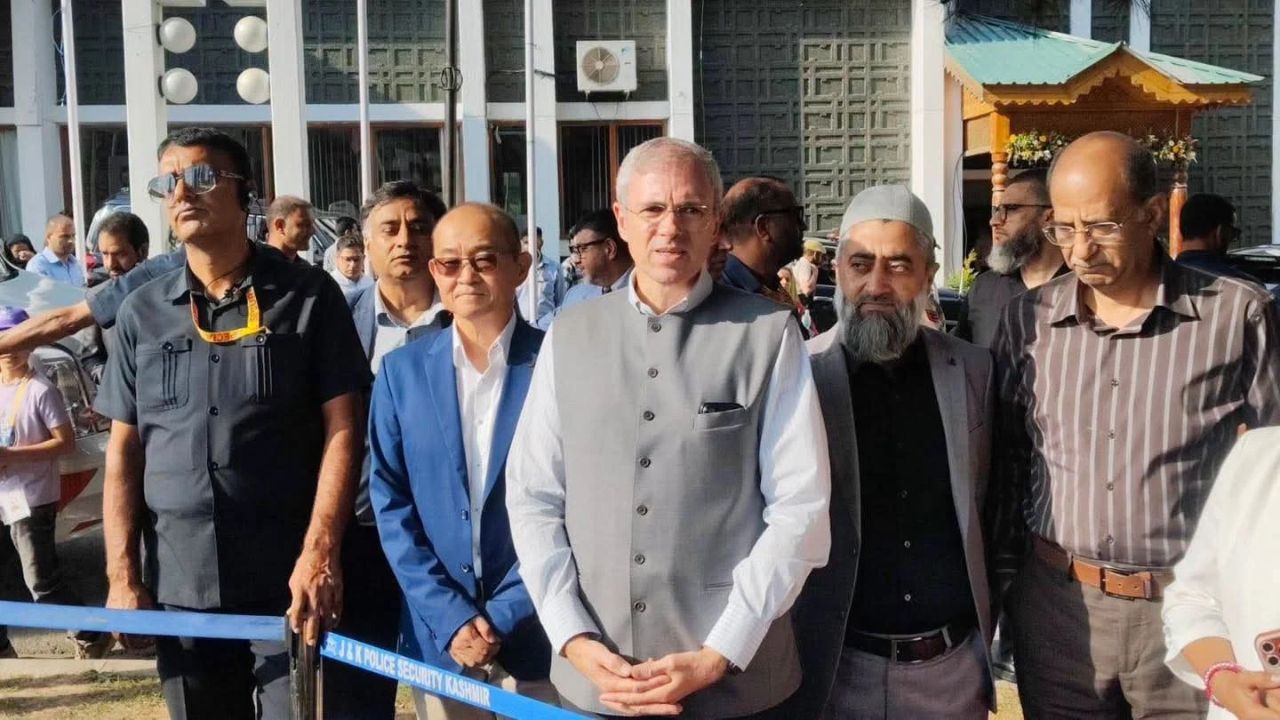
Omar Abdullah and BJP face off over Sheikh Abdullah’s legacy in J&K Assembly. (Img: Dynamite News)
Srinagar: A fresh political battle erupted in Jammu and Kashmir Assembly on Wednesday as Chief Minister Omar Abdullah challenged the BJP’s narrative on Sheikh Mohammad Abdullah’s legacy, turning a debate over a public holiday into a wider ideological confrontation over Kashmir’s political history.
The face-off between the National Conference and BJP has brought historical narratives, regional identity and the legacy of Kashmir’s prominent political figures back to the centre of political discourse, with both sides defending their contrasting interpretations of the region’s past.
The controversy unfolded during an Assembly debate after BJP Leader of Opposition Sunil Sharma raised questions over the political legacy and historical role of Sheikh Mohammad Abdullah, the founder of the National Conference.
The remarks triggered a strong political response from Chief Minister Omar Abdullah, who positioned Sheikh Abdullah as a central figure in Jammu and Kashmir’s political evolution and defended the sacrifices associated with the National Conference movement.
Omar Abdullah argued that the contribution of Sheikh Abdullah, popularly known as Sher-e-Kashmir, remains deeply embedded in the political history of the region and cannot be removed from public memory.
The Chief Minister accused the BJP of attempting to reshape historical narratives according to contemporary political positions and said that differing ideological viewpoints should not erase established historical developments.
The latest political clash is rooted in the controversy surrounding public holidays linked to historical figures of Jammu and Kashmir. The administration’s decision to recognise Maharaja Hari Singh’s birth anniversary as a public holiday while discontinuing the holiday associated with Sheikh Mohammad Abdullah’s birth anniversary triggered a strong reaction from the National Conference.
The party demanded restoration of Sheikh Abdullah’s holiday, arguing that his role in Jammu and Kashmir’s political journey deserved continued recognition. The BJP opposed the demand, maintaining a different position on historical recognition and highlighting the importance of other figures associated with Jammu and Kashmir’s history.
The dispute has now evolved beyond a symbolic holiday issue, becoming part of a larger political contest over historical representation, identity politics and ideological positioning in the Union Territory.
During his response, Omar Abdullah expanded the debate by questioning the BJP’s interpretation of history and referring to discussions surrounding the role of the Rashtriya Swayamsevak Sangh and organisations linked to the BJP’s ideological lineage during the freedom movement.
His remarks reflected the broader political argument over competing versions of India’s historical journey and the role of different organisations and leaders during crucial phases of the national movement.
The Chief Minister maintained that the sacrifices made by the National Conference and the political contribution of Sheikh Abdullah remain significant chapters in Jammu and Kashmir’s history.
The BJP, however, has consistently presented its own interpretation of historical events and has emphasised different personalities and movements while discussing the political evolution of the region.
The Assembly confrontation highlights a long-running ideological divide between the BJP and National Conference over how Jammu and Kashmir’s political history should be remembered and interpreted.
For the National Conference, Sheikh Mohammad Abdullah represents a key figure in the region’s political transformation and its struggle for political representation.
The BJP has often questioned certain aspects of Sheikh Abdullah’s political decisions and has sought greater recognition for other historical personalities, including Maharaja Hari Singh.
The latest exchange demonstrates how historical memory continues to influence political messaging in Jammu and Kashmir, where questions of identity, governance and regional aspirations remain closely connected.
The confrontation carries significance beyond the Assembly floor as historical narratives remain an important instrument of political mobilisation in Jammu and Kashmir.
For the National Conference, defending Sheikh Abdullah’s legacy is linked to preserving its political heritage and ideological foundation. For the BJP, debates around historical figures form part of a broader effort to revisit and reinterpret political narratives associated with Jammu and Kashmir.
The latest dispute reflects the continuing contest over symbolism, public recognition and the ownership of historical narratives in the Union Territory.

