Indian Army para warriors transform injuries into medals with unmatched determination
New Delhi: The battlefield may have changed, but the fighting spirit of the Indian Army’s wounded soldiers remains undiminished. From military operations to the sporting arena, a growing group of Army personnel and veterans are redefining the meaning of rehabilitation by taking up para sports and competing at the highest level.
For these soldiers, the journey from injury to the podium has become a story of military discipline, mental fortitude and an unwavering commitment to the national flag.
Their sporting careers have emerged from circumstances that could have ended their professional journeys. Instead, injury has become the starting point of another mission.
The Army’s specialised para-sports ecosystem has played a crucial role in this transition, particularly through structured rehabilitation and high-performance training. The approach seeks to move beyond conventional recovery, enabling injured personnel to regain physical confidence while preparing them for elite competition.
The philosophy is unmistakably military: an altered physical condition does not automatically mean the end of an individual’s contribution.
Among the soldiers who have demonstrated this most strikingly is Subedar Soman Rana. A former boxer, Rana sustained a severe injury in a landmine incident during his military career and lost his left leg. Rather than allowing the injury to bring his sporting aspirations to a close, he redirected his competitive instincts towards para athletics.
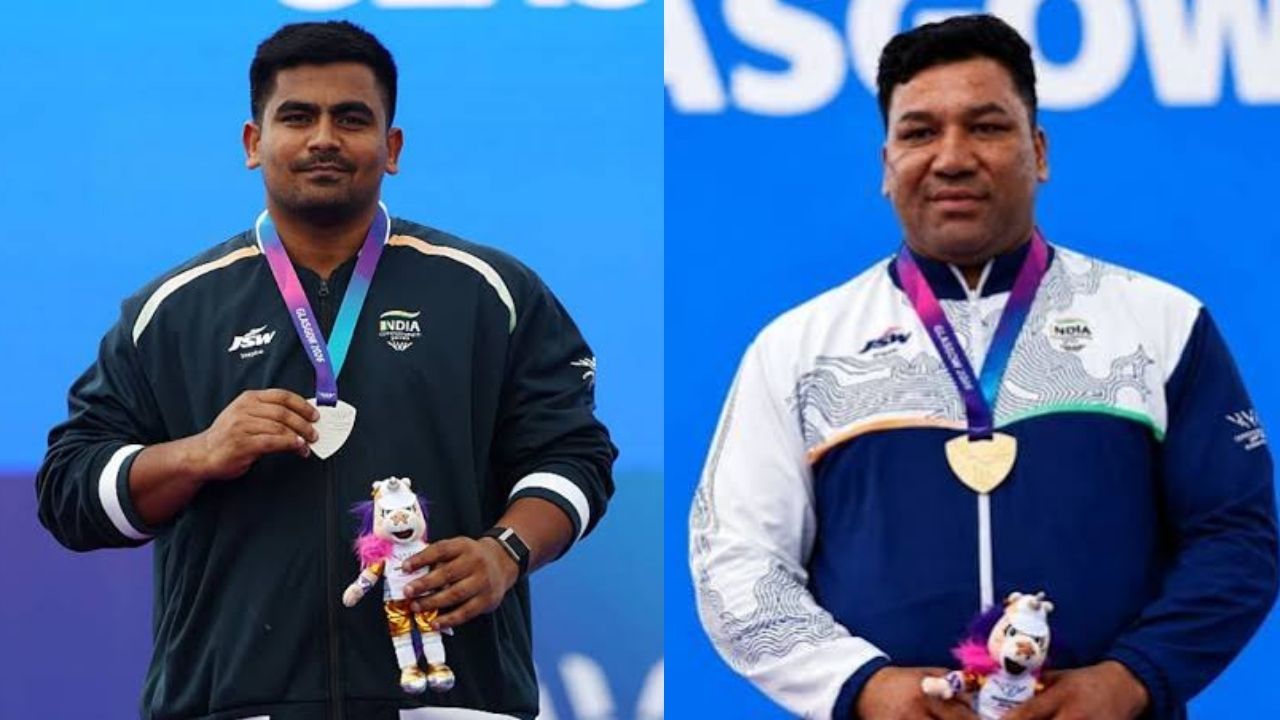
He eventually took up seated shot put and went on to establish himself as a formidable competitor. His gold medal in the F57 shot put at the 2026 Commonwealth Games in Glasgow represented the culmination of years of rehabilitation, conditioning and uncompromising training.
The achievement became even more significant when Shubham Juyal, another athlete associated with the Army’s para-sports ecosystem, secured silver in the same event.
Juyal’s own journey began after a motorcycle accident resulted in the loss of his leg and disrupted his ambition of joining the Army. Para sport subsequently provided him with a new avenue to pursue competitive excellence. His 13.28-metre effort in Glasgow earned him the silver medal and produced a memorable Indian one-two in the event.
The performances of Rana and Juyal underline a larger transformation taking place within military rehabilitation.
For an injured soldier, recovery is not simply about learning to walk again or adapting to a prosthetic limb. The psychological battle can be equally formidable. The sudden disruption of an active military career can leave a vacuum of purpose, identity and direction.
Sport can fill that vacuum with a new mission. Training brings structure back into everyday life. Competition creates measurable objectives. The discipline of repeated practice restores confidence. And representing India provides a renewed sense of service.
This convergence between military ethos and sporting excellence has made the Army a significant contributor to India’s expanding para-sport movement.
The similarities between military training and elite sport are striking. Both demand physical conditioning, psychological preparedness, technical precision and the ability to function under intense pressure. Both require individuals to trust their training when the decisive moment arrives.
For para-athletes with a military background, these attributes often become critical competitive assets.
The sporting arena may not have the uncertainty of a battlefield, but it demands its own form of courage. An athlete must confront physical limitations, competitive pressure and the possibility of failure repeatedly.
For an injured soldier, stepping into that arena can itself represent a declaration of resilience.
The Army’s investment in para sport has consequently acquired significance beyond medals and records. It reflects an evolving understanding of rehabilitation in which wounded personnel are encouraged not merely to adapt to their circumstances but to pursue excellence despite them.
Recent performances have demonstrated the potential of this approach. At the 2026 World Para Athletics Grand Prix in New Delhi, Army athletes delivered a strong showing, collecting three gold, six silver and two bronze medals while also recording six personal bests.
Such results indicate that military para sport is moving steadily from rehabilitation towards high-performance competition.
The development also carries a powerful message for soldiers recovering from serious injuries. An injury can alter a military career. It need not erase ambition. A lost limb can change mobility. It need not diminish identity. A uniform may eventually be replaced by sporting attire. The commitment to the nation can remain exactly the same.
This is perhaps what distinguishes Army para-athletes from conventional sporting narratives. Their achievements are rooted in a culture where endurance is not merely admired but trained, where discipline is institutionalised and where setbacks are treated as challenges to be overcome rather than reasons to retreat.
Their sporting equipment may differ from the weapons they once carried. Their battlefield may now be a stadium. Their operational objective may be a qualifying mark, a medal or a record.
But the fundamental principle remains unchanged: prepare thoroughly, remain focused and complete the mission.
The success of these athletes also demonstrates why para sport should be viewed through the prism of capability rather than limitation. Their stories are not defined by what injury took away from them, but by what determination enabled them to build afterwards.
For the Indian Army, every such medal represents more than a place on a podium. It is evidence that the institution can continue to provide its wounded personnel with avenues for purpose, achievement and national service. And for the athletes themselves, every competition is another deployment of sorts.
There is no battlefield smoke, no combat gear and no military convoy. There is instead a track, a throwing circle, a wheelchair, a prosthetic limb and thousands of spectators. Yet when the national flag rises after victory, the symbolism is unmistakable. The soldier has found another front. And once again, he has chosen to fight.

