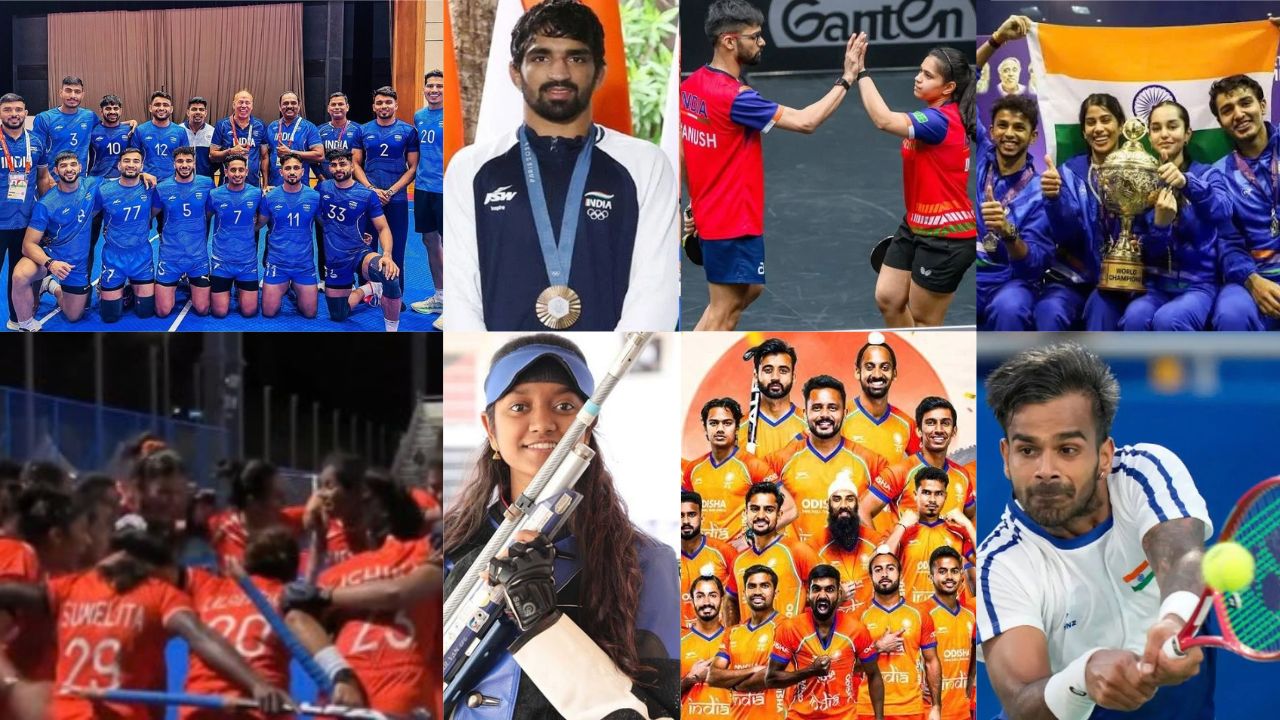
India celebrates an 85-medal Asian Games campaign highlighted by historic gold medals and landmark performances. (Img: X)
Aichi-Nagoya: India concluded its Asian Games 2026 campaign in fourth place with 85 medals, including 21 gold, 27 silver and 37 bronze, in a competition that produced historic triumphs, breakthrough performances and a few unexpected setbacks.
The medal haul fell short of India’s record-breaking 106-medal performance at Hangzhou in 2023, when the country won 28 gold, 38 silver and 40 bronze medals. However, the Aichi-Nagoya Games delivered several landmark moments that could have a lasting impact on the country’s sporting ambitions ahead of the Los Angeles 2028 Olympics.
Around 500 Indian athletes competed across 20th edition of the Asian Games, with the campaign producing success in traditional strongholds such as shooting, athletics, hockey and wrestling, while newer disciplines also brought historic medals.
## India’s historic gold-medal moments
Archery emerged as one of the brightest chapters of India’s campaign, with the country securing five gold medals. India dominated the compound events through its men’s and women’s teams and the mixed compound team, while the women’s recurve team also created history.
Seventeen-year-old Kumkum Mohod became one of the biggest stories of the Games after winning individual recurve gold. She became the first Indian woman to claim an individual recurve title at the Asian Games.
Mohod also contributed to India’s silver medal in mixed recurve alongside Dhiraj Bommadevara. The women’s recurve team featuring Mohod, Ankita Bhakat and Kirti Sharma became the first Indian women’s team to win the Asian Games recurve title.
The archery campaign also carried significance beyond the medal table, with India securing Olympic qualification opportunities in the compound mixed team and women’s individual recurve events.
## Women’s hockey ends a 44-year wait
Indian hockey produced one of the most emotional moments of the Games as the women’s team finally reclaimed Asian Games gold after a 44-year wait.
The achievement restored India’s position at the top of Asian women’s hockey and also secured Olympic qualification for Los Angeles 2028.
The men’s hockey team added another gold medal by defeating Malaysia 5-1, successfully defending its Asian Games title and securing another Olympic qualification spot.
The double hockey success became one of the defining achievements of India’s campaign.
## Cricket delivers another double gold
India retained both its Asian Games cricket titles.
The women’s team successfully defended its gold medal after defeating Sri Lanka, while the men’s team also secured gold by beating Pakistan by 19 runs in a high-profile final.
The men’s final attracted considerable attention because of the India-Pakistan rivalry. Abhishek Sharma and Tilak Varma played crucial unbeaten knocks of 51 to guide India to victory.
The two cricket golds strengthened India’s dominance in the format at the continental level and added another major success to the medal tally.
## Boxing produces three gold medals
India’s boxing contingent delivered three gold medals, led by Lovlina Borgohain, Parveen Hooda and Ankush Panghal.
Borgohain created a significant piece of history by becoming only the second Indian woman after Mary Kom, who achieved the feat at the 2014 Incheon Asian Games, to win an Asian Games boxing gold medal.
The results also highlighted the depth developing within Indian boxing across both established and emerging weight categories.
## Wrestling produces comeback stories
Wrestling contributed two gold medals through Aman Sehrawat and Sujeet Kalkal.
Sehrawat’s triumph carried particular significance after a difficult period following the Paris Olympics. His return to the top after illness, setbacks and a period of diminished motivation added a strong human dimension to his gold-medal performance.
Antim Panghal won silver, while Deepak Punia secured bronze, giving India a competitive presence across multiple wrestling categories.
## Pranavi Urs makes golf history
Golf delivered another landmark moment when Pranavi Urs became the first Indian woman to win an individual Asian Games golf gold medal.
India also secured a women’s team silver, while Neeraj Chauhan won bronze, further strengthening the country’s presence in a sport where Asian Games success has traditionally been limited.
Urs’ victory stood out as one of the Games’ most significant breakthroughs for Indian women’s sport.
## Athletics becomes India’s biggest medal contributor
Athletics remained India’s largest contributor to the overall medal tally, producing 24 medals.
However, the discipline had a striking imbalance: only one of those medals was gold.
Several athletes nevertheless created memorable moments. Vithya Ramraj won bronze in the women’s 400m hurdles while breaking a national record that had stood for 42 years.
Sawan Barwal created history by becoming the first Indian athlete since 1982 to win an Asian Games marathon medal. He also set a national record.
Sarvesh Kushare ended a 56-year wait for India in the men’s high jump by winning a medal, while Baranica Elangovan became the first Indian pole vaulter to win an Asian Games medal.
Yash Vir Singh won silver in men’s javelin, while Rohit Yadav added bronze. The performances assumed greater importance in the absence of Neeraj Chopra, who missed the Games because of injury.
## Shooting recovers after a slow beginning
Shooting contributed 15 medals, including three golds, although India’s campaign began with several near-misses and fourth-place finishes.
Suruchi Singh and Kamaljeet provided breakthrough gold-medal performances as the shooting contingent recovered strongly during the competition.
Tilottama Sen finished fourth in the women’s 50m rifle 3P individual event, while Vidarsa Vinod finished fifth, underlining the narrow margins separating medal-winning performances from near misses.
## Kabaddi maintains its dominance
India retained both its men’s and women’s Asian Games kabaddi titles.
The double triumph reinforced the country’s long-standing strength in the sport and ensured that kabaddi once again became an important contributor to India’s gold-medal count.
## Historic firsts across multiple sports
Beyond the headline gold medals, the Aichi-Nagoya Games produced several significant firsts for India.
Suchika Tariyal became the first Indian to win an Asian Games medal in mixed martial arts, while Jay Meena secured India’s first Asian Games medal in soft tennis.
Mirabai Chanu won silver in the women’s 49kg weightlifting category, giving India its first Asian Games weightlifting medal since the 1998 Bangkok Games.
Roshibina Devi continued her remarkable continental record by securing her third consecutive Asian Games medal in wushu.
Seema Kumari ended a 16-year wait for India in the women’s 10,000m event, while squash produced singles silver medals through Anahat Singh and Abhay Singh after both fell short in their respective finals.
These results demonstrated that India’s medal base is gradually expanding beyond its traditional sporting strengths.
## Tennis suffers a historic setback
The campaign was not without major disappointments.
India failed to win a tennis medal at the Asian Games for the first time in four decades.
Sumit Nagal’s quarter-final defeat to China’s Wu Yibing, 4-6, 4-6, ended India’s hopes in men’s singles and highlighted one of the most surprising gaps in an otherwise successful campaign.
India’s last Asian Games tennis medal had come in 1986, making the Aichi-Nagoya result particularly notable.
## Badminton falls below expectations
Badminton also produced a disappointing return, with India winning only one medal — bronze in the men’s team event.
Given India’s growing stature in international badminton, the limited medal haul was below expectations.
The campaign also raised concerns around scheduling, accommodation and tournament organisation, adding another layer to India’s mixed experience in the sport.
## Several disciplines miss the podium
India failed to win medals in equestrian, fencing, volleyball and esports.
Table tennis produced one bronze, while rowing also contributed a bronze.
The results highlighted the uneven nature of India’s medal performance across disciplines and the continuing need to broaden the country’s competitive depth ahead of major multi-sport events.
## A strong finish lifts India to 85 medals
India produced a powerful finish to the Games.
The penultimate day alone brought nine medals, including golds in cricket, hockey, wrestling, archery and golf. On the final major day of competition, India added 12 medals, including six golds, with boxing playing a particularly important role.
The late surge helped India finish with 21 gold medals and 85 medals overall.
Although the final tally remained below the record 106 medals won in Hangzhou, India still recorded its second-highest medal total in Asian Games history.
## What the 85-medal campaign means for India
The Aichi-Nagoya campaign offered a picture that was more complex than the final medal table suggested.
India continued to dominate in sports such as hockey, cricket, kabaddi and shooting while making major breakthroughs in archery, golf, wrestling and several emerging disciplines.
At the same time, the absence of medals in tennis and the limited return from badminton and some other established sports exposed areas that require renewed attention.
The emergence of young athletes such as Kumkum Mohod also offers an important glimpse into the next generation of Indian sporting talent.
## The road to Los Angeles 2028
The Asian Games were not only about medals. Several events also carried direct significance for India’s Olympic preparations.
Archery, hockey, sailing, squash, surfing, tennis and triathlon offered Olympic qualification opportunities during the Games.
India secured important qualification opportunities through men’s and women’s hockey, along with archery in the compound mixed team and women’s individual recurve categories.
These gains could prove crucial as India builds towards the Los Angeles 2028 Olympics.
India leaves Aichi-Nagoya with 85 medals, 21 golds and a collection of performances that combined established dominance with remarkable new breakthroughs.
The 44-year wait for women’s hockey gold ended. A teenager made archery history. Cricket delivered another double triumph. Boxing, wrestling and golf produced landmark victories, while athletics once again emerged as the country’s biggest medal contributor.
There were also warning signs, particularly in tennis and badminton.
Ultimately, India’s Asian Games 2026 campaign was defined not merely by the number 85, but by the changing breadth of Indian sport — and by a new generation of athletes beginning to reshape the country’s ambitions for Los Angeles 2028 and beyond.

