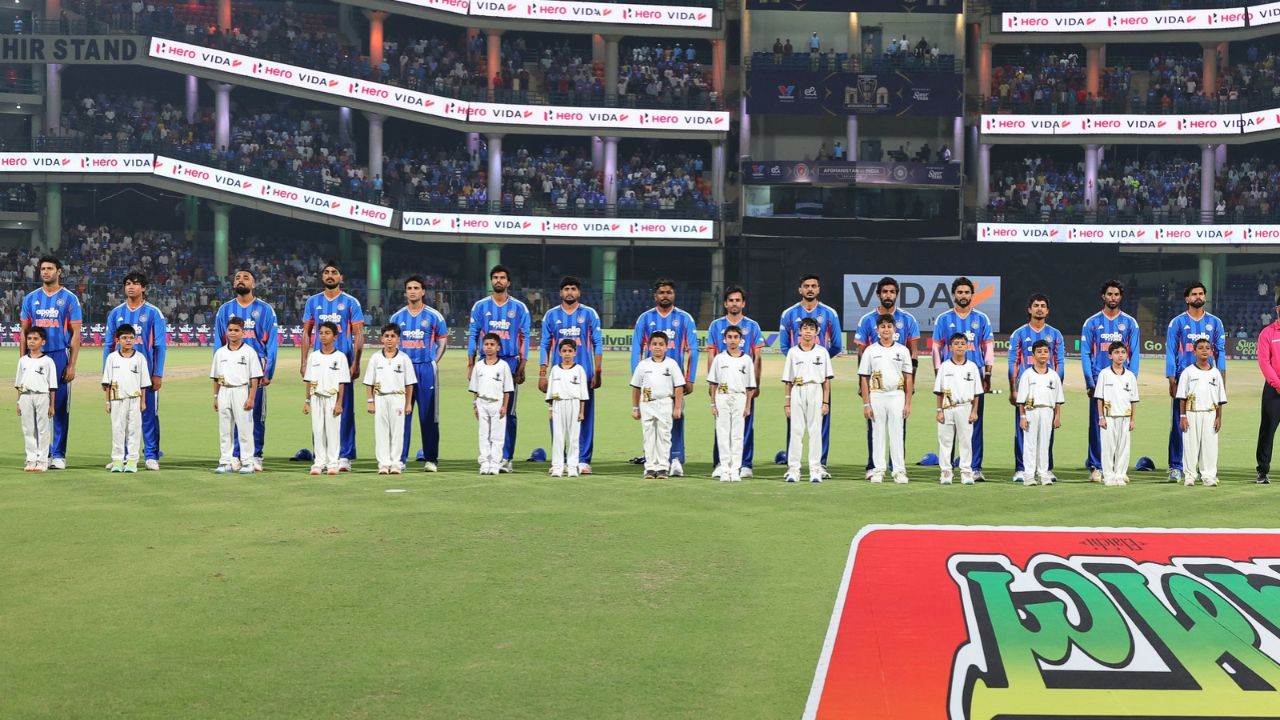
Indian players stand during the historic Vande Mataram ceremony before India Afghanistan T20I. (Img: BCCI)
New Delhi: A new chapter was added to Indian cricket history when Vande Mataram was played before Jana Gana Mana ahead of the first T20 International between India and Afghanistan at the Arun Jaitley Stadium. For the first time in an international cricket match involving India, the national song was performed before the national anthem, creating a unique pre-match atmosphere as players from both teams stood on the field.
The complete six-stanza rendition of Vande Mataram was played before Jana Gana Mana, followed by Afghanistan’s national anthem ahead of the opening match of the three-game T20I series. The unusual sequence immediately caught the attention of cricket fans, political observers and social media users, making the Delhi encounter significant beyond the cricketing contest.
The historic ceremony was later followed by India’s dominant performance, with the team defeating Afghanistan by seven wickets to begin the series on a winning note.
Normally, international cricket matches begin with the national anthems of the participating countries before the first ball is bowled. However, the India Afghanistan T20I witnessed a different protocol as Vande Mataram was performed first, followed by Jana Gana Mana.
The moment became historic because it was the first instance where India’s national song was played before the national anthem at an international cricket fixture.
The ceremony added national significance to an already anticipated cricket contest, which featured major talking points including team selection, player combinations and the return of key Indian players.
The event quickly became one of the most discussed moments from the match, with clips from the stadium ceremony circulating widely across social media platforms.
The sequence followed the guidelines issued by the Ministry of Home Affairs regarding the official rendition of Vande Mataram. The ministry had established protocols stating that whenever both the national song and the national anthem are performed together, Vande Mataram should be played before Jana Gana Mana.
The complete official version of Vande Mataram includes all six stanzas and takes approximately three minutes and 10 seconds for completion. The guidelines were introduced during the 150th anniversary celebrations of Vande Mataram, highlighting the historical importance of the composition and its role in India’s freedom movement.
Although the guidelines primarily focused on official functions and government occasions, the India Afghanistan T20I became the first major international sporting event where the sequence was followed.
Written by Bankim Chandra Chattopadhyay in the 1870s, Vande Mataram was first published in his Bengali novel Anandamath in 1882. The song became one of the most powerful symbols of India’s independence movement and inspired generations during the freedom struggle.
After independence, the first two stanzas of Vande Mataram were officially recognised as India’s National Song in 1950, while Jana Gana Mana was adopted as the National Anthem.
Over decades, Vande Mataram has remained an important part of national celebrations, cultural events and patriotic occasions across India. The latest development has brought renewed attention to its historical legacy, official protocols and role in modern public events.
The memorable ceremony took place before the opening match of the India Afghanistan three-match T20I series at the Arun Jaitley Stadium. After the national song and anthems, the cricket action began with India captain Shreyas Iyer winning the toss and deciding to bowl first.
India included Jasprit Bumrah in the playing XI as he returned to T20 international cricket, while young batter Vaibhav Sooryavanshi missed out despite impressive performances in previous matches.
Afghanistan entered the contest with experienced campaigners including Ibrahim Zadran, Rashid Khan, Mohammad Nabi and Mujeeb Ur Rahman. Although the series is being played in India, Afghanistan are officially designated as the hosts of the bilateral T20I series.
The historic evening at Arun Jaitley Stadium ended with another major highlight as India defeated Afghanistan by seven wickets in the opening T20I. Chasing a target of 157 runs, India completed the run chase in just 13.4 overs, producing a dominant batting display.
Young opener Abhishek Sharma was the star performer for India, smashing an explosive 82 runs from just 32 deliveries. His aggressive stroke play and fearless approach completely changed the momentum of the match. Abhishek’s match-winning innings helped India cross the target with 38 balls remaining and provided a memorable start to the three-match series.
Earlier, Afghanistan managed to score 156 runs for the loss of eight wickets in their allotted 20 overs. India’s decision to bowl first after winning the toss proved effective as the bowling attack controlled Afghanistan’s scoring rate throughout the innings.
Left-arm pacer Arshdeep Singh delivered a crucial performance, claiming three wickets and preventing Afghanistan from accelerating during the middle and final overs. India’s disciplined bowling effort ensured Afghanistan could not post a challenging total despite having experienced players in their lineup.
The victory further strengthened India’s impressive record against Afghanistan across formats. India have traditionally maintained an upper hand in their contests, and the conditions at the Arun Jaitley Stadium once again suited their style of aggressive cricket.
The Delhi pitch offered excellent batting conditions with shorter boundaries and a flat surface, allowing stroke-makers to play attacking shots. India used the conditions perfectly, combining explosive batting with controlled bowling to register a comprehensive victory.
The Vande Mataram ceremony highlighted the growing connection between sports, national identity and public events. Cricket in India has always carried emotional and cultural significance, with major matches often becoming moments of national attention.
The historic sequence at Arun Jaitley Stadium created a moment beyond the scoreboard, generating conversations about tradition, protocol and patriotism. The combination of a historic ceremony and India’s emphatic victory made the opening T20I one of the most talked-about cricket events.
The India Afghanistan T20I ceremony could influence how national symbols are presented at future sporting events. As celebrations around Vande Mataram’s 150th anniversary continue, similar discussions around its official rendition and public appearances are expected to remain active.
The Delhi event has opened a wider conversation about balancing sporting traditions with national ceremonies in modern India. Future international sporting events may witness closer attention to protocols involving national symbols and ceremonial practices.
Meanwhile, the India Afghanistan T20I series will continue to remain in focus for cricket performances, emerging players and the historic moment that marked its beginning.

