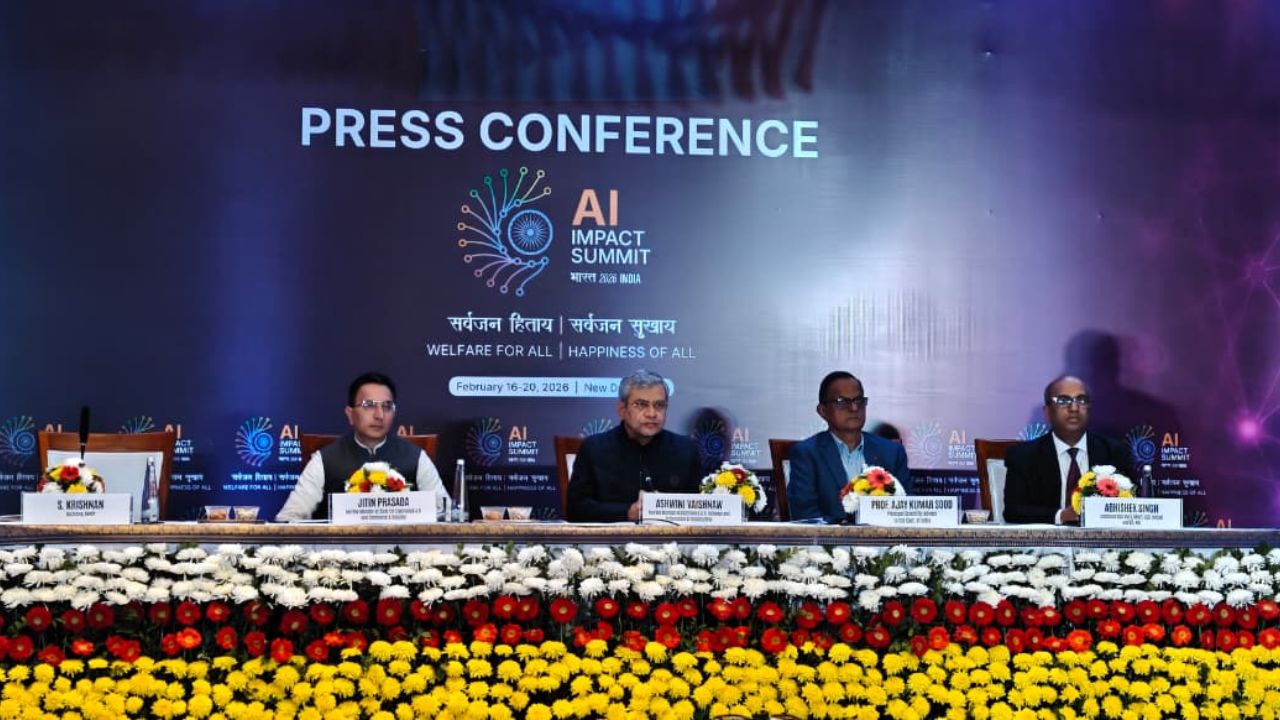
At a curtain-raiser for the India AI Impact Summit 2026, Union Minister Ashwini Vaishnaw outlined India’s full-stack AI strategy, talent expansion plans, global partnerships, and job creation goals, as Prime Minister Narendra Modi is set to preside over the summit on February 19.

New Delhi: Union Minister for Electronics and Information Technology Ashwini Vaishnaw on Friday chaired a curtain-raiser press conference for the India AI Impact Summit 2026 at the Oberoi Hotel in New Delhi, outlining India’s long-term, methodical strategy to emerge as a major global force in artificial intelligence.
The briefing set the stage for the upcoming summit and brought together senior government officials, industry stakeholders, and media representatives to highlight India’s expanding role in the global AI ecosystem.
Addressing the media, Vaishnaw announced that the India AI Summit will be held on February 16 and will be presided over by Prime Minister Narendra Modi on February 19. The event will see participation from representatives of several countries, global CEOs, and ministers. A high-level CEO roundtable is also scheduled on the same day, underscoring the summit’s international importance.
The minister said more than 100 CEOs from across the world are expected to participate in the summit, reflecting India’s growing influence in shaping global AI conversations. He added that some AI models have already been demonstrated to the Prime Minister and will be showcased during the summit.
Vaishnaw highlighted the government’s focus on building a strong domestic talent pipeline. “We currently have 300 laboratories where students are developing chips. This will now be expanded to 500 universities, creating a massive talent pipeline for the AI industry,” he said, stressing the importance of semiconductor and AI hardware capabilities.
The minister also pointed to AI Kosh, a common platform where nearly 7,000 non-personal, anonymised datasets related to geography and weather have been uploaded. The platform will be accessible to students and researchers, enabling innovation while maintaining data privacy.
Addressing concerns around job losses, Vaishnaw said AI adoption has instead boosted employment. “India’s IT industry has leveraged AI effectively to create jobs. Around 33 percent of jobs have been generated due to AI adoption,” he noted.
Responding to a question from Dynamite News on whether India is engaging with middle powers like Japan, Singapore, and Switzerland to avoid over-dependence on the US or China for critical AI components, Vaishnaw emphasised India’s comprehensive strategy.
“We have to work on each and every layer of the AI stack. India today is one of the most important countries in the AI ecosystem, and we cannot afford to leave out any layer,” he said.
He added that India’s progress is being globally recognised and is following a step-by-step, methodical path, with a clear focus on building strong capabilities in at least two of the five layers of the AI value chain.
The curtain-raiser made it clear that India’s AI vision is not about selective partnerships or geopolitical dependence, but about building end-to-end capabilities — from talent and data to hardware and AI models — positioning India as a reliable and indispensable global AI player.
New Delhi: Union Minister for Electronics and Information Technology Ashwini Vaishnaw on Friday chaired a curtain-raiser press conference for the India AI Impact Summit 2026 at the Oberoi Hotel in New Delhi, outlining India’s long-term, methodical strategy to emerge as a major global force in artificial intelligence.
The briefing set the stage for the upcoming summit and brought together senior government officials, industry stakeholders, and media representatives to highlight India’s expanding role in the global AI ecosystem.
Addressing the media, Vaishnaw announced that the India AI Summit will be held on February 16 and will be presided over by Prime Minister Narendra Modi on February 19. The event will see participation from representatives of several countries, global CEOs, and ministers. A high-level CEO roundtable is also scheduled on the same day, underscoring the summit’s international importance.
The minister said more than 100 CEOs from across the world are expected to participate in the summit, reflecting India’s growing influence in shaping global AI conversations. He added that some AI models have already been demonstrated to the Prime Minister and will be showcased during the summit.
Vaishnaw highlighted the government’s focus on building a strong domestic talent pipeline. “We currently have 300 laboratories where students are developing chips. This will now be expanded to 500 universities, creating a massive talent pipeline for the AI industry,” he said, stressing the importance of semiconductor and AI hardware capabilities.
The minister also pointed to AI Kosh, a common platform where nearly 7,000 non-personal, anonymised datasets related to geography and weather have been uploaded. The platform will be accessible to students and researchers, enabling innovation while maintaining data privacy.
Addressing concerns around job losses, Vaishnaw said AI adoption has instead boosted employment. “India’s IT industry has leveraged AI effectively to create jobs. Around 33 percent of jobs have been generated due to AI adoption,” he noted.
Responding to a question from Dynamite News on whether India is engaging with middle powers like Japan, Singapore, and Switzerland to avoid over-dependence on the US or China for critical AI components, Vaishnaw emphasised India’s comprehensive strategy.
“We have to work on each and every layer of the AI stack. India today is one of the most important countries in the AI ecosystem, and we cannot afford to leave out any layer,” he said.
He added that India’s progress is being globally recognised and is following a step-by-step, methodical path, with a clear focus on building strong capabilities in at least two of the five layers of the AI value chain.
The curtain-raiser made it clear that India’s AI vision is not about selective partnerships or geopolitical dependence, but about building end-to-end capabilities — from talent and data to hardware and AI models — positioning India as a reliable and indispensable global AI player.
No related posts found.