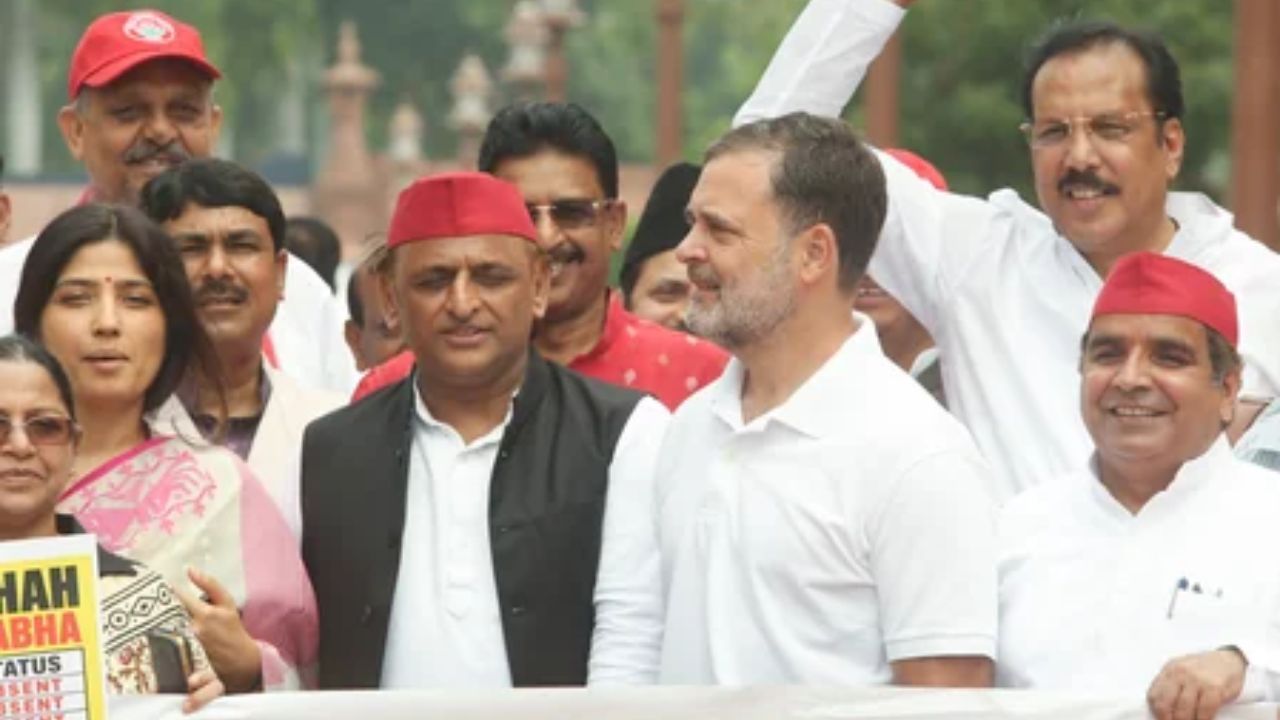
Akhilesh Yadav escalates his attack on the BJP's proposed delimitation exercise ahead of Parliament's special session. (Img: IANS)
New Delhi: The political confrontation over the proposed delimitation exercise has intensified ahead of Parliament's special sitting, with Samajwadi Party (SP) president Akhilesh Yadav launching a sharp attack on the BJP-led Union government and warning that the proposed legislation could become the biggest political mistake in the ruling party's history.
The former Uttar Pradesh Chief Minister's criticism comes amid mounting opposition resistance to the Centre's proposed delimitation-linked constitutional amendment, which could expand the strength of the Lok Sabha from 543 to as many as 850 members and pave the way for implementing 33 per cent women's reservation in Parliament and state legislative assemblies ahead of the 2029 general elections.
In a post on social media platform X on Friday, Akhilesh described the proposed delimitation exercise as a potentially disastrous political move for the BJP. His intervention has added momentum to the opposition's campaign against the proposed restructuring of parliamentary constituencies, with several parties questioning the government's intentions and the possible consequences for India's federal structure.
The controversy has escalated just days before Parliament reconvenes for a special four-day sitting from November 30 to December 3. The government has described the session as necessary for essential legislative business, although the possibility of reintroducing the delimitation-linked women's reservation legislation has become the principal focus of political speculation.
The constitutional amendment requires a special majority of Parliament, making the government's numerical strength particularly important. The Lok Sabha has an authorised strength of 543 elected seats, but three seats are currently vacant, bringing its effective membership to 540.
For a constitutional amendment requiring support from at least two-thirds of the total membership, the government would need 361 votes if calculated against the full sanctioned strength, while 360 would be required on the current effective membership.
The NDA is estimated to have approximately 320-322 MPs, leaving the ruling alliance dependent on additional support from outside its traditional coalition. The government's position has reportedly improved since its earlier legislative setback in April 2026, with 26 MPs moving away from opposition formations.
According to the political realignment described in the reports, 20 Trinamool Congress MPs broke away and merged with the Nationalist Citizens Party of India (NCPI), pledging support to the NDA. Another six Shiv Sena (UBT) MPs joined the Eknath Shinde-led Shiv Sena.
Despite these developments, the BJP-led government still needs additional parliamentary backing to cross the constitutional threshold. The DMK, with 22 Lok Sabha MPs, and the Nationalist Congress Party (Sharadchandra Pawar), with eight MPs, could therefore become influential players in the evolving political negotiations.
The YSR Congress Party (YSRCP) is also reportedly considering supporting the legislation, provided the proposed framework ensures adequate regional balance. However, none of these potential support arrangements should be treated as confirmed commitments until the respective parties announce their final positions.
Delimitation involves the redrawing of electoral constituency boundaries and the allocation of legislative representation based on constitutional and statutory provisions. The exercise is particularly sensitive because it determines how political representation is distributed across states and constituencies.
The existing freeze on inter-state allocation of Lok Sabha seats is linked to constitutional provisions based on the 1971 Census framework. The freeze on readjustment of seats among states is scheduled to operate until the relevant population figures from the first Census conducted after 2026 become available, subject to the applicable constitutional framework.
Several southern states, including Tamil Nadu, have argued that population-based redistribution should not penalise them for successful family-planning and population-stabilisation policies. The Centre's proposed framework has included assurances of a uniform increase in parliamentary seats across states. However, regional parties have demanded that such assurances be incorporated into the legislation itself rather than remaining political commitments.
The proposed expansion of the Lok Sabha to a maximum of 850 seats would represent a major restructuring of India's parliamentary architecture and could have far-reaching consequences for national electoral politics.
The Lok Sabha Secretariat has announced that the second part of the eighth session of the 18th Lok Sabha will commence on November 30 and is expected to conclude on December 3, depending on government business. The sitting will be an extension of the Monsoon Session, which concluded on August 13 after both Houses were adjourned sine die without being prorogued.
Union Parliamentary Affairs Minister Kiren Rijiju confirmed that the government had requested the Lok Sabha Speaker and Rajya Sabha Chairman to reconvene the respective Houses to transact essential government business. The Lok Sabha is scheduled to meet from November 30, while the Rajya Sabha is expected to reconvene on December 2.
The Union Cabinet is also scheduled to meet on Friday, November 27, with sources indicating that the proposed delimitation-linked women's reservation legislation could feature in the discussions. Although the government has not officially disclosed the complete legislative agenda, speculation surrounding the introduction of the proposed constitutional amendment has intensified.
Opposition parties are also expected to raise the issue of Special Intensive Revision of electoral rolls and demand accountability from Chief Election Commissioner Gyanesh Kumar, potentially setting the stage for confrontational proceedings.
The latest political developments follow the defeat of the Constitution (131st Amendment) Bill, 2026, during an earlier special parliamentary sitting in April. The proposed legislation failed to secure the constitutionally mandated two-thirds majority, exposing the BJP-led government's difficulties in obtaining sufficient support for a major constitutional restructuring.
Prime Minister Narendra Modi subsequently criticised the opposition for blocking the legislation and reiterated his government's commitment to ensuring women's representation in elected institutions.
In a signed article published in newspapers on Thursday, Modi highlighted the contribution of women to India's constitutional development and argued that the failure to advance women's reservation was a setback for democratic representation. He also expressed confidence that his government would continue pursuing the objective of greater political participation for women.
The opposition, however, has maintained that women's reservation should be implemented without making it contingent on a contentious delimitation exercise. Congress leader P Chidambaram has questioned the need for another women's reservation Bill, arguing that the Constitution (106th Amendment) Act, 2023, had already been passed with the support of his party.
The upcoming parliamentary sitting could become a decisive test of the BJP's legislative strategy, the opposition's unity and the willingness of regional parties to negotiate over the future distribution of parliamentary representation.
For Akhilesh Yadav and the Samajwadi Party, the proposed delimitation exercise represents a major political and constitutional challenge that requires sustained opposition. For the Congress, the central argument is that women's reservation should not be used as a vehicle for advancing constituency restructuring without adequate democratic consultation and safeguards.
Regional parties, meanwhile, are weighing their support against concerns over federal representation, state interests and future electoral influence. With the BJP still requiring additional votes to secure the constitutional majority, the positions taken by the DMK, NCP (SP), YSRCP and other regional formations could prove crucial.
The central question confronting Parliament is no longer limited to the expansion of the Lok Sabha or the implementation of women's reservation. It concerns the future balance of political power among India's states, the integrity of the delimitation process and the constitutional safeguards governing representative democracy.
As the November 30 session approaches, Akhilesh Yadav's warning has added another dimension to an already charged political contest. Whether the BJP can overcome its April setback or whether the opposition can consolidate resistance will become clearer during the crucial parliamentary proceedings.

