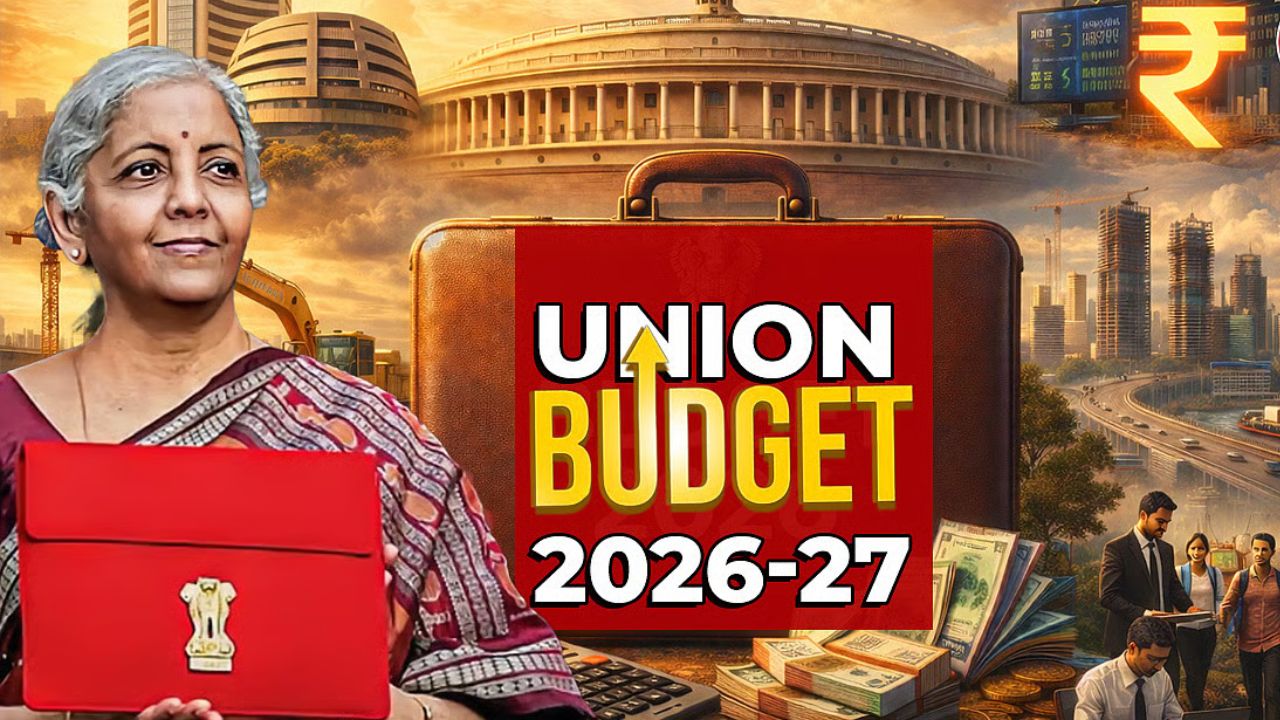
Finance Minister Nirmala Sitharaman announced a major boost to public infrastructure
New Delhi: Finance Minister Nirmala Sitharaman on Saturday announced a major boost to public infrastructure spending, proposing a capital expenditure (capex) of ₹12.2 lakh crore for FY2026-27 as part of the Union Budget. The move aims to sustain economic growth, improve competitiveness and build resilience amid global uncertainties.
Presenting her ninth consecutive budget in Parliament, Sitharaman said accelerating growth remains the government’s “first kartavya”, with infrastructure playing a central role.
The Finance Minister said, “Public capital expenditure has increased manifold, from Rs two lakh crore in 2014-15 to an allocation of Rs 11.2 lakh crore in BE 25-26. In this coming year, that is financial year 2026-27 Budget proposes to increase it to Rs 12.2 lakh crore, to continue the momentum.”
Budget 2026–27 Leaves Middle Class Disappointed as Income Tax Relief Fails to Arrive
She added that instruments such as Infrastructure Investment Trusts (InVITs), Real Estate Investment Trusts (REITs), and institutions like NIIF and NABFID have strengthened infrastructure financing. To further unlock value, the Budget proposes setting up dedicated REITs to monetise large real estate assets of central public sector enterprises (CPSEs).
To encourage private sector participation, Sitharaman proposed an Infrastructure Risk Guarantee Fund. The fund will offer partial credit guarantees to lenders, helping mitigate risks during the development and construction phases of infrastructure projects.
To promote environmentally sustainable cargo movement, the Budget proposes a new Dedicated Freight Corridor connecting Dankuni in the east to Surat in the west. Additionally, 20 new National Waterways will be operationalised over the next five years, beginning with National Waterway-5 in Odisha.
The government aims to raise the share of inland waterways and coastal shipping in freight transport from 6% to 12% by 2047. A Coastal Cargo Promotion Scheme will be launched to encourage a shift from road and rail to waterways.
In a significant push for green passenger transport, the Finance Minister announced seven high-speed rail corridors to act as “growth connectors.” These include Mumbai-Pune, Pune-Hyderabad, Hyderabad-Bengaluru, Hyderabad-Chennai, Chennai-Bengaluru, Delhi-Varanasi and Varanasi-Siliguri.
Union Budget 2026: India to get 7 high-speed Rail Corridors, FM Nirmala Sitharaman announces
To improve last-mile and remote connectivity, a Viability Gap Funding (VGF) scheme for seaplane operations will be introduced, alongside incentives for indigenous manufacturing.
The Budget also allocates ₹20,000 crore over five years for Carbon Capture, Utilisation and Storage (CCUS) across key industrial sectors such as power, steel, cement and chemicals.
Emphasising the role of cities as growth engines, Sitharaman announced the mapping of City Economic Regions (CERs), especially in Tier II, Tier III cities and temple towns. Each CER will receive ₹5,000 crore over five years to support targeted infrastructure development.

