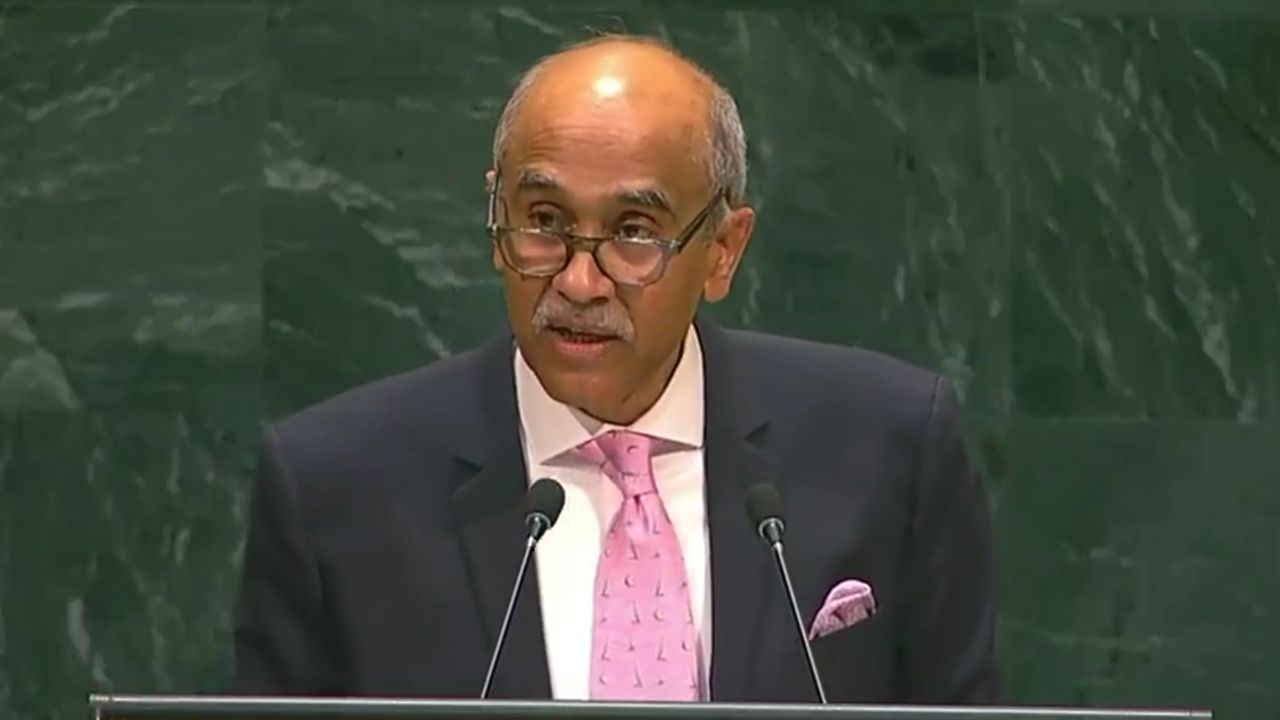
India demands equal veto rights in reformed UN Council (Img: X)
New Delhi: India has reiterated that all permanent members of a reformed United Nations Security Council (UNSC) must have equal rights and responsibilities, insisting that veto power must be extended to every permanent member if the provision continues to exist.
Delivering India's statement at the United Nations in New York, India's Permanent Representative to the UN, Ambassador Parvathaneni Harish, warned that creating a separate category of permanent members without equal powers would deepen existing inequalities and make the already complex reform process more difficult.
“India’s position on the veto is principled and well known. It is aligned with the Common African Position. We reiterate that as long as a veto exists, it must be held by all permanent members of a reformed Council. Fairness and justice demand that all permanent members enjoy the same rights and responsibilities," Harish said.
Harish opposed proposals to introduce a new category of permanent membership, whether with or without veto powers, arguing that such an arrangement would undermine the objective of making the Council more representative and equitable.
“A new category of permanent members, with or without the veto, would only further complicate a discussion that is already difficult, and would further entrench the very inequity we are seeking to correct," he said.
India called for comprehensive reform of the Security Council, maintaining that the question of veto power cannot be separated from other issues concerning the body's composition and functioning.
Also Read: Form 6 Unchanged, All SIR Decisions Unanimous: ECI Tells Supreme Court
Harish urged member states to begin text-based negotiations at the earliest, supported by clearly defined timelines and milestones, to move the reform process forward.
“Limiting the veto cannot be separated from the questions of categories of membership, regional representation, size and working methods. We need to move forward on all five clusters together," he said.
Delivered India's statement at the UNGA Plenary on the use of the Veto
Highlighted:
➡️ Veto is a responsibility, not a tool of narrow political expediency. We note that two of the P5 have not exercised veto for over three and a half decades. Most vetoes or threats of vetoes have emanated from three of the P5.
➡️ Piecemeal reforms will not work. All five clusters of UNSC reform must be addressed together.
➡️ Veto initiative of 2022 was seen as a harbinger of change. However, actual record of large number of vetoes cast since UNGA 76/262 tells a contrary story.
➡️ Unwritten consensus rules enable de facto vetoes in Council decisions and sanctions committees.
➡️ Consensus cannot become a disguised veto in the Inter Governmental Negotiations (IGN).
➡️ India aligns with the Common African Position: As long as the veto exists, all permanent members must enjoy equal rights.
➡️ New long-term seats without veto powers would create second-class members and perpetuate inequity. All permanent members, including new ones, must enjoy equal rights.
➡️ Begin text-based negotiations with clear timelines. The UNSC must reflect today's realities, not those of 1945.
— Parvathaneni Harish (@AmbHarishP) October 26, 2026
“India reiterates its call for a comprehensive approach towards Security Council reforms. The starting point is early commencement of text-based negotiations, with clearly defined timelines and milestones. Addressing the veto in isolation does not change the decision-making dynamic of the P5," the Indian envoy added.
The five permanent members, known as the P5, are China, France, Russia, the United Kingdom and the United States. They currently hold veto power over substantive Security Council resolutions.
India argued that meaningful reform must address five interconnected areas: membership categories, regional representation, the Council's size, working methods and veto powers. Harish also questioned the compatibility of periodic elections with the concept of permanent membership.
India also stressed that the veto must be exercised with restraint, particularly when decisions concern international peace and security. Harish warned against using the power to advance narrow political interests.
“India has always maintained that the veto, which is right now a prerogative only of the five permanent members of the UN Security Council, is a responsibility that must be exercised with great restraint, especially on matters bearing upon the maintenance of international peace and security. It should not be an instrument of narrow political expediency," Harish said.
Also Read: Rahul Gandhi Invokes Lord Shiva Ahead of Supreme Court Hearing on SIR Row
Highlighting the historical use of the veto, the ambassador said it had been exercised 331 times on around 200 resolutions over the United Nations' history.
He noted that two of the five permanent members had not used the veto for more than three and a half decades, while most vetoes or threats to use the power had come from only three P5 members.
Harish also referred to the 2022 Veto Initiative, under which the UN General Assembly holds a debate whenever a permanent member casts a veto. The mechanism was introduced to strengthen accountability and scrutiny of veto use.
However, he said the substantial number of vetoes exercised since the adoption of UN General Assembly Resolution 76/262 presented a contrasting picture of the initiative's impact.
Harish raised concerns about informal consensus-based procedures within the Security Council, arguing that these can allow a single member to block proposals without formally casting a veto.
“The veto is not only what is cast in the open. There is also the ‘effective or de facto veto’ that every Council member, elected and non-elected, holds over presidential statements, press statements and the decisions of sanctions committees, where the unwritten rule of consensus allows a single member to hold or block a proposal, most often without explanation," Harish said.
His remarks highlighted India's concern that decision-making practices can give individual members the ability to obstruct proposals even when no formal veto is recorded.
India's position is that reform must address both the Council's membership structure and its decision-making procedures. Harish maintained that equal rights and responsibilities should guide any expansion of permanent membership for as long as veto power remains part of the Security Council's functioning.

