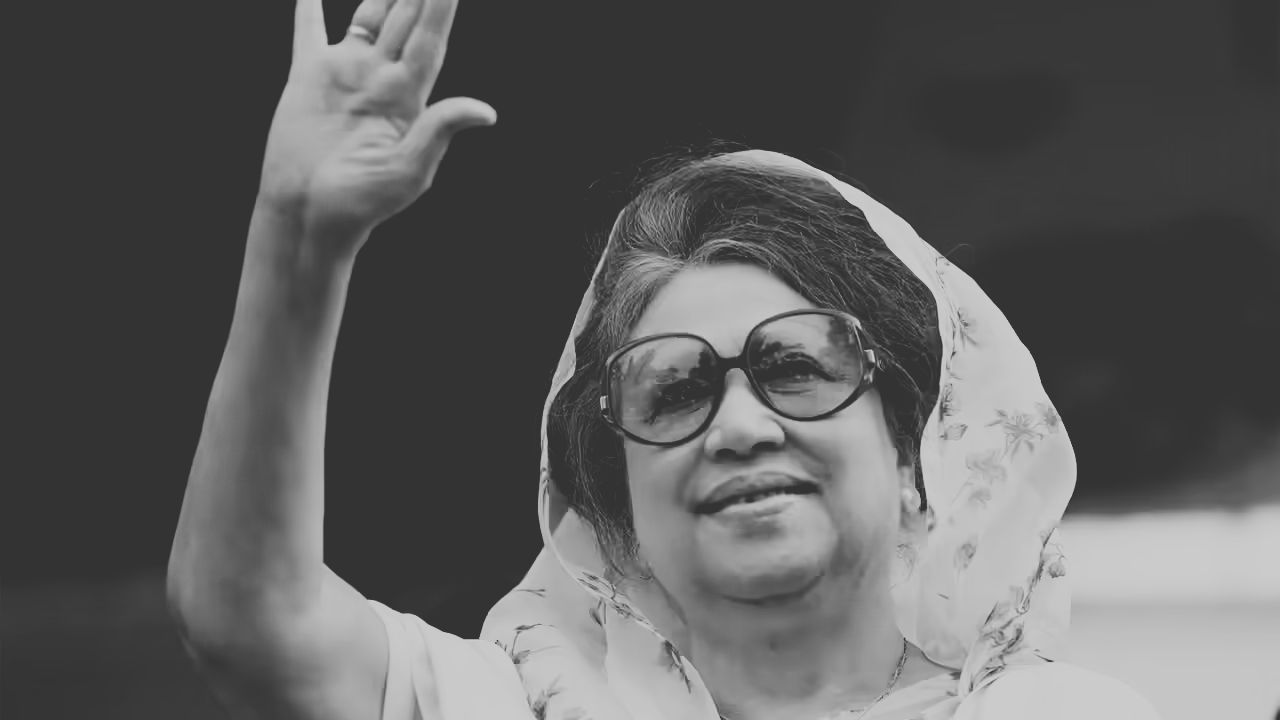
Former Bangladesh PM Khaleda Zia dies at 80
New Delhi: Former Bangladeshi Prime Minister Khaleda Zia passed away at the age of 80. She had been ill for a long time.
Her party, the Bangladesh Nationalist Party (BNP), said that Khaleda died on December 30 at 6 am while undergoing treatment at Evercare Hospital in Dhaka.
She was suffering from kidney and heart disease, as well as pneumonia. For several years, she had been battling various complications, including liver cirrhosis, arthritis, diabetes, kidney, lung, and eye problems. She was admitted to the hospital on November 23 due to breathing difficulties. Earlier, in June 2024, she had also undergone heart pacemaker surgery.
Who was Khaleda Zia?
Khaleda was born in 1945 in Jalpaiguri (now in West Bengal, India). She initially studied at Dinajpur Missionary School and later matriculated from Dinajpur Girls' School in 1960. Khaleda's father, Iskander Majumdar, was a businessman, and her mother, Tayyaba Majumdar, was a housewife.
In 1960, she married Ziaur Rahman, who was a captain in the Pakistan Army at the time. She continued her studies at Surendranath College in Dinajpur until 1965, when she moved to West Pakistan to live with her husband.
From a Shy Housewife to the First Female PM
When the Liberation War began in 1971, Ziaur Rahman rebelled against the Pakistani Army and participated in the war. Until this time, Khaleda was not politically active. Ziaur Rahman used to say that she was a shy housewife devoted to her two children.
But after Ziaur Rahman's assassination on May 30, 1981, the BNP plunged into a serious crisis. During this difficult time, Khaleda Zia entered politics. She joined the party and became its Vice-President on January 12, 1984. She was elected Chairperson of the BNP on May 10, 1984.
Khaleda Zia was the first female Prime Minister of Bangladesh. She took the oath of office for the first time on March 20, 1991. She became Prime Minister again in 1996, although several parties boycotted that election.
During this period, she introduced the provision for a neutral caretaker government during emergencies. She amended the constitution for this purpose. However, in the mid-term elections held after the formation of the caretaker government, the BNP suffered a crushing defeat at the hands of the Awami League.
Khaleda's first imprisonment
However, in the 2001 elections, she won with a two-thirds majority. Then, in 2007, the army-backed caretaker government sent her to jail. She was released in 2008.
She was again imprisoned in 2018, but her party and family members repeatedly appealed to the then Awami League government to allow Khaleda to go abroad for better treatment, but their appeals were rejected.
Also imprisoned on corruption charges
Khaleda Zia was imprisoned in 2018 during the Awami League government's tenure. She was accused of involvement in the Zia Orphanage Trust corruption case. However, she was temporarily released during the COVID-19 pandemic.
On August 6, 2025, Khaleda was fully released. President Mohammed Shahabuddin pardoned her sentence using the presidential power granted under Article 49 of the Constitution.

