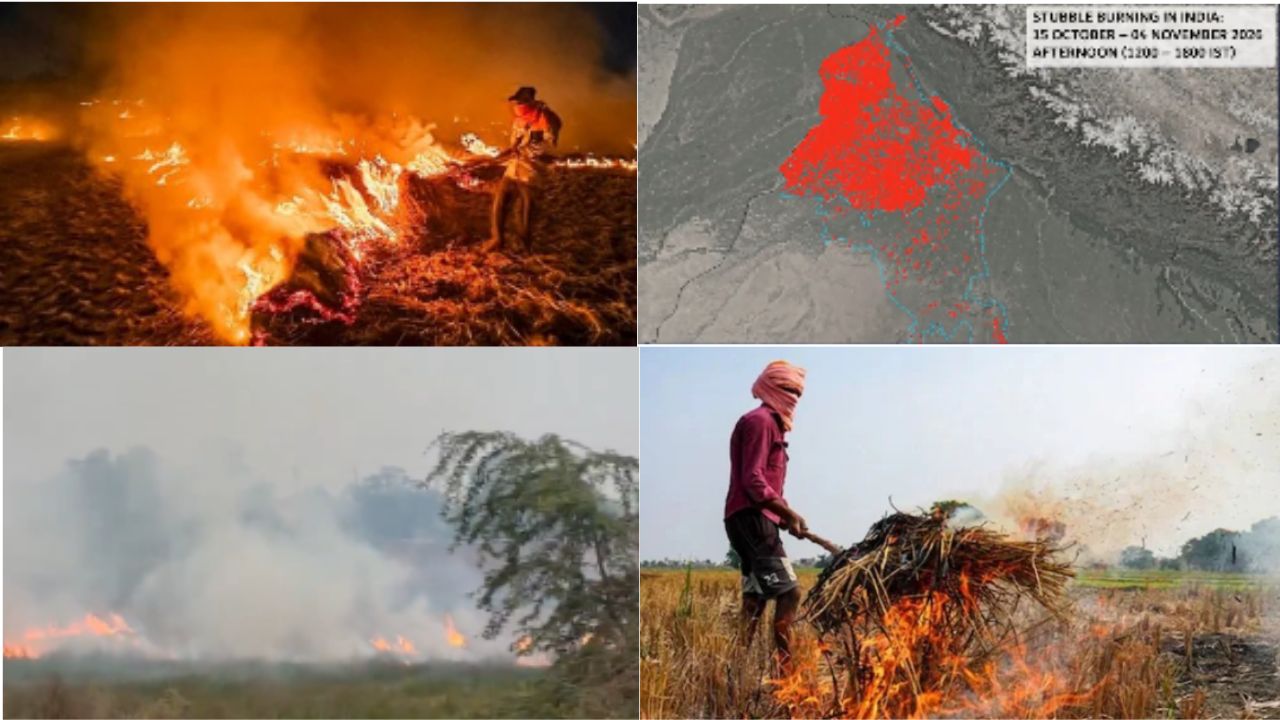
Punjab recorded 1,152 farm-fire incidents in a single day, taking the paddy-season tally to 4,459. (Img: X)
Chandigarh: Punjab’s efforts to curb stubble burning suffered a major setback on Diwali, with the state recording 1,152 farm-fire incidents in a single day on November 8, the highest daily count of the ongoing paddy season. The sudden surge reversed the marginal improvement registered over the corresponding period last year, pushing the cumulative number of farm fires to 4,459.
The scale of the spike is evident from the fact that Punjab had recorded 3,307 incidents until November 7, compared with 3,384 during the corresponding period in 2025. This represented a marginal decline of 77 incidents, or approximately 2.3 per cent. However, the 1,152 fresh detections on Diwali took the cumulative tally to 4,459, against 3,622 on the corresponding date last year, an increase of 837 incidents, or 23.1 per cent.
The 1,152 incidents detected on November 8 marked a nearly seven-fold increase over the 163 farm fires reported on November 7, translating into a staggering rise of approximately 607 per cent within 24 hours.
The figure was also almost twice the previous highest daily count of 584, recorded on November 3. The Diwali spike was particularly significant as the 1,152 incidents accounted for nearly 58.5 per cent of the 1,968 farm fires reported during the entire preceding week, between November 1 and 7.
The increase was widespread, with 20 of Punjab's 23 districts registering a rise in active fire incidents on Diwali compared with the previous day. The remaining three districts Gurdaspur, Pathankot and Rupnagar, reported no change. Significantly, no district recorded a decline.
Sangrur, the home district of Chief Minister Bhagwant Mann, accounted for the highest number of fresh incidents, recording 194 farm fires on November 8. Ferozepur followed with 157, Bathinda with 132, Patiala with 92 and Barnala with 91.
Together, these five districts contributed 666 incidents, accounting for nearly 58 per cent of the state's single-day tally. Moga recorded 73 fresh incidents, followed by Ludhiana with 71 and Mansa with 62.
The daily figures preceding Diwali had remained relatively lower, although they fluctuated considerably during the week. Punjab recorded 175 farm fires on November 1, 98 on November 2, 584 on November 3, 151 on November 4, 440 on November 5, 357 on November 6 and 163 on November 7.
The cumulative tally of 4,459 incidents is substantially higher than the 3,622 recorded on the corresponding date in 2025, although it remains below the 6,029 reported on November 8, 2024. The latest figures have once again brought the effectiveness of measures to discourage crop-residue burning under scrutiny, particularly as the state approaches the final phase of the paddy harvesting season.
The escalation also comes at a crucial juncture for farmers, who have a limited window to clear their fields and prepare the land for the next wheat crop. With November 15, the Punjab Agricultural University's recommended deadline for wheat sowing, approaching, the pressure to dispose of paddy residue and ready agricultural fields has intensified.
The state government has been promoting in-situ and ex-situ crop-residue management as alternatives to burning. However, the latest figures underscore the continuing difficulty of preventing farm fires during the peak harvesting period.
The data are based on satellite monitoring of active farm-fire incidents during the kharif paddy season, with the annual monitoring exercise commencing on September 15. Satellite detections establish the occurrence of active fire events but do not, by themselves, determine the precise circumstances behind individual incidents.

