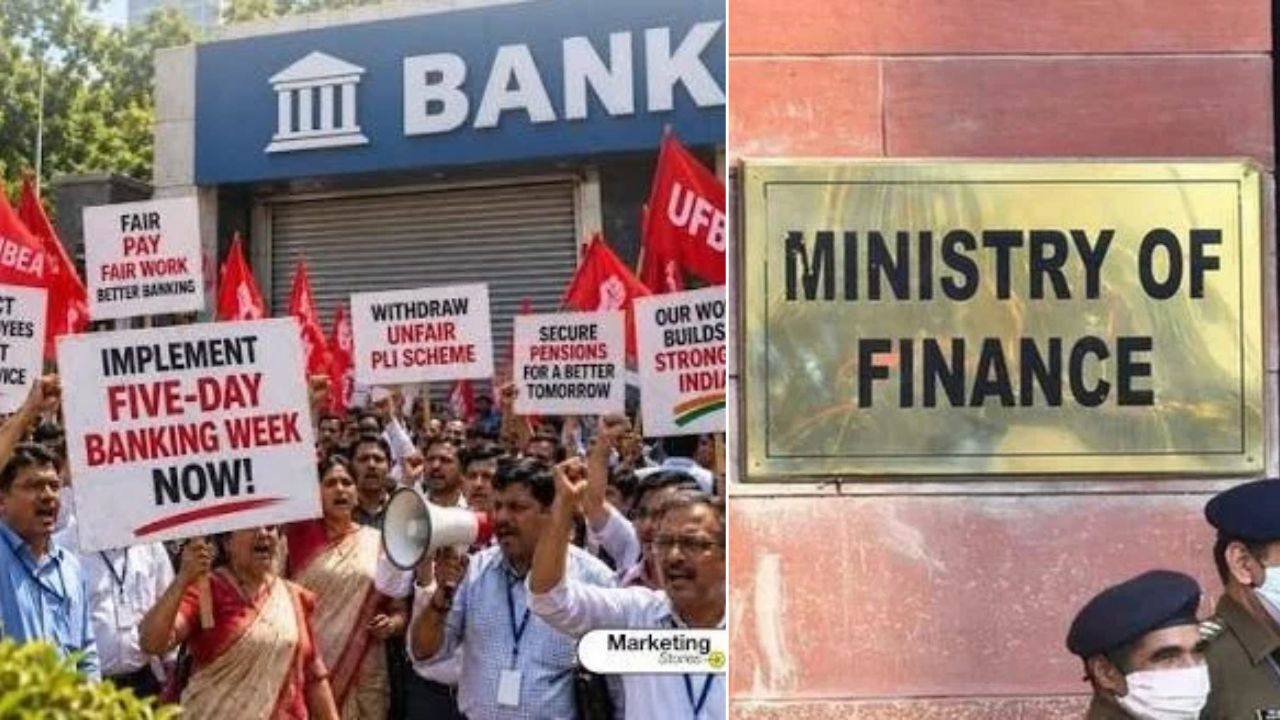
SBI to public sector banks: What three-day strike means for everyday banking. (Img: Pinterest)
New Delhi: A nationwide three-day bank strike is set to disrupt banking services across India from September 28 to 30 as employee unions remain firm on their demand for a five-day working week. The deadlock between bank unions and the Finance Ministry has intensified, leaving customers, businesses and government transactions facing possible disruptions.
The United Forum of Bank Unions (UFBU), an umbrella body representing major bank employee and officer organisations, has decided to continue its strike call after talks failed to produce a concrete assurance on their key demand of making all Saturdays holidays.
The government, however, has urged unions to reconsider the strike, highlighting recent wage revisions, salary hikes, recruitment drives, pension improvements and welfare benefits provided to bank employees.
With both sides maintaining their positions, the September 28-30 strike has turned into a larger debate over working conditions, employee welfare and the future structure of banking operations in India.
The primary demand behind the strike is the implementation of a five-day banking week. Currently, banks remain closed on the second and fourth Saturdays of every month. Bank unions want the remaining Saturdays to also be declared holidays, bringing banking work patterns in line with many other government and private sector organisations.
According to UFBU, the five-day banking week proposal was discussed during earlier wage settlement negotiations. The unions claim that the Indian Banks’ Association (IBA) and bank managements had agreed to the proposal, with increased working hours from Monday to Friday to compensate for the additional holidays.
The proposal was later sent to the Finance Ministry for approval but has remained pending, according to the unions. The employee organisations argue that longer weekday working hours can ensure that customer service hours remain unaffected despite Saturday holidays.
The Finance Ministry has appealed to bank unions to resolve their concerns through dialogue instead of going ahead with the strike. The ministry has pointed out that public sector bank employees have received several benefits in recent settlements, including salary and allowance revisions, improved pension provisions, welfare schemes, recruitment expansion and changes in promotion and transfer policies.
The government has also highlighted that public sector banks recruited a large number of employees in recent years and that recruitment activity increased significantly during the last few years. According to the government’s position, the banking sector has already witnessed substantial improvements in employee compensation and service conditions.
The UFBU has maintained that the five-day banking week demand is not new and has remained pending for years. The organisation represents seven major bank employee and officer unions, including All India Bank Employees’ Association (AIBEA), All India Bank Officers Confederation (AIBOC), National Confederation of Bank Employees (NCBE), All India Bank Officers Association (AIBOA), Bank Employees Federation of India (BEFI), Indian National Bank Officers Congress (INBOC) and Indian National Bank Employees Federation (INBEF).
The unions represent a significant portion of employees across public sector banks, private banks, foreign banks, regional rural banks and cooperative banks. Apart from the five-day workweek, unions have also raised several other pending issues, including recruitment of clerical and subordinate staff, pension-related reforms, restoration of the old pension system, gratuity-related changes, medical insurance benefits for retired employees and filling vacant posts.
The demand for a complete five-day banking week dates back more than a decade. In 2015, the banking sector moved towards a partial five-day system when the second and fourth Saturdays were declared holidays. At that time, discussions indicated that efforts would be made to consider making all Saturdays holidays in the future.
The issue was again discussed during later wage settlements, including the 2020 agreement and the 2024 wage revision talks. Bank unions say that despite discussions and agreements, final approval for the remaining Saturdays as holidays has not been granted.
The unions argue that several sectors, including government departments, financial institutions and private companies, already follow a five-day working system.
If the strike proceeds as planned, physical banking operations at branches could be affected across the country. Banks have already started informing customers to complete important transactions before September 28 and use alternative digital banking options during the strike period.
Customers have been advised to rely on mobile banking, internet banking, UPI services and ATMs for routine transactions. The timing of the strike has raised additional concerns as September 30 is also linked with half-yearly closing activities for banks.
With September 26 and 27 already falling on the second Saturday and Sunday, banking services could face disruption for several consecutive days.
The latest strike call comes after several previous protests by bank unions over issues related to recruitment, staffing shortages, pensions and working conditions. Bank employees had also observed a strike on September 11, 2026, over similar demands.
Earlier protests in January 2024 and March 2025 focused on manpower shortages, outsourcing of banking jobs, pension reforms and the five-day working week demand.

