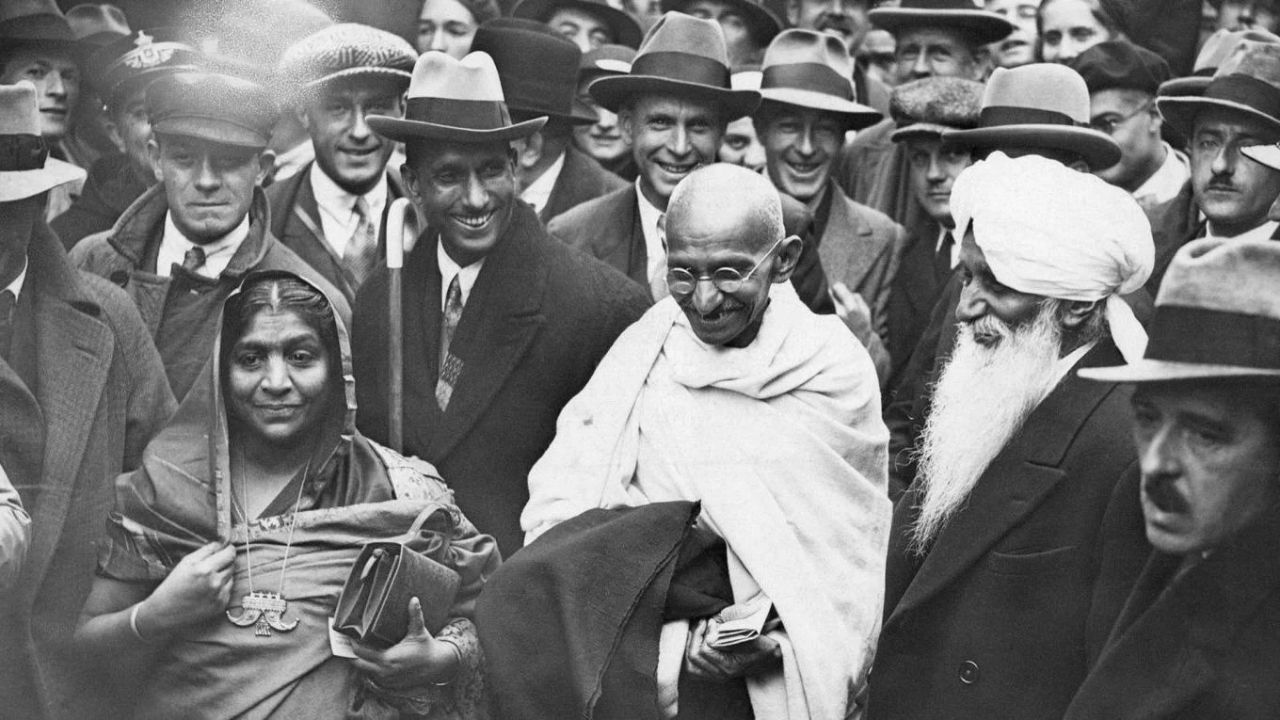
Remembering Mahatma Gandhi and his enduring legacy of truth and non-violence (Img: Pinterest)
New Delhi: He walked with a wooden stick, dressed simply and carried the weight of a wounded nation on his frail shoulders. Yet behind the familiar face of Mahatma Gandhi was a man who knew fear, loneliness, doubt and loss. On his 157th birth anniversary, India remembers not only the leader who challenged an empire without raising a weapon, but the human being whose final years were marked by pain, separation and an unshaken belief in peace.
Across India, schools held prayer meetings, offices observed Gandhi Jayanti and tributes were paid at Rajghat as the country marked the birth anniversary of Mohandas Karamchand Gandhi, born on October 2, 1869, in Porbandar, Gujarat.
The date has also acquired a global meaning. In 2007, the United Nations General Assembly declared October 2 the International Day of Non-Violence, recognising the continuing relevance of Gandhi’s philosophy.
Long before he became one of the most recognisable figures of the 20th century, Gandhi was a young man who struggled with confidence and public speaking.
His early years did not immediately suggest the emergence of a global political leader. He studied law in London and later travelled to South Africa, where experiences of racial discrimination played an important role in shaping his political thinking.
It was there that Gandhi began developing the methods of resistance that would later define his public life — particularly satyagraha, his philosophy of holding firmly to truth while resisting injustice without violence.
The transformation was gradual. The shy lawyer evolved into a mass leader who could mobilise millions without commanding an army.
Gandhi understood that political movements needed more than protests and speeches. They needed ideas that could reach ordinary people.
Through newspapers and journals, he wrote extensively about politics, society, religion, morality and public life. His publications became important platforms for explaining his ideas and communicating with supporters.
For Gandhi, journalism was not simply about reporting events. It was closely linked to his larger effort to persuade people to examine their own actions and responsibilities.
His writings also reflected a characteristic that remained central to his public life: a willingness to turn the spotlight on himself and question his own beliefs.
One of the most striking details of Gandhi’s final years is where he was when India became independent.
While celebrations filled Delhi on August 15, 1947, Gandhi was in Bengal, focused on communal violence and reconciliation.
Independence had arrived, but the country was already facing the enormous human cost of Partition. For Gandhi, political freedom could not be separated from the suffering of ordinary people.
Instead of joining the celebrations in the capital, he chose to remain among people caught in communal conflict.
That decision captured the contradiction of his final years: the man who had spent decades fighting for freedom found little reason to celebrate while communities were being torn apart.
Gandhi remains one of the most famous figures associated with the Nobel Peace Prize despite never receiving it.
According to the Nobel Prize organisation, he was nominated for the Peace Prize in 1937, 1938, 1939, 1947 and again in 1948, shortly before his assassination.
He was never awarded the prize.
The Nobel committee later noted Gandhi’s influence on the non-violent movement, while also acknowledging that no suitable living candidate was selected for the 1948 award after his death.
His absence from the list of Nobel laureates remains one of the more striking facts surrounding his international legacy.
The story of Gandhi is also inseparable from Kasturba Gandhi, his wife and a participant in the freedom movement in her own right.
Their relationship passed through decades of political struggle, imprisonment, personal disagreements and shared hardship.
Kasturba died on February 22, 1944, at the Aga Khan Palace in Pune while the couple was being held under detention during the freedom struggle.
Her death was a profound personal loss for Gandhi.
The image of Gandhi as a solitary national leader can sometimes obscure the people who shared the difficult and often painful journey around him. Kasturba was among the most important of them.
Gandhi’s final days were dominated by the same issue that had troubled him throughout his later life: communal violence.
On January 30, 1948, Gandhi was walking towards his evening prayer meeting at Birla House in New Delhi when he was assassinated.
His death came less than six months after India had achieved independence.
The final moments of his life transformed him from a political leader into an even more powerful symbol of non-violence and sacrifice. But behind the symbol was a man who had spent decades wrestling with politics, faith, society, relationships and his own understanding of truth.
More than seven decades after his assassination, Gandhi continues to occupy a complicated place in public memory.
His face is instantly recognisable. His name is associated with non-violence around the world. His birthday has become an international day dedicated to the same principle.
But remembering Gandhi only through statues, currency notes and official ceremonies risks reducing a complicated human being to a simple symbol.
His life contained victories and disappointments, convictions and contradictions, public triumphs and deeply personal losses.
Perhaps that is why Gandhi continues to invite debate.
The Mahatma may belong to history, but the questions he raised about violence, truth, inequality, power and individual responsibility remain part of the present.
On his 157th birth anniversary, the most meaningful remembrance may therefore be less about repeating familiar slogans and more about remembering the human being behind them — a man who believed that lasting change could begin with something as difficult, and as powerful, as changing oneself.

