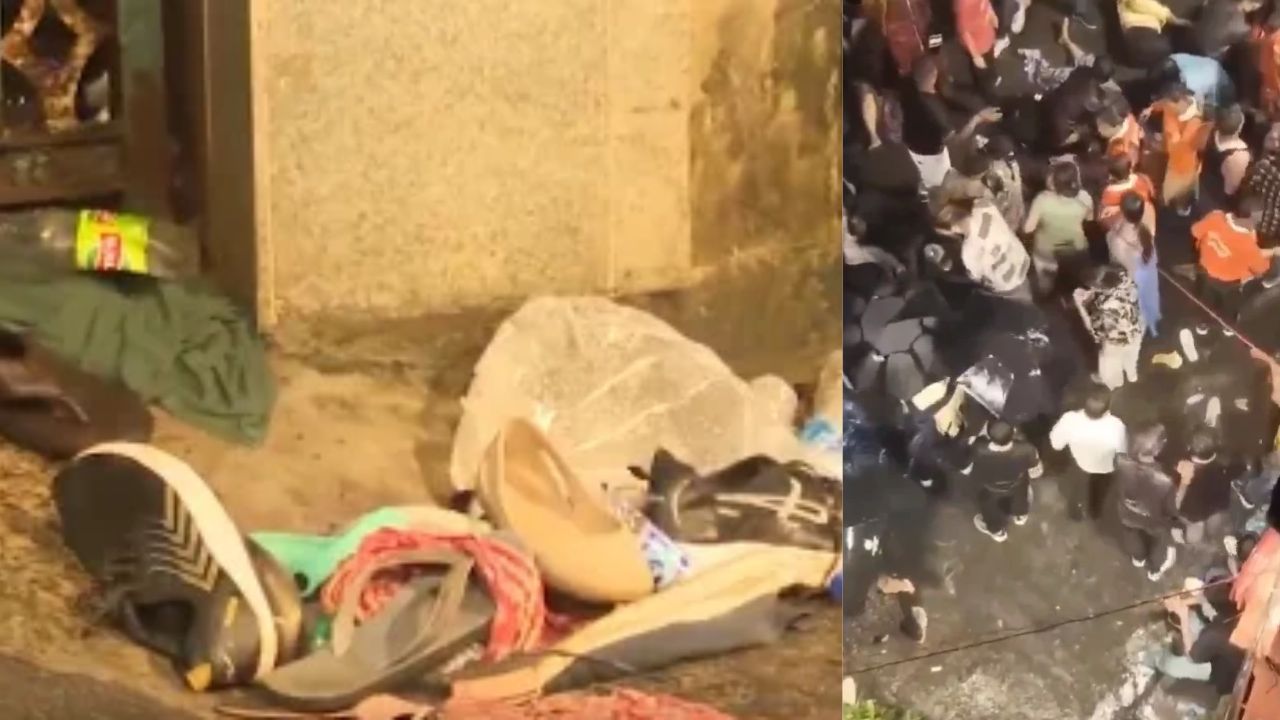
The Chorbagan Durga Puja stampede in North Kolkata claimed 19 lives and left around 25 people injured. (Img: X)
New Delhi: A holy dip, a temple darshan, a festival procession or a victory celebration can draw thousands of people together in moments of collective excitement. But when a crowd surges beyond the capacity of a venue, an occasion of faith or celebration can become a life-threatening emergency. From the Maha Kumbh in Prayagraj and the New Delhi Railway Station to Bengaluru’s IPL victory celebrations and the latest Durga Puja tragedy in Kolkata, a recurring question haunts India’s public gatherings: why do deadly crowd disasters continue to claim lives?
India’s history of mass-casualty crowd disasters reveals a disturbing pattern. Overcrowded access routes, sudden surges, bottlenecks, rumours, infrastructure failures and gaps in crowd management have featured in multiple tragedies at religious gatherings, transport hubs, festivals and political events. The circumstances differ from one incident to another, but the consequences are often devastating: people become trapped, lose their footing, struggle to breathe and find themselves unable to escape the pressure around them.
The latest tragedy at the Chorbagan Sarbojanin Durga Puja pandal in north Kolkata has once again brought crowd safety into sharp focus. At least 19 people were reported dead and 25 injured after a stampede-like crowd crush on October 17, 2026. The incident unfolded amid heavy rain, with a large number of visitors reportedly moving towards the pandal for shelter. Reports have also raised questions about a public-address announcement that may have triggered panic. The precise sequence of events and the responsibility for the disaster require investigation.
The tragedy is a grim reminder that crowd disasters rarely emerge from a single factor alone. Weather conditions, crowd density, restricted movement, communication failures and the absence of effective emergency controls can interact within seconds, leaving little room for people to escape.
Durga Puja draws vast crowds to Kolkata every year, with elaborately designed pandals, artistic installations and community celebrations attracting visitors from across the city and beyond. At the Chorbagan pandal, however, the festive atmosphere gave way to panic on the evening of October 17.
According to initial reports, heavy rain prompted visitors to move towards the pandal, intensifying congestion. An announcement warning of a possible pavilion collapse has also been cited as a potential trigger for the rush. As investigators examine the circumstances, concerns have emerged over crowd-control arrangements, access routes and the management of visitors during adverse weather.
The reported death toll of 19 and injuries to 25 people make the incident one of the latest major reminders of the risks associated with large public gatherings. Authorities have initiated an investigation, while reports indicate that people associated with the event’s organisation and security arrangements were detained for questioning. These developments do not, by themselves, establish the cause or individual culpability.
The central question is whether the venue’s crowd capacity, entry and exit arrangements, emergency communication systems and contingency plans were adequate for the volume of visitors present. The answers will be crucial not only for the investigation but also for improving safety at future festivals.
On January 29, 2025, a crowd crush at the Maha Kumbh in Prayagraj claimed 30 lives and injured around 60 people, according to reported figures. The incident occurred near the Sangam during Mauni Amavasya, an especially significant bathing day that attracted millions of pilgrims seeking a holy dip at the confluence of the Ganga, Yamuna and the traditionally revered Saraswati.
The immense scale of the gathering created extraordinary demands on crowd-flow management, route segregation and the coordination of people moving towards the bathing area. A surge near the Sangam and the reported breach of barricades formed part of the circumstances surrounding the tragedy.
The incident highlighted the challenge of managing crowds at mega-events where visitors arrive in enormous numbers, often moving towards the same location at the same time. Even when extensive arrangements are made, safety depends on real-time information, controlled access, clear evacuation routes and the ability to prevent crowd density from reaching dangerous levels.
The deaths at Prayagraj raised renewed questions about how crowd movement is monitored at religious gatherings and how authorities respond when pedestrian flows become unstable.
On February 15, 2025, at least 18 people died in a crowd surge at New Delhi Railway Station as large numbers of Maha Kumbh pilgrims attempted to board trains for Prayagraj. The incident was reported around platforms 14 and 15, where passengers were caught up in the rush.
Railway stations present a distinct set of crowd-management challenges. Passengers may converge on platforms after train announcements, changes in departure information or uncertainty about boarding locations. When large groups move simultaneously through stairways, footbridges and narrow access points, congestion can escalate rapidly.
The New Delhi tragedy underlined the need for effective passenger-flow management during major travel peaks, including clear announcements, platform monitoring, regulated access and coordination between railway staff, security personnel and emergency responders.
For transport hubs handling festival traffic, the challenge extends beyond arranging additional trains. Authorities must also anticipate where passengers will gather, how they will reach platforms and what procedures will prevent a sudden rush from overwhelming available space.
On June 4, 2025, the celebrations surrounding Royal Challengers Bengaluru’s maiden Indian Premier League title turned tragic when a stampede near M Chinnaswamy Stadium killed at least 11 people and injured several others.
The team’s long-awaited victory had generated enormous public excitement, drawing fans eager to celebrate with players and fellow supporters. The scale of the gathering, however, created a major public-safety challenge in and around the stadium.
The disaster demonstrated that crowd-crush risks are not confined to religious events. Sporting victories, celebrity appearances, political rallies and other occasions that attract large, emotionally charged gatherings can produce similar hazards when attendance exceeds the capacity of the surrounding area or when crowd movement is not adequately controlled.
Successful event planning requires more than arranging a venue and deploying security staff. It demands realistic attendance estimates, controlled access, designated pedestrian corridors, crowd-density monitoring and emergency plans that can be activated before congestion becomes critical.
On September 27, 2025, a stampede at a political rally in Karur, Tamil Nadu, organised around actor and Tamilaga Vettri Kazhagam leader Vijay, reportedly killed at least 39 people.
Political events can attract large crowds within a short period, particularly when a prominent public figure is expected to appear. The movement of attendees towards a stage, access point or anticipated arrival route can create intense pressure if the number of people exceeds the space available.
The Karur tragedy underscored the need for event organisers and authorities to assess attendance risks before a rally begins. Crowd estimates, venue capacity, entry and exit planning, emergency medical access and coordination among police, organisers and local administration are essential elements of preventive planning.
The incident also reinforced a broader point: crowd safety must be treated as a core operational responsibility, not as an arrangement to be improvised after people have already assembled.
On January 8, 2025, a stampede at Tirupati in Andhra Pradesh killed at least six devotees and injured dozens, according to reports. Around 2,500 people had gathered to collect passes for Vaikunta Dwara Darshanam at the Venkateswara Temple. The crowd surged after a gate was opened, triggering a deadly crush.
The incident illustrated how even a system intended to organise access can become hazardous if the release of people is not carefully controlled. When large numbers of devotees wait for a limited service or entry opportunity, uncertainty about queues and access can encourage sudden movement.
Crowd management at major shrines therefore requires transparent queue systems, staggered distribution, clear instructions, adequate holding areas and controlled release through gates. Organisers must also account for people who may be elderly, unwell or unable to withstand prolonged standing and crowd pressure.
The tragedy at Tirupati showed how a routine operational step, such as opening an access point, can become dangerous when crowd movement is not sufficiently regulated.
On May 3, 2025, a stampede at the Shree Lairai Devi Temple festival in Shirgao, Goa, killed at least six people and injured dozens, according to contemporary reports. Large numbers of devotees had gathered for the annual Jatra, with reports describing a crowd of substantial size and congestion along a narrow, sloping approach.
A fall in a tightly packed crowd can have consequences far beyond the person who loses balance. When people behind are unable to see what has happened or stop moving, they may fall over those in front, creating a chain reaction. On a slope or narrow path, the risk can increase because people have fewer opportunities to regain their footing or move away from the pressure.
The incident demonstrated why crowd-safety assessments must consider the physical characteristics of a site, including gradients, turns, barriers, approach roads and the width of pedestrian corridors. A route that appears manageable under ordinary conditions may become hazardous when thousands of people use it simultaneously.
On June 29, 2025, three devotees died and dozens were injured in a stampede near the Shree Gundicha Temple in Puri, Odisha, during Rath Yatra festivities. Thousands had gathered to see the deities on their chariots, and reports described a sudden surge in the crowded area. The entry of vehicles carrying ritual materials was also cited in accounts of the incident.
Rath Yatra is a major religious event that brings together devotees from different regions. The movement of chariots, ritual schedules, pedestrian traffic and access restrictions creates a complex operating environment. Any unexpected change in movement or delay in access can lead to people converging on the same space.
The Puri tragedy highlighted the importance of separating pedestrian and vehicle movement, maintaining emergency corridors, communicating changes in ritual schedules and ensuring that crowd-control arrangements remain effective throughout an event—not only at its beginning.
On July 27, 2025, a stampede at the Mansa Devi Temple in Haridwar, Uttarakhand, killed at least eight people and injured more than 25, according to updated reports. The incident occurred along a crowded stairway route leading to the shrine. Early reports pointed to the possibility that an electrical cable falling near the route triggered panic, although the full sequence of events required investigation.
The incident brought two important safety concerns into focus: the risks associated with narrow access routes and the potential for an electrical hazard to trigger a sudden crowd movement. Where people are moving along stairs or beside walls, their ability to disperse is limited. If a sudden rush develops, those at the front may have nowhere to go while those behind continue moving forward.
Temple safety planning must therefore account for electrical installations, overhead cables, stairways, retaining walls and other physical constraints. Clear emergency communication and the rapid isolation of electrical hazards can be critical to preventing a localised problem from escalating into a mass-casualty event.
On July 28, 2025, a stampede was reported at the Avsaneshwar Temple in Barabanki district, Uttar Pradesh, after a live electrical cord reportedly fell onto a tin shed, triggering panic among devotees.
The incident illustrated how a sudden infrastructure failure can generate fear in a densely packed religious gathering. Even when a hazard affects only one section of a venue, people who cannot see its source may respond by rushing towards exits or away from the perceived danger.
The episode highlights the importance of inspecting electrical systems, securing cables, checking temporary structures and ensuring that emergency announcements provide clear, verified instructions. Unclear information can compound the danger by encouraging people to move in conflicting directions.
On August 17, 2026, seven devotees were reported dead following a stampede at Ashokdham Temple in Lakhisarai district, Bihar. The incident occurred during a large gathering of devotees on the third Monday of the holy Shravan month. Reports indicated that an electrical incident and fears of a live wire had triggered panic among people waiting in a queue.
The tragedy demonstrated how a perceived threat can spread rapidly through a crowd, even before people have verified what has happened. When individuals receive incomplete or conflicting information, they may attempt to flee simultaneously. In a confined queue, that reaction can generate dangerous pressure.
The incident also underlined the importance of separating electrical infrastructure from pedestrian areas, maintaining safe queue layouts and ensuring that trained personnel communicate accurate information during emergencies.
The incidents across India differ in their immediate circumstances, but several recurring vulnerabilities deserve attention. One is excessive crowd density. When too many people occupy a limited space, movement becomes difficult and individuals lose control over their own direction. A small disruption, such as a fall, a sudden stop, an announcement or a change in access, can create pressure that spreads through the crowd.
Another is the bottleneck effect. Narrow gates, stairways, barricades, footbridges and single-lane approaches can restrict movement at precisely the moment when people need space to disperse. If incoming and outgoing flows intersect, congestion can become more severe.
Communication failures can also magnify danger. A warning that is misunderstood, an unverified rumour or a lack of clear directions may trigger sudden movement. Emergency communication must be accurate, consistent and designed to guide people towards safe routes rather than create further uncertainty.
Physical infrastructure is equally important. Slopes, walls, temporary structures, electrical cables and vehicle access points can increase risk when they are not assessed as part of a comprehensive safety plan. Weather conditions, including rain and extreme heat, can add further pressure by changing where people gather and how long they can safely remain in a queue.
Finally, crowd safety depends on coordination. Event organisers, police, local administration, transport authorities, medical teams and emergency services must operate under a clear plan, with defined responsibilities and the ability to respond to changing conditions.
Preventing crowd disasters requires a shift from reactive response to proactive risk management. Authorities and event organisers need to estimate likely attendance, establish safe venue capacities, separate entry and exit flows, create unobstructed evacuation routes and monitor crowd density in real time.
Large gatherings should have clearly designated emergency corridors, accessible medical posts and ambulance routes that remain free from public congestion. Temporary structures and electrical installations require safety inspections before visitors are admitted. Where conditions change because of weather, unexpected attendance or an emerging hazard, organisers must have the authority and procedures to pause entry or suspend an event.
Public-address systems should deliver short, verified instructions in languages that attendees understand. Trained crowd marshals must be positioned at gates, intersections, stairways and other pressure points, with clear communication links to the control room. Technology such as CCTV and crowd-density monitoring can support these measures, but it cannot replace trained personnel, adequate space and sound operational decisions.
Equally important is accountability after an incident. Investigations must establish the sequence of events, examine compliance with safety requirements and identify specific failures where evidence supports them. Findings should lead to practical changes in planning, enforcement and training rather than end with compensation announcements or temporary restrictions.
Every stampede toll represents families whose lives have changed irreversibly. People who leave home to pray, travel, celebrate a sporting victory or attend a public meeting may never return. Survivors can face physical injuries and lasting psychological trauma, while families are left seeking answers about how an ordinary gathering became a fatal emergency.
India's religious and cultural gatherings are central to its social life. The answer is not to discourage public participation or diminish the significance of festivals, pilgrimages and celebrations. It is to ensure that safety planning reflects the scale of those occasions and that no event proceeds without credible arrangements to protect those attending.
From Prayagraj and Tirupati to Bengaluru, Karur and Kolkata, the recurring lesson is clear: crowd disasters should not be treated as inevitable consequences of large gatherings. Their risks can be reduced through careful planning, reliable communication, infrastructure checks, coordinated emergency response and strict enforcement of safety standards.
The question after each tragedy is no longer simply how the crowd surged or how many people died. It is whether the warning signs were recognised, whether the safeguards were adequate and whether the lessons from previous disasters were put into practice before another gathering turned deadly.

