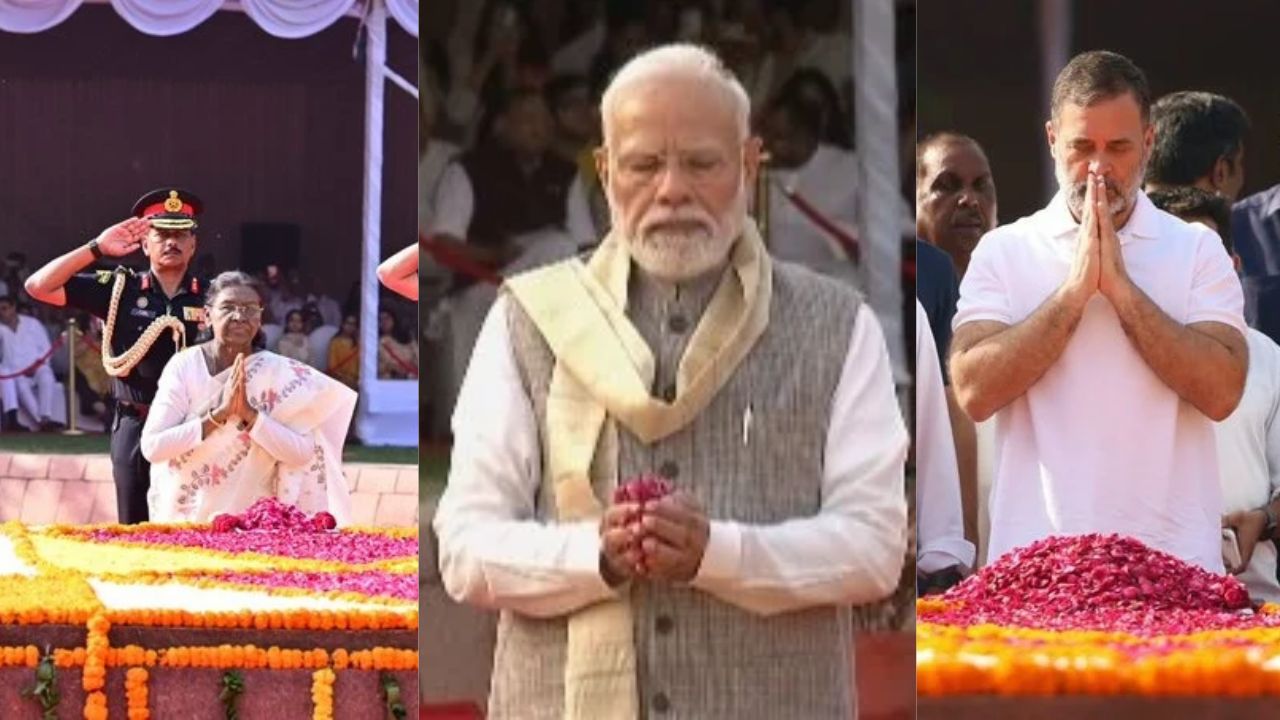
President Droupadi Murmu pays homage to former Prime Minister Lal Bahadur Shastri at Vijay Ghat on his 122nd birth anniversary. (Img: X)
New Delhi: India on Friday marked the 122nd birth anniversary of former Prime Minister Lal Bahadur Shastri, with President Droupadi Murmu, Prime Minister Narendra Modi and several senior leaders paying tribute to the leader at memorials across the country. The occasion has once again brought Shastri’s remarkable journey, simple lifestyle, leadership during the 1965 India-Pakistan War and contribution to India’s food-security efforts into the spotlight.
Prime Minister Narendra Modi paid homage to Shastri at Vijay Ghat in New Delhi and remembered him for his simplicity, dedication and firm resolve. President Droupadi Murmu also paid tribute at Vijay Ghat, while leaders in Delhi, Uttar Pradesh and other states recalled Shastri’s contribution to nation-building and public life.
Lal Bahadur Shastri Jayanti 2026: Why October 2 Is Significant
Lal Bahadur Shastri was born on October 2, 1904, in Mughalsarai, a railway town near Varanasi in Uttar Pradesh. He went on to become India’s second Prime Minister, taking office on June 9, 1964, after the death of Jawaharlal Nehru.
His tenure lasted only until January 11, 1966, but those 19 months placed him at the centre of some of the most difficult challenges faced by India in the early years after Independence. The country was dealing with food shortages, economic pressure, agricultural constraints and growing security concerns.
Shastri’s political journey was shaped by the freedom movement, public service, administrative experience and a strong sense of personal responsibility.
PM Modi Pays Tribute At Vijay Ghat
Prime Minister Narendra Modi visited Vijay Ghat in New Delhi on Friday to pay homage to the former Prime Minister. In his message on Shastri’s birth anniversary, Modi highlighted his simplicity and dedication to the nation and recalled the combination of humility and determination that became associated with his public image.
The Prime Minister’s tribute has renewed public attention on Shastri’s legacy at a time when October 2 remains an important date in India’s national calendar.
The focus on Shastri’s legacy is particularly significant because his political career offers a rare combination of freedom struggle experience, administrative responsibility, military leadership, food-security policy and diplomatic engagement.
President Murmu Pays Homage At Vijay Ghat
President Droupadi Murmu also paid homage to Lal Bahadur Shastri at Vijay Ghat in New Delhi on his birth anniversary.
The memorial became a focal point for national remembrance as senior leaders gathered to recall Shastri’s contribution to India’s political history.
Tributes were also paid by Union Education Minister Pralhad Joshi, Maharashtra Chief Minister Devendra Fadnavis, Delhi Chief Minister Rekha Gupta and Uttar Pradesh Chief Minister Yogi Adityanath.
In Lucknow, Yogi Adityanath paid floral tribute to the former Prime Minister, while leaders in different parts of the country remembered Shastri’s simplicity, administrative discipline and commitment to public service.
From A Modest Childhood To India’s Prime Minister
Shastri’s early life was marked by financial hardship. His father, a school teacher, died when he was very young, leaving his mother to raise the family in difficult circumstances.
The challenges of his childhood became an important part of the story of his rise in Indian public life.
As a young man, Shastri became involved in the freedom movement. He joined the Non-Cooperation Movement and later participated in the Civil Disobedience Movement and Quit India Movement.
He studied at Kashi Vidya Peeth in Varanasi, where he received the academic title Shastri, meaning scholar. The title eventually became part of his public name.
Freedom Struggle Shaped Shastri’s Political Career
Shastri participated in the freedom struggle and spent several years in British prisons. His involvement in the Civil Disobedience Movement and Quit India Movement strengthened his political experience and organisational skills.
After Independence, he took up important responsibilities in Uttar Pradesh before moving to the national political arena.
He served in several Union portfolios, including Railways, Transport and Communications, Commerce and Industry and Home Affairs. His administrative experience eventually helped prepare him for the country’s highest political office.
The Railway Resignation That Became A Symbol Of Accountability
One of the most remembered episodes from Shastri’s political career came during his tenure as Railway Minister.
After a major railway accident in 1956, Shastri resigned from the Railway Ministry, accepting moral responsibility for the tragedy. His resignation became an important example in discussions around ministerial accountability and ethical conduct in public office.
The episode also contributed to the image of Shastri as a politician who believed that holding public office involved accepting responsibility for administrative failures.
Jai Jawan, Jai Kisan And The 1965 War
Shastri’s most defining political moment came during the 1965 India-Pakistan War.
India was facing a difficult security situation while simultaneously struggling with food shortages and agricultural challenges. The crisis required the government to focus on both national defence and domestic food production.
Against this backdrop, Shastri’s Jai Jawan, Jai Kisan message became closely associated with his leadership.
The slogan linked two critical pillars of national strength: the armed forces responsible for national security and farmers responsible for food production.
Its continued popularity has made it one of the most recognisable political messages of post-Independence India.
The 1965 conflict became a major test of India’s military preparedness and political leadership. Shastri’s government took a firm position on national security while also pursuing a diplomatic route after the fighting.
The Tashkent Declaration And Shastri’s Sudden Death
The 1965 war eventually led to negotiations between India and Pakistan.
On January 10, 1966, Shastri and Pakistan’s President Ayub Khan signed the Tashkent Declaration in the Soviet city of Tashkent. The agreement dealt with the withdrawal of armed forces, restoration of diplomatic relations and steps towards improving relations between the two countries.
But the development was followed by a dramatic turn.
Shastri died in Tashkent on January 11, 1966, just hours after the declaration was signed. He was 61.
His sudden death brought an abrupt end to his tenure as Prime Minister and became one of the most remembered episodes in India’s early post-Independence political history.
India’s Food Crisis And Shastri’s Agricultural Push
National food security was another major challenge during Shastri’s tenure.
India was struggling with low agricultural productivity and dependence on food imports. The government therefore placed greater emphasis on increasing farm output, improving irrigation, strengthening agricultural research and developing institutional support for food procurement and distribution.
This period formed part of the policy groundwork that preceded India’s later Green Revolution.
Shastri’s approach placed agriculture at the centre of national planning at a time when food availability was directly linked to economic stability, rural livelihoods and national self-reliance.
Food Corporation Of India And Agricultural Institutions
The institutional architecture around food security also developed during this period.
The Food Corporation of India was established in 1965 under the Food Corporations Act, 1964. Its subsequent role in procurement, storage and distribution became an important part of India’s foodgrain management system.
Agricultural pricing and procurement mechanisms also received greater policy attention during the period, contributing to the broader transformation of India’s farm economy in the years that followed.
Shastri And The Beginning Of India’s Dairy Transformation
Shastri’s legacy was not limited to agriculture and defence.
He also supported efforts to expand dairy production and strengthen cooperative institutions. The National Dairy Development Board was established in 1965, while the cooperative dairy model associated with Amul received greater national attention.
These developments later became important components of the White Revolution, which transformed India’s dairy sector, increased milk production and created new income opportunities for rural communities.
Why Shastri’s Name Still Resonates
More than six decades after his death, Shastri continues to attract public attention because his political image was built around a combination of personal simplicity and administrative responsibility.
He lived at a time when India was still establishing its institutions, strengthening national security and dealing with severe economic and food-related pressures.
His short tenure therefore covered issues that continue to dominate public policy even today: national security, food security, agricultural productivity, rural development, institutional accountability and diplomatic relations.
The Human Side Of Lal Bahadur Shastri
Behind the Prime Minister’s office was a leader who came from a modest background and entered public life during the freedom struggle.
His journey from a small railway town to the Prime Minister’s Office remains one of the most striking aspects of his biography.
His decision to enter the freedom movement as a young man, years spent in prison, rise through public administration and eventual leadership of India created a political career that was closely connected with discipline and public service.
The contrast between his quiet personality and the difficult national decisions he faced remains one of the reasons his story continues to generate interest among younger generations.
Lal Bahadur Shastri Jayanti 2026: A Legacy Beyond One Slogan
The 122nd birth anniversary celebrations have once again placed Shastri’s life in the national spotlight.
While Jai Jawan, Jai Kisan remains the phrase most strongly associated with him, his legacy extends much further. His record includes freedom movement participation, Union ministerial responsibilities, railway accountability, leadership during the 1965 war, food-security initiatives, agricultural policy and the Tashkent negotiations.
His time as Prime Minister was brief, but it came during a period of extraordinary pressure for the young Indian republic.
As India remembers Lal Bahadur Shastri on October 2, the focus is not only on a former Prime Minister but also on a chapter of Indian history shaped by war, food shortages, institutional development and the search for national self-reliance.
The continued tributes at Vijay Ghat and across the country show how Shastri’s name remains embedded in India’s political and public memory. His life continues to offer a historical lens through which the country can revisit the meaning of leadership, responsibility and public service.

