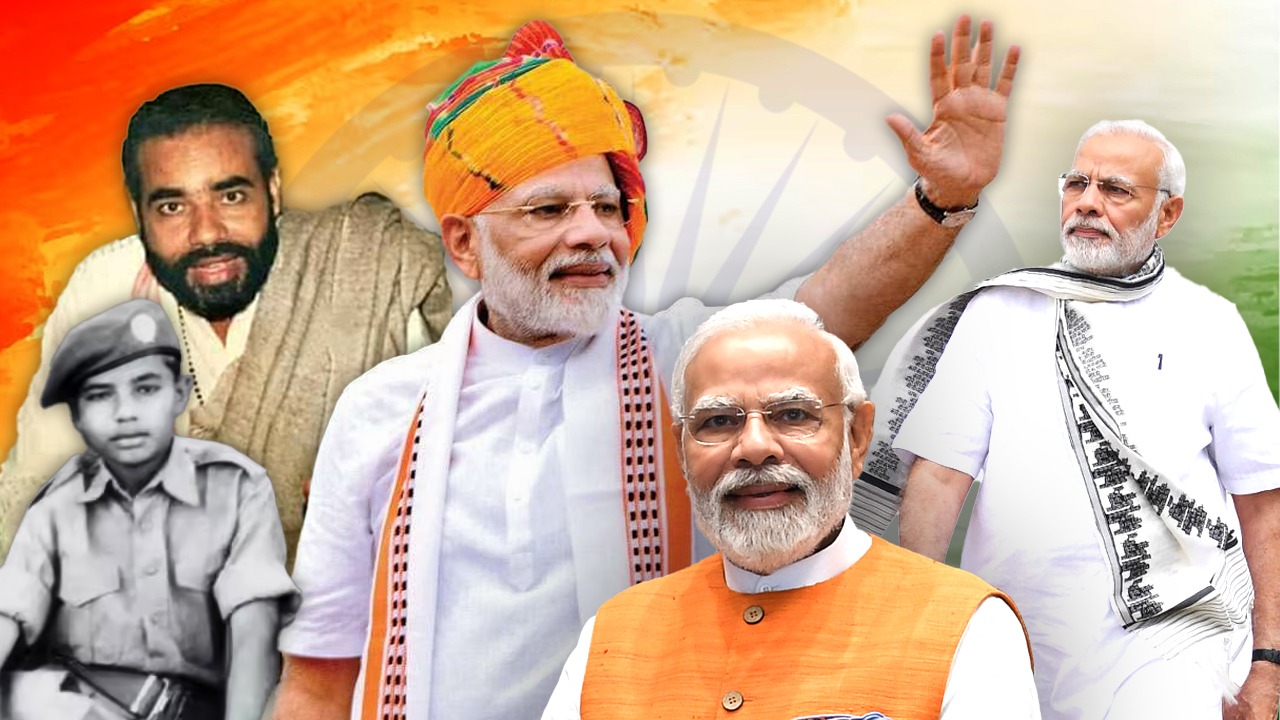
Narendra Modi turns 76 as his journey from Vadnagar to the Prime Minister’s Office marks one of India’s most significant political careers (Img: Dynamite News)
New Delhi: Prime Minister Narendra Modi turns 76 on Wednesday, marking another milestone in a political journey that has taken him from a modest upbringing in Gujarat to becoming one of India’s most prominent leaders.
His rise from a tea stall near Vadnagar railway station to the Prime Minister’s Office remains one of the most closely followed political journeys in India. While supporters highlight his governance record and policy decisions, opposition parties continue to debate the impact of several measures introduced during his tenure.
Narendra Modi was born on September 17, 1950, in Vadnagar, a small town in Gujarat’s Mehsana district. He was the third of six children in a family belonging to the Ghanchi community. His father, Damodardas Modi, ran a small tea stall, and Modi is widely reported to have helped his father during his childhood.
Those who knew him as a student have described him as disciplined and interested in reading, particularly the works of Swami Vivekananda, whose ideas influenced his interest in public service.
During his youth, Modi became associated with the Rashtriya Swayamsevak Sangh (RSS), where he worked as a full-time pracharak. He later joined the Bharatiya Janata Party (BJP) in the early 1980s and gradually rose through the party organisation.
By the late 1990s, he had emerged as one of the BJP’s key organisational leaders in Gujarat. In 2001, Modi became the Chief Minister of Gujarat, a position he held for more than 13 years before moving to New Delhi as Prime Minister on May 26, 2014.
During his years in office, several policy decisions introduced by the Modi government have remained central to political discussions.
In 2016, the government announced demonetisation, withdrawing Rs 500 and Rs 1,000 currency notes with the stated objectives of tackling black money, counterfeit currency and encouraging digital payments.
The introduction of the Goods and Services Tax (GST) in 2017 created a unified indirect tax system by replacing multiple central and state-level taxes.
Following terror attacks in Uri in 2016 and Pulwama in 2019, India carried out cross-border military operations, which the government described as responses to security threats.
In 2019, the government revoked Jammu and Kashmir’s special constitutional status under Article 370 and reorganised the region into two Union Territories.
Other major developments during his tenure include the criminalisation of instant triple talaq, the Citizenship Amendment Act, agricultural reforms and their later repeal following farmer protests, the inauguration of the Ram Mandir in Ayodhya in 2024, and the implementation of new criminal law codes replacing colonial-era statutes.
The Women’s Reservation Act, passed in 2023, provided for reservation of one-third of seats in the Lok Sabha and state assemblies, with implementation linked to the delimitation process.
India’s G20 presidency in 2023 was also seen as a major diplomatic moment, with the government highlighting the country’s role in representing the Global South.
The Modi government has highlighted initiatives including the expansion of digital payments, infrastructure development, manufacturing promotion and welfare schemes.
Government data has pointed to the rapid expansion of UPI transactions, which have grown significantly since its launch. The government has also cited improvements in poverty reduction, while opposition parties have questioned the impact of economic policies on employment, inflation and inequality.
During the COVID-19 pandemic, India conducted one of the world’s largest vaccination drives and promoted domestic manufacturing through initiatives such as Aatmanirbhar Bharat.
In June, Modi crossed 4,399 days in office, becoming the Prime Minister with the longest uninterrupted tenure after winning a general election.
Since taking office in 2014, he has secured three consecutive electoral victories, leading governments formed by the BJP-led National Democratic Alliance (NDA).
This year, Modi’s birthday coincides with the BJP’s Seva Sankalp Abhiyan, a campaign highlighting his public life journey. The celebrations are also being held alongside the annual Seva Pakhwada and Swachhata Hi Seva initiatives.
At 76, Narendra Modi’s political journey continues to remain a subject of intense public discussion, with supporters highlighting his governance model and critics raising questions over policy outcomes and social issues.

