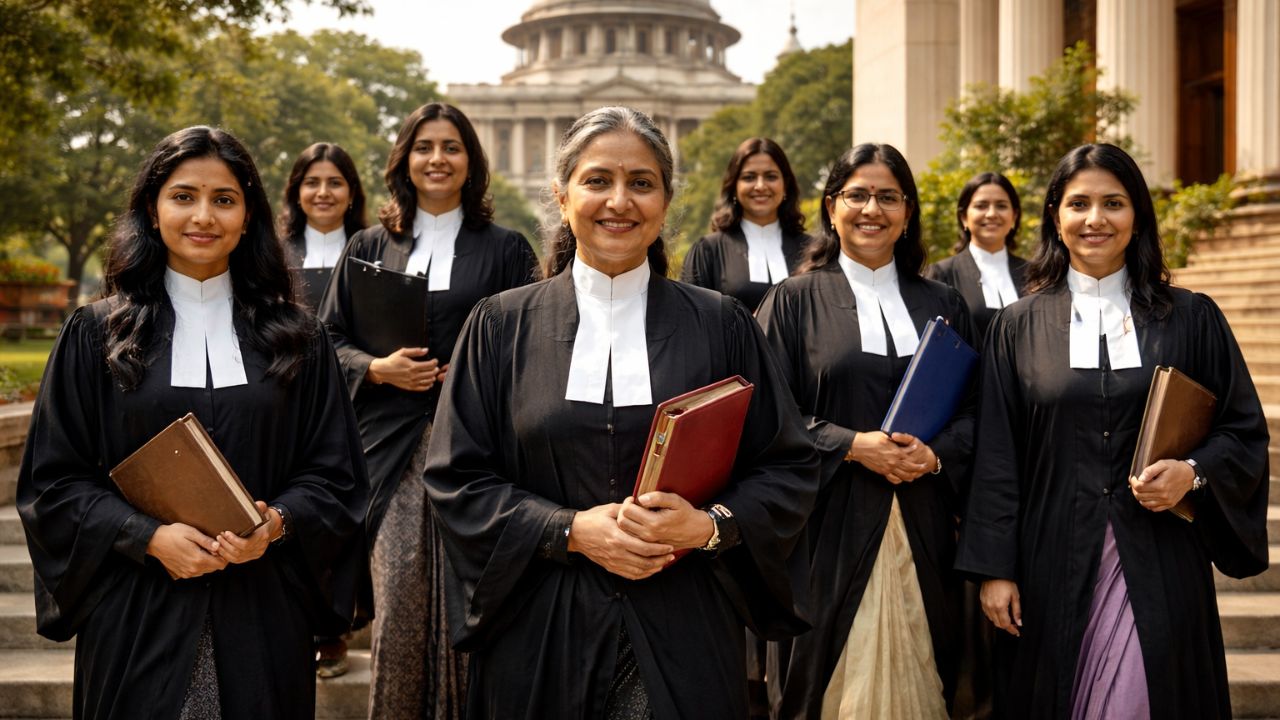
Women judges still a minority in India’s high courts (Image Source: AI)
New Delhi: The Union Law Minister, Arjun Ram Meghwal, on Friday informed the Lok Sabha during Question Hour that at present there are only 116 women judges across the country in various High Courts, out of a total of 814 sitting judges, as per Dynamite News correspondent.
The Minister said that the states of Punjab and Haryana lead with the highest number of 18 women judges. This is followed by the Maharashtra High Court with 12 women judges, while the Delhi and Tamil Nadu High Courts represent 10 women judges each.
It has been a long journey for the Indian judiciary ever since three High Courts were established in 1862 in Calcutta, Bombay, and Madras by the British Raj. Over the years, gradually, women started entering the legal profession.
With literacy rising, women began to establish themselves in the profession, especially in big cities. The first woman judge of a High Court in India was Justice Anna Chandy, appointed to the Kerala High Court in 1959.
In 1991, Justice Leila Seth became the first female Chief Justice of the Himachal Pradesh High Court. As more women began to pursue careers in the Supreme Court as well, the country saw its first woman judge of the Supreme Court in the form of Justice Fathima Beevi in 1989. She was also the first Muslim woman to be appointed to the apex court.
Further, the present Judge of the Supreme Court, Justice B V Nagarathna, is all set to become the first Chief Justice of the Supreme Court on September 25, 2027, based on the Supreme Court seniority principle.
Although she will hold the position for a brief 36-day tenure, this appointment would mark a historic milestone in the history of the Supreme Court, which started in 1950 from the House of Princes in the Parliament House.

