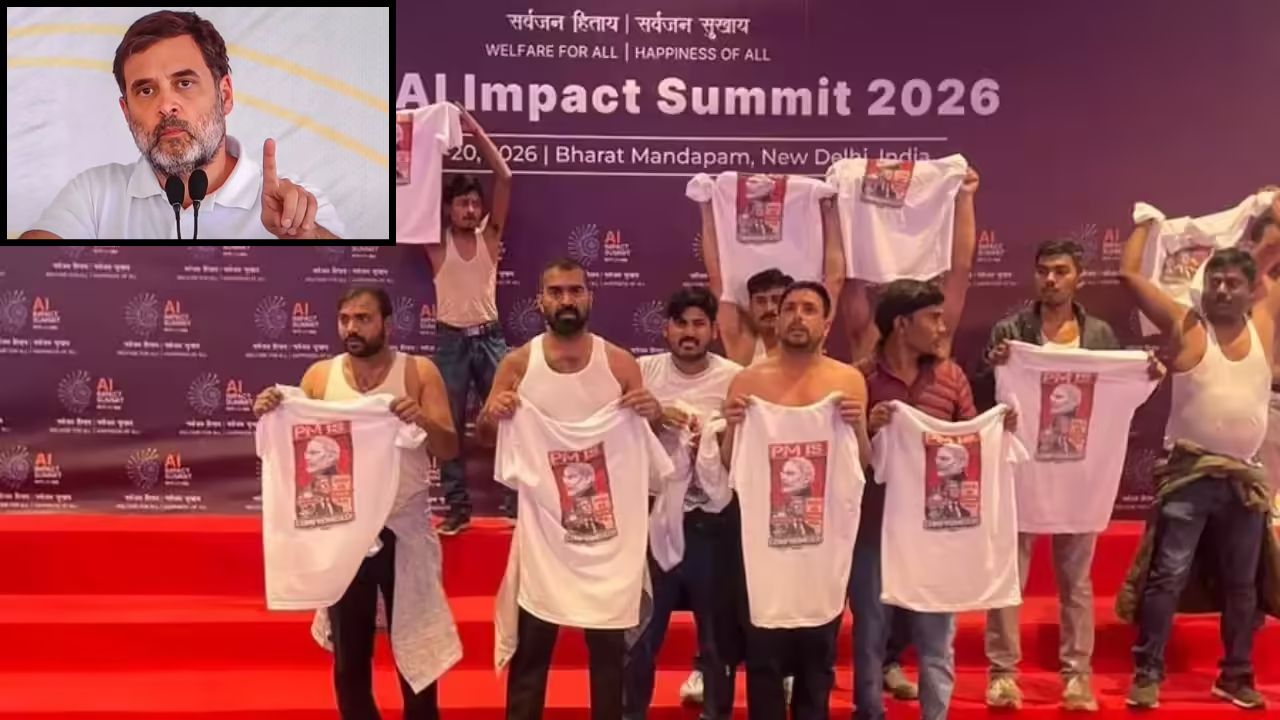
Some protesters were seen wearing or carrying T-shirts with provocative messages
New Delhi: Tension flared at the AI Impact Summit 2026 on Friday after a group of protesters allegedly linked to the Indian Youth Congress entered the venue and raised slogans against Prime Minister Narendra Modi and the proposed India-US trade deal. Some protesters were seen wearing or carrying T-shirts with provocative messages, triggering brief chaos at the high-profile international gathering.
Security personnel intervened and removed the demonstrators, but the incident quickly snowballed into a political flashpoint. The Bharatiya Janata Party (BJP) criticised the protest, describing it as irresponsible and disruptive at a global forum focused on technology and innovation.
India AI Impact Summit: Congress workers stage protests, raise Anti-Modi slogans at Bharat Mandapam
The BJP accused the Congress of attempting to politicise a global AI platform and tarnish India’s image. Party leaders alleged the protest was orchestrated to divert attention from India’s growing role in artificial intelligence cooperation with global partners.
Congress leaders, however, defended the right to protest and raised concerns about transparency in international trade engagements. The exchange deepened the political divide even as summit discussions continued inside the venue.
Amid the controversy, India formally joined Pax Silica, the United States’ flagship initiative on artificial intelligence and supply chain security. The move signals closer technological collaboration between the two countries at a time when AI governance and data sovereignty are emerging as global priorities.
The final day of the summit is expected to feature discussions on AI in education, diplomacy, data protection, and inclusive growth. A Leaders’ Declaration outlining shared commitments on global AI governance may also be adopted.
Prime Minister Narendra Modi, who addressed the summit earlier, outlined India’s “MANAV” vision for artificial intelligence. The framework emphasises moral systems, accountable governance, national sovereignty over data, accessibility, and legitimacy in AI deployment.
‘AI Can Do a Lot, But Not Fix Delhi Traffic’: Here’s why former UK PM Rishi Sunak made the remark
He called for stronger regulatory guardrails, protection of children online, and democratisation of AI technologies to ensure benefits reach all sections of society.
During the summit, OpenAI CEO Sam Altman cautioned that early forms of superintelligence could emerge within a few years. He suggested that global oversight mechanisms may be required to manage the risks of advanced AI systems.
Despite the political turbulence outside, the summit continues to position India as a major player in shaping the future of artificial intelligence.

