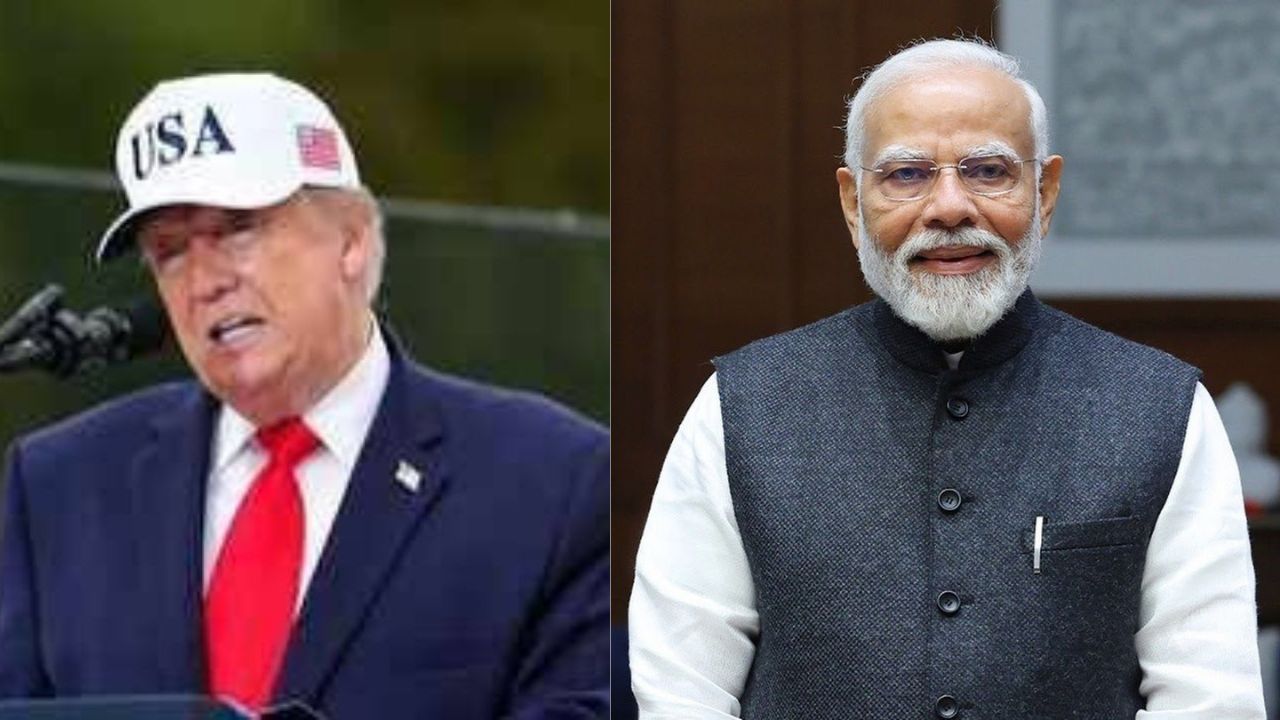
India's diplomatic calculations are under renewed focus after the Democrats' sweeping victory in the 2026 US midterm elections. (Img: X)
New Delhi: The sweeping victory of the Democratic Party in the 2026 US midterm elections has dealt a major political blow to President Donald Trump, with the opposition securing control of both chambers of Congress. The outcome is being closely watched in New Delhi, where concerns have mounted over Washington's increasingly unpredictable approach to trade, regional security, immigration and its strategic engagement with South Asia.
For India, the electoral setback suffered by Trump's Republican Party could offer some diplomatic relief after months of friction over tariffs, Russian oil imports, Pakistan, H-1B visas and the broader direction of bilateral relations. However, the change in the balance of power in Congress does not automatically translate into a shift in the White House's foreign policy. The next phase of India-US engagement will largely depend on how the Trump administration responds to the new political reality in Washington.
The midterm verdict has also placed the relationship between the world's two largest democracies under renewed scrutiny. New Delhi will be assessing whether the Democratic majority can act as an institutional counterweight to the President's decisions and encourage a more predictable approach towards India.
India's concerns have particularly centred on Trump's engagement with Pakistan and his public statements on the India-Pakistan relationship. The US President has developed a close working relationship with Pakistan's military leadership, particularly Field Marshal Asim Munir, and has repeatedly taken credit for facilitating the ceasefire understanding between New Delhi and Islamabad following Operation Sindoor.
Trump's claims about his role in securing the cessation of hostilities have remained a sensitive issue for India, which has consistently maintained that matters concerning Pakistan must be addressed bilaterally without third-party intervention. His public remarks on the India-Pakistan conflict have therefore added another layer of diplomatic unease.
New Delhi has also been concerned about Washington's approach towards Pakistan's economic and security requirements. While the US has extended support to Islamabad as it navigates financial difficulties, India has continued to seek a stronger and more consistent American position against cross-border terrorism.
A particularly significant development for Indian policymakers was Washington's public endorsement of Pakistan's assertion that terrorist activity against it was originating from Afghanistan. Such positions have reinforced concerns in New Delhi that the Trump administration's engagement with Pakistan could increasingly diverge from India's security priorities.
India is also likely to monitor the implications of closer US-Pakistan military engagement. Greater American support for Pakistan's defence capabilities, including the possible modernisation of its US-origin aerial platforms, could have consequences for the regional military balance and India's strategic calculations.
Trade has emerged as another major source of friction between New Delhi and Washington. The Trump administration threatened India with steep tariffs over its continued purchases of Russian oil, putting pressure on a relationship that had been projected as a central pillar of the wider Indo-Pacific partnership.
India has maintained that its energy procurement decisions are guided by national interests, energy security and the need to protect consumers from excessive price volatility. New Delhi has also defended its right to maintain diversified energy partnerships in a rapidly changing global market.
The controversy became more contentious because Washington itself moved to secure energy supplies from Russia, including a reported arrangement to purchase diesel ahead of the midterm elections. The apparent contrast between American pressure on India and its own energy-related dealings with Moscow added to questions about the consistency of the administration's approach.
Trump had also described India as a dead economy, although he subsequently praised the country's growth trajectory during a television interview earlier this year. Such contrasting remarks have contributed to uncertainty over the tone and direction of the administration's India policy.
For India, the issue is not limited to tariffs or the immediate cost of trade. It concerns the reliability of the broader economic partnership, the treatment of Indian exporters and the possibility of policy decisions being influenced by shifting political considerations in Washington.
Immigration policy has become another important area of concern for India, particularly because of the large number of Indian professionals and students who travel to the United States for employment and higher education.
The Trump administration's restrictive approach towards H-1B visas has generated anxiety among Indian technology professionals, employers and companies that depend on skilled international talent. Changes in visa rules, heightened scrutiny and uncertainty over the future of employment-based immigration have implications for India's technology workforce and the operations of Indian firms with a presence in the US.
Pressure on student visas has added to the concerns of Indian families and educational institutions. The United States remains a major destination for Indian students, and any tightening of immigration procedures can affect enrolment decisions, research collaborations and the movement of skilled talent between the two countries.
These issues have a direct domestic dimension for India. The treatment of Indian professionals and students is closely linked to public perceptions of the bilateral relationship, making immigration policy an important component of New Delhi's diplomatic engagement with Washington.
The delay in convening the Quad leaders' summit, which India was expected to host in 2025, has also attracted attention. The Quad, comprising India, the United States, Japan and Australia, is a key platform for cooperation in the Indo-Pacific region.
The grouping focuses on maritime security, critical and emerging technologies, resilient supply chains, infrastructure, regional connectivity and a rules-based regional order. For India, the Quad is an important element of its wider Indo-Pacific strategy and its efforts to maintain a stable regional balance.
The postponement of the summit has therefore raised questions about the pace of high-level coordination among the four partners. While the midterm results do not directly determine the future of the Quad, the new congressional balance could influence the political debate surrounding America's regional commitments and strategic partnerships.
New Delhi will be watching whether Washington continues to treat the Indo-Pacific as a central foreign policy priority or whether domestic political divisions and other international crises affect its engagement with the region.
India's approach to the Ukraine conflict has also been a recurring point of disagreement with Washington. New Delhi has faced criticism and pressure over its purchases of Russian crude oil, with the Trump administration linking energy trade to its wider policy towards Moscow.
India has consistently argued that its energy decisions must be assessed in the context of national requirements, affordability and the interests of its citizens. It has maintained that access to reliable and competitively priced energy supplies is essential for economic stability.
New Delhi has also advocated an end to the war in Ukraine and has emphasised the importance of dialogue and diplomacy in resolving international conflicts. Its position reflects a broader effort to maintain strategic autonomy while engaging with major global powers.
India has similarly called for an end to the conflict involving Iran, underscoring its preference for de-escalation and diplomatic solutions in regions that have a direct bearing on global energy markets and regional stability.
The Democratic victory in the US midterms may increase scrutiny of the administration's international decisions, but it does not necessarily indicate an immediate change in America's approach towards either conflict.
The Democrats' takeover of both the House and the Senate gives the party greater institutional leverage over the remaining two years of Trump's presidency. A Democratic-controlled Congress can scrutinise administration policies, conduct investigations, influence legislation and exercise greater oversight over government spending and appointments.
This could create additional avenues for Indian policymakers to engage with lawmakers across the political spectrum, particularly on trade, immigration, defence cooperation and the Indo-Pacific. It may also increase the political scrutiny of decisions that have created friction between Washington and New Delhi.
However, Congress does not independently control the entire foreign policy apparatus. The President retains substantial executive authority, including considerable influence over diplomatic engagement, trade policy and national security decisions. Any expectation that the midterm outcome will immediately reverse Trump's approach towards India would therefore be premature.
The election result should instead be viewed as a change in Washington's domestic political balance that could affect the environment in which bilateral negotiations and strategic decisions take place.
India has little reason to celebrate the electoral setback of a US President with whom it must continue to work on a range of strategic and economic issues. New Delhi's priorities remain centred on stable trade relations, predictable tariff policies, access for Indian professionals and students, counterterrorism cooperation and a balanced approach towards South Asia.
The relationship also carries significant importance for defence technology, supply-chain diversification, critical minerals, emerging technologies and Indo-Pacific security. These shared interests provide a strong basis for engagement despite the differences that have emerged during Trump's presidency.
The midterm verdict has altered the political landscape in Washington and strengthened the Democratic Party's ability to challenge the administration's agenda. Whether that translates into a more consistent and constructive approach towards India will depend on decisions taken by the White House and the willingness of both countries to address outstanding differences.
For New Delhi, the priority is not to interpret Trump's defeat as a diplomatic victory, but to use the evolving political environment to reinforce India's strategic interests. After months of disagreements over tariffs, Pakistan, Russian oil and immigration, the responsibility for restoring confidence in the partnership now rests substantially with Washington.

