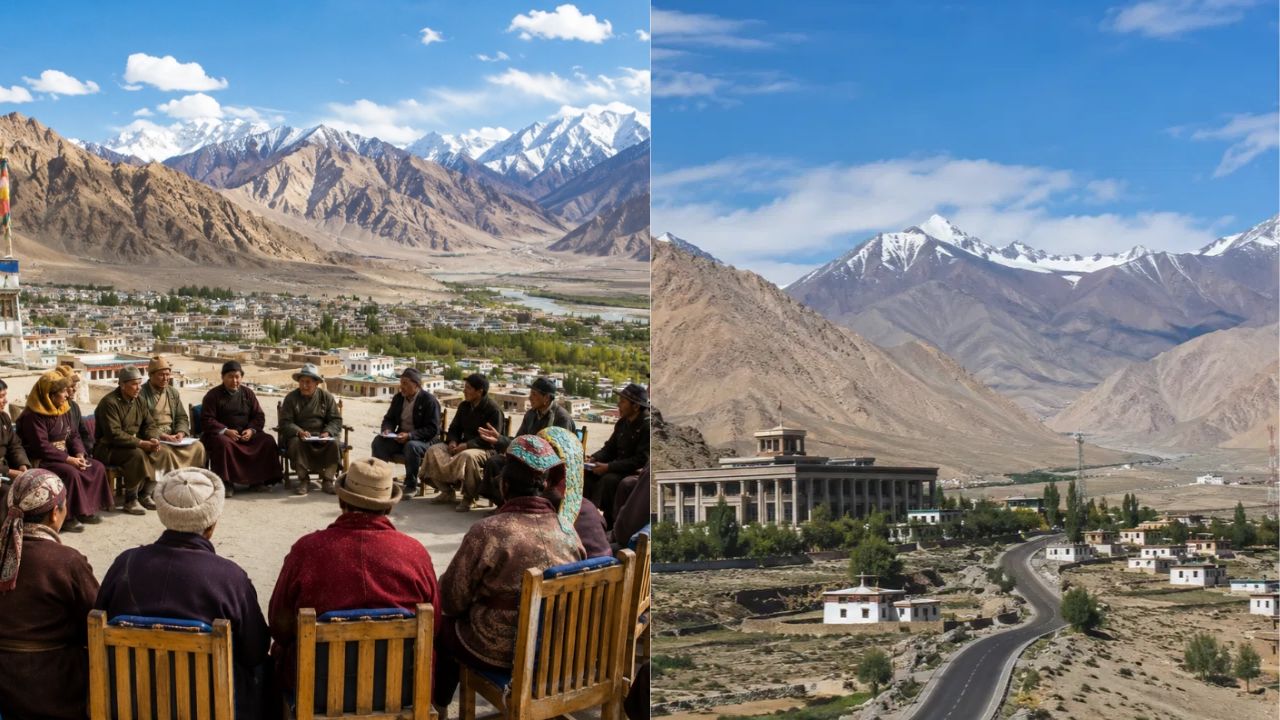
Ladakh announces autonomous hill councils for all 7 districts (Img: Dynamite News)
Leh: The Ladakh administration has announced that each of the Union Territory’s seven districts will have an Autonomous Hill Development Council, significantly expanding elected local governance beyond Leh and Kargil.
The five newly notified districts- Sham, Nubra, Changthang, Zanskar and Drass will also receive separate councils. Ladakh moved from two to seven districts in April 2026.
Also Read: Cheetah Helicopter Crash in Ladakh Injures Senior Army Officers
The proposed councils are expected to exercise legislative, executive, administrative and financial authority over several local matters. Their responsibilities could include land allotment, district-level recruitment, promotions and preparation of development plans.
The councils are also expected to oversee education, healthcare, tourism, welfare schemes and other areas directly affecting residents.
Chief Secretary Ashish Kundra described the decision as a major step towards democratic decentralisation and grassroots governance. The existing council law permits the creation of a hill council for every district, though amendments and constituency delimitation will be required before the new bodies become operational.
Part XXI of the Constitution contains special provisions for particular states and regions. Article 371 and its related provisions- Articles 371A to 371J provide region-specific administrative arrangements and safeguards based on historical, cultural, geographical or social circumstances.
Depending on the state concerned, these provisions may protect customary laws, land ownership, local employment, cultural identity or administrative structures.
Also Read: Kharge’s slip of tongue exposed Modi-Shah’s gameplan on Article 371: Congress leader Jairam Ramesh
Ladakh does not currently have a separate Article 371 provision. The proposed arrangement is expected to involve a customised constitutional framework inspired by such safeguards and linked to a Union Territory-level institution.
Demands for protection of Ladakh’s land, jobs, environment and cultural identity have intensified since it became a Union Territory in 2019.
Civil society organisations, including the Leh Apex Body and Kargil Democratic Alliance, have repeatedly sought constitutional safeguards and greater political representation. The expansion of hill councils is therefore being viewed as an important step, although the final powers will depend on legal amendments and the constitutional framework approved by the Centre.

