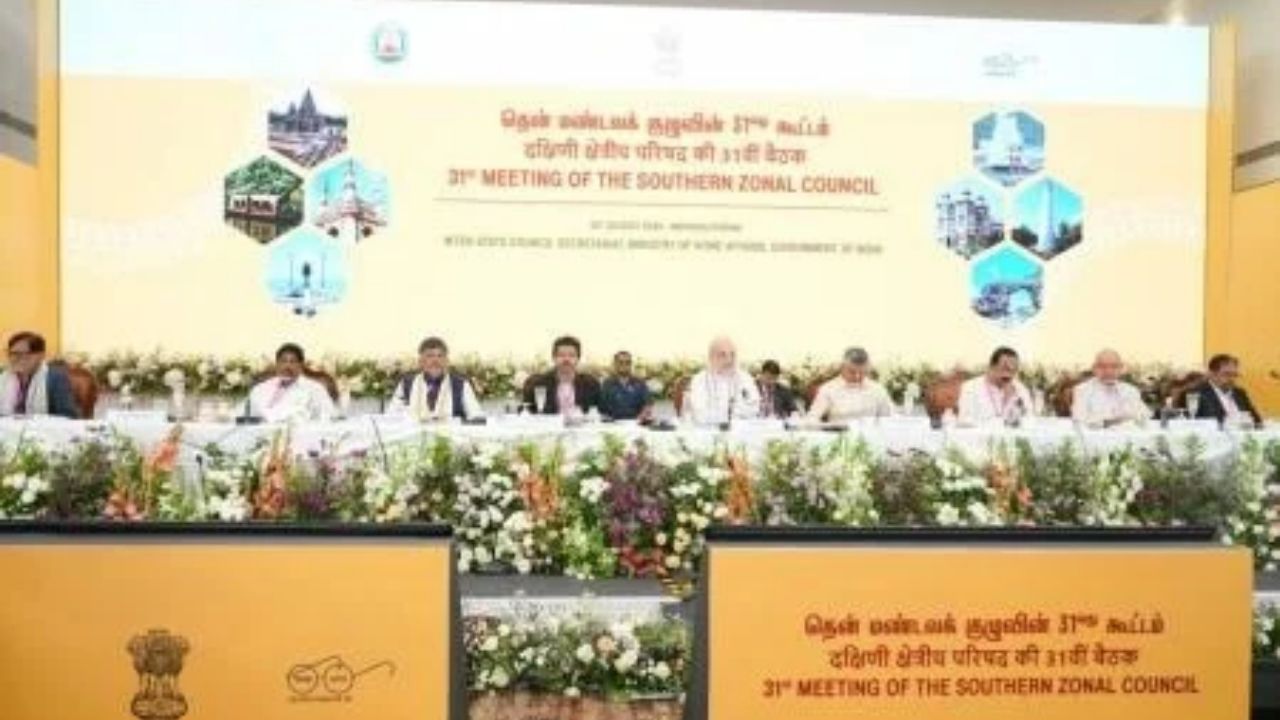
Union Home Minister Amit Shah brings top southern leaders together at the 31st Southern Zonal Council meeting in Tamil Nadu
New Delhi: Union Home Minister Amit Shah on Thursday chaired the 31st meeting of the Southern Zonal Council at Kovalam in Tamil Nadu’s Chengalpattu district, bringing together chief ministers, deputy chief ministers, administrators and senior officials from five southern states and three Union Territories.
The meeting, hosted by the Tamil Nadu government at the Taj Fisherman’s Cove resort, became a major platform for discussing long-pending interstate disputes, development challenges and issues involving coordination between the Centre and states.
Tamil Nadu Chief Minister C. Joseph Vijay, Andhra Pradesh Chief Minister N. Chandrababu Naidu, Karnataka Deputy Chief Minister D.K. Shivakumar, Kerala leaders and Telangana Deputy Chief Minister Mallu Bhatti Vikramarka were among the prominent participants.
The discussions gained significance as southern states raised concerns related to river water sharing, parliamentary delimitation, infrastructure projects, welfare schemes and protection of regional interests.
The Southern Zonal Council is one of the five Zonal Councils created under Sections 15 to 22 of the States Reorganisation Act, 1956. The council includes Andhra Pradesh, Karnataka, Kerala, Tamil Nadu and Telangana, along with the Union Territories of Puducherry, Andaman and Nicobar Islands and Lakshadweep.
Union Home Minister Amit Shah serves as the chairman of the council, while Tamil Nadu Chief Minister C. Joseph Vijay is currently the vice-chairman. Unlike Parliament or state assemblies, Zonal Councils are advisory platforms that help the Centre, states and Union Territories discuss issues involving multiple governments and find solutions through dialogue.
The meetings are organised by the Inter-State Council Secretariat under the Ministry of Home Affairs and are considered an important part of India’s cooperative federalism framework.
One of the biggest issues discussed during the Southern Zonal Council meeting was interstate water sharing. Southern states continue to face several river-related disputes, including the Cauvery water dispute between Karnataka and Tamil Nadu, Krishna river-related concerns between Andhra Pradesh and Telangana and water-sharing issues involving Tamil Nadu and Kerala.
Tamil Nadu Chief Minister C. Joseph Vijay highlighted the economic importance of southern states, pointing out that the region contributes more than 30 per cent of India’s Gross Domestic Product and remains a major growth engine for the country. He stressed that the rights of lower riparian states must be protected and states dependent on rivers should receive assured water flows.
Tamil Nadu also emphasised that Supreme Court judgments, tribunal awards and statutory river management mechanisms should be implemented effectively to avoid future conflicts.
The future delimitation exercise emerged as another major issue during the meeting. Karnataka Deputy Chief Minister D.K. Shivakumar raised concerns over the possible impact of population-based delimitation on southern states’ representation in Parliament.
He urged the council to consider continuing with the 1971 Census as the basis for delimitation and retaining the existing strength of the Lok Sabha at 543 seats for the next 25 years.
The Karnataka leadership argued that states which successfully controlled population growth should not lose their political representation because of demographic changes. The issue reflects a wider concern among southern states that future seat redistribution could reduce their influence in national politics despite their economic contribution.
Karnataka Deputy Chief Minister DK Shivakumar also raised concerns over public sector undertakings auctioning land that was earlier allotted by state governments. He questioned the use of government-linked land assets and called for better coordination between the Centre and states.
The issue came up during discussions related to defence and government land utilisation. The matter highlights growing concerns among states regarding ownership, management and future use of valuable public land resources.
Apart from political and interstate disputes, the Southern Zonal Council meeting covered several development-related issues. The agenda included education, healthcare funding, civil aviation, infrastructure projects involving multiple states, environmental protection and regional security.
The council also reviewed issues linked to the Andhra Pradesh Reorganisation Act and implementation of central schemes, including Pradhan Mantri Awas Yojana-Gramin. The functioning of Fast Track Special Courts for speedy investigation and disposal of crimes against women and children was also discussed.
The Ministry of Home Affairs highlighted the role of Zonal Councils in strengthening cooperative federalism and promoting better coordination between the Centre and states. The meetings are linked with Prime Minister Narendra Modi’s vision of “Team Bharat”, where governments work together on issues affecting national development.
Since June 2014, 69 meetings of various Zonal Councils and their standing committees have been held, showing the growing importance of these platforms in resolving regional issues.
The meeting brought several powerful southern leaders together at a time when debates over federalism, political representation and resource sharing remain important national issues. The presence of leaders from Tamil Nadu, Karnataka, Andhra Pradesh, Kerala and Telangana made the gathering politically significant.
Beyond administrative discussions, the meeting highlighted deeper questions surrounding economic contribution, political representation, water security and the relationship between southern states and the Centre.

