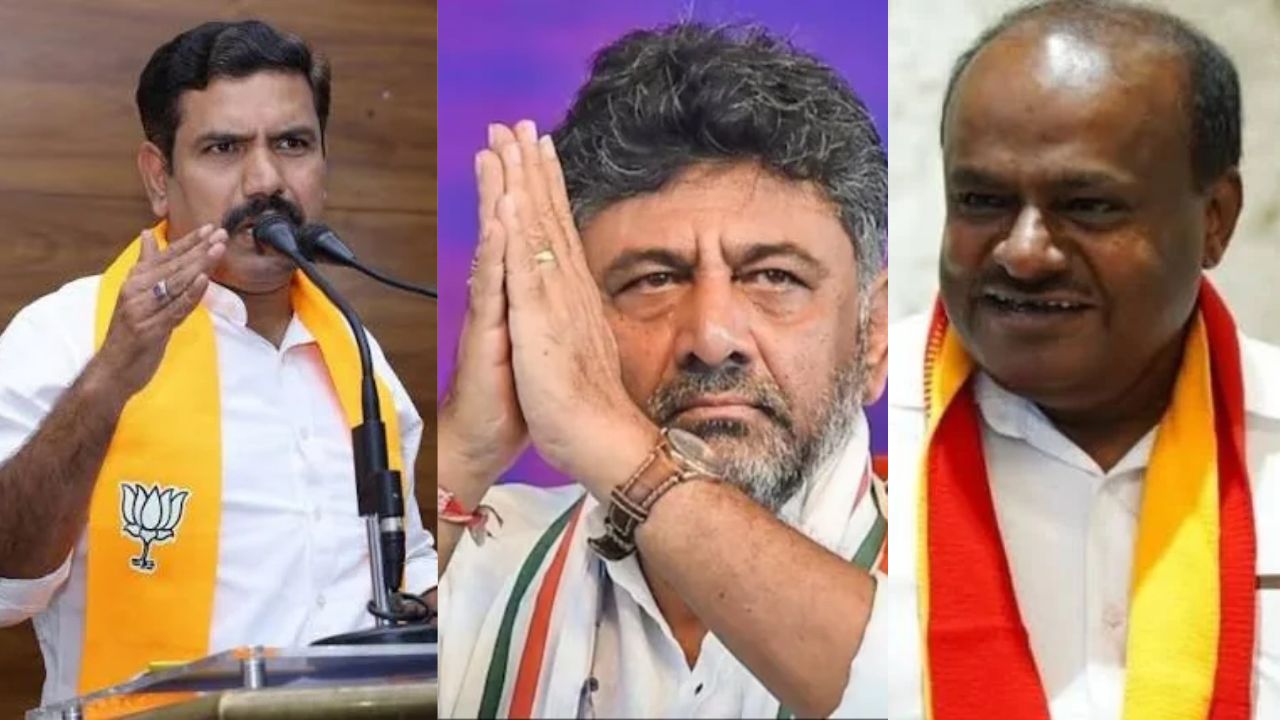
BJP and JD(S) celebrate a clean sweep in Karnataka’s four Legislative Council constituencies, leaving Congress without a victory. (Img: X)
Bengaluru: The BJP-JD(S) alliance has won all four Karnataka Legislative Council seats contested in the October 23 elections, leaving the ruling Congress without a single victory. The clean sweep marks a significant political setback for Congress and gives the Opposition a boost as the alliance tests its electoral coordination across teachers’ and graduates’ constituencies.
The BJP won three of the four seats, securing victories in the North East Teachers, South East Graduates and West Graduates constituencies. Its alliance partner, the Janata Dal (Secular), won the Bengaluru Teachers constituency, completing a clean sweep for the two parties.
The outcome is significant because the BJP and JD(S) contested the elections together, putting their coordination to the test across constituencies representing teachers and graduates. Their combined performance has given the alliance a political win to highlight as it seeks to challenge the Congress government in Karnataka.
For Congress, the result is a setback on two fronts. The party contested all four seats but failed to secure a victory, while the BJP-JD(S) partnership demonstrated its ability to convert coordinated electoral efforts into results across all the constituencies.
The four seats were more than a limited electoral contest. Teachers’ and graduates’ constituencies represent specific voter groups, making their results an indicator of political support among sections of the electorate with professional and educational interests.
The BJP-JD(S) sweep gives the Opposition fresh political ammunition against the Congress government, which came to power in Karnataka in 2023. The result also provides the alliance with an opportunity to present its partnership as an effective electoral arrangement ahead of future political contests.
For the Congress, the immediate challenge is to understand why it could not translate its position as the ruling party into a win in any of the four constituencies. The results may prompt renewed scrutiny of the party’s organisational preparedness, candidate selection and outreach among teachers and graduates.
However, the outcome of these four seats should not automatically be interpreted as a verdict on the preferences of the entire Karnataka electorate. The constituencies involved represent specific voter groups, and their results must be viewed within that electoral context.
The clean sweep offers an early indication that the BJP and JD(S) can coordinate their electoral efforts effectively when contesting together. The alliance secured victories across all four constituencies, with the BJP winning three seats and the JD(S) taking the remaining one.
Seat-sharing and coordination are central to alliances seeking to maximise their electoral strength. When partners divide constituencies between themselves and avoid competing against one another, they can potentially consolidate their respective support bases. The Karnataka MLC results provide the BJP and JD(S) with a favourable outcome to cite in support of that approach.
The results do not, by themselves, establish how the alliance would perform in a wider election. Nevertheless, the victory gives both parties a positive political development to build on as they prepare for future contests in the state. The outcome also places pressure on Congress to reassess its strategy in constituencies where the BJP and JD(S) have demonstrated electoral strength.
Despite the electoral setback, the results fail to threaten the Congress government’s position in the Karnataka Legislative Council. The 75-member Council has 38 Congress members, 24 from the BJP and six from the JD(S), alongside one Independent member and the Chairman. Five seats reserved for government nominees are currently vacant.
The four-seat result represents a political setback rather than an immediate threat to the government’s position in the Council. Congress continues to hold a substantial presence in the chamber, while the BJP and JD(S) gain a result they can use to sharpen their criticism of the state government.
The BJP and JD(S) are likely to use the clean sweep to reinforce their argument that coordinated opposition can deliver electoral gains in Karnataka. The result may also encourage both parties to assess how their partnership can be maintained in future contests.

