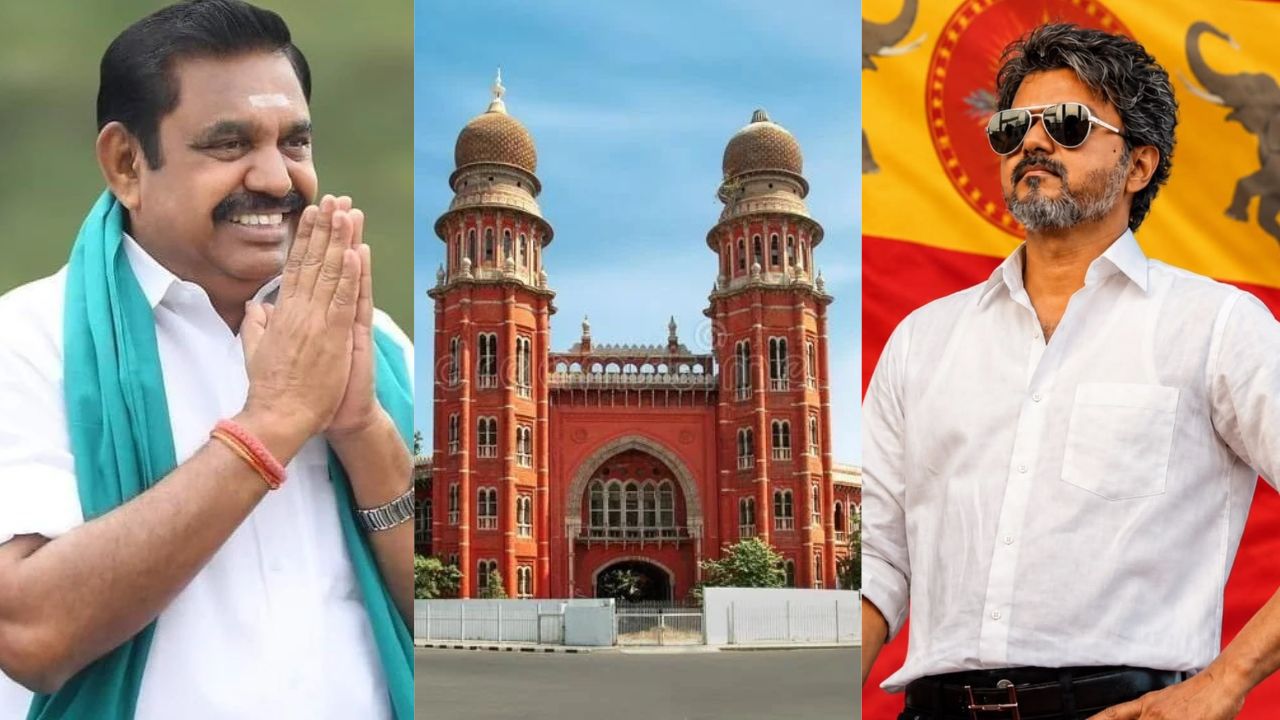
Madras High Court upholds the resignations of six former AIADMK MLAs who joined Vijay’s TVK, but the disqualification battle continues. (Img: Pinterest)
Chennai: The Madras High Court on Tuesday upheld the Tamil Nadu Assembly Speaker’s decision to accept the resignations of six former AIADMK legislators who subsequently joined Chief Minister Joseph Vijay’s Tamilaga Vettri Kazhagam (TVK), delivering a significant ruling in the state’s ongoing political and legal battle over alleged defections.
The Division Bench of Chief Justice Sushrut Arvind Dharmadhikari and Justice G. Arul Murugan, however, made it clear that the resignations will not shield the legislators from pending disqualification proceedings, directing the Speaker to decide the cases within two months.
The Court declined to interfere with the Speaker’s decision to accept the resignations, holding that the letters were genuine and voluntary. It also clarified that the Speaker was not required to conduct an exhaustive inquiry into the political motives behind the legislators’ decisions.
The ruling followed petitions filed by AIADMK whip Agri Krishnamurthy and National People’s Sakthi Party leader ML Ravi, who challenged the acceptance of the resignations.
The petitioners questioned whether the Speaker should have accepted the resignation letters while disqualification proceedings relating to the legislators’ voting conduct remained pending. They also raised concerns about the speed of the process and allegations of possible horse-trading and inducements.
The court distinguished between resignation from the legislature and disqualification under the Constitution. While the former concerns the voluntary relinquishment of an Assembly seat, the latter examines whether a legislator’s conduct attracts constitutional penalties for defection. Consequently, the acceptance of the resignations does not automatically terminate the pending proceedings.
The case concerns S. Jayakumar, Maragatham Kumaravel, P. Sathyabhama, Isakki Subbaiah, C. Vijaya Bhaskar and M. R. Vijayabhaskar. All six had contested the Tamil Nadu Assembly elections as AIADMK candidates before resigning and subsequently joining the TVK.
Their political shift became controversial after they allegedly defied the AIADMK’s instructions during a confidence motion and supported the TVK government.
The AIADMK maintained that the legislators’ voting behaviour warranted action under the Tenth Schedule of the Constitution, which provides the framework for disqualification on grounds of defection.
The petitioners argued that the circumstances surrounding the resignations required closer scrutiny, particularly because the legislators subsequently aligned themselves with the ruling party. The court’s ruling, however, establishes that the validity of a resignation and the question of disqualification must be assessed separately.
The petitioners relied on Article 190 of the Constitution, which governs the vacation of seats in state legislatures. Under Article 190(3)(b), the Speaker must examine whether a resignation is voluntary and genuine before accepting it.
The AIADMK argued that the Speaker should have conducted a meaningful inquiry and given the party an opportunity to raise objections. It also questioned whether the speed with which the resignations were accepted, followed by the legislators’ move to the TVK, justified greater scrutiny.
The petitioners further challenged the Gazette notifications declaring the Assembly seats vacant, arguing that constitutional safeguards should not be reduced to a procedural formality.
The Speaker maintained that the resignations were accepted only after personal interaction with the legislators and verification that they were acting voluntarily, without coercion or undue influence.
The Assembly authorities also argued that the Constitution does not require the Speaker to investigate every political motive behind a resignation. The central requirement, they maintained, is to establish that the resignation reflects the member’s genuine intention.
Representing the legislators, Senior Advocate Menaka Guruswamy argued that resigning from the legislature before joining another political party could constitute an exercise of democratic choice. The legislators disputed the suggestion that their actions should automatically be treated as evidence of wrongdoing.
The dispute emerged following the Tamil Nadu Assembly election results announced on May 4, 2026. The TVK, led by Vijay, emerged as a major political force but fell short of the 118 seats required for a simple majority in the 234-member Assembly.
The party subsequently secured support from other legislators and formed the government. During the confidence motion held on May 13, the government secured 144 votes in its favour.
According to the AIADMK, the party had issued a whip directing its legislators to oppose the confidence motion. However, 25 AIADMK MLAs allegedly voted in favour of the TVK government, prompting disqualification proceedings against members accused of defying the party directive.
Proceedings were initiated under the Tenth Schedule on May 14. Some cases were subsequently dropped after certain legislators apologised for their conduct, according to the material reported in connection with the dispute.
The six legislators at the centre of the present case later resigned and joined the TVK, prompting the legal challenge over the Speaker’s authority to accept their resignations while proceedings relating to alleged defection remained pending.
The ruling has implications beyond the six legislators. It highlights the constitutional distinction between a member’s right to resign and the legislature’s responsibility to examine alleged violations of the anti-defection framework.
For political parties, the case underscores the importance of party whips and the legal mechanisms available when legislators allegedly vote against official instructions. For elected representatives, it demonstrates that leaving the legislature does not necessarily erase the consequences of conduct that occurred while they held office.
The political implications have also extended to the electoral arena. Maragatham Kumaravel and P. Sathyabhama subsequently contested by-elections from Madurantakam and Dharapuram, respectively, as TVK candidates and won, according to the reports provided.
Their victories add another dimension to the controversy, although electoral success does not independently determine the outcome of separate constitutional disqualification proceedings.

