 English
 English

Nishad Kumar celebrates a historic double-gold campaign at the Asian Para Games 2026 after setting a new Games record in the men’s high jump T47. (Img: X)
Aichi-Nagoya: India’s para-athletes delivered a memorable performance on Day 2 of the Asian Para Games 2026 in Aichi-Nagoya, Japan, combining record-breaking achievements, multiple podium finishes and significant progress across disciplines. Nishad Kumar emerged as the headline performer after winning his second gold medal in two days and setting a new Games record in the men’s high jump T47 event.
The Indian contingent also celebrated gold-medal performances from Deepthi Jeevanji, Simran, Pranav Soorma and Devender Kumar, alongside podium finishes in para-athletics, para-shooting, para-powerlifting, para-table tennis and para-swimming. Indian para-badminton players advanced through the quarter-finals, while Sheetal Devi progressed to the women’s individual compound final in para-archery.
According to the competition reports available on October 20, India’s medal tally stood at 35, comprising nine gold, 11 silver and 15 bronze medals. The results underlined the contingent’s growing depth across multiple para-sport disciplines, with further medal opportunities remaining in events still underway.
Nishad Kumar delivered one of the defining performances of the Games by winning gold in the men’s high jump T47 final with a record-breaking clearance of 2.04 metres. The victory followed his triumph in the men’s long jump T47 event on Monday, where he recorded a best effort of 7.11 metres.
The double-gold campaign made Nishad only the third Indian to win two gold medals in a single edition of the Asian Para Games. He joined middle-distance runner Ankur Dhama and armless archer Sheetal Devi, who achieved the distinction at the previous edition in Hangzhou, China. Dhama won the men’s 5,000-metre T11 and 1,500-metre T11 titles, while Sheetal secured gold in the women’s individual compound open and mixed team compound open events.
Nishad’s high-jump performance was marked by technical precision and consistency. He cleared heights of 1.88 metres, 1.94 metres, 1.98 metres and 2.02 metres on his first attempts before crossing 2.04 metres to establish the new Games record. He subsequently attempted 2.06 metres but could not clear the bar. By then, however, the gold medal was already secured.
Uzbekistan’s Muhammadabdulloh Tursunjonov finished second with a best clearance of 1.94 metres, while Thailand’s Angkarn Chanaboon claimed bronze with 1.75 metres. Nishad’s winning height was 10 centimetres greater than the silver medallist’s best effort, underlining the Indian athlete’s commanding performance.
The T47 classification is intended for athletes with upper-limb impairments. Nishad’s achievement in this category adds another significant milestone to a career that includes high-jump silver medals at the Tokyo 2020 and Paris 2024 Paralympic Games, as well as a world championship gold in the discipline.
Nishad’s rise has been defined by resilience and sustained competitive excellence. At the age of six, he lost his right arm in an accident involving a grass-cutting machine at his family’s farm in Amb, Himachal Pradesh. He subsequently built an international sporting career, establishing himself among India’s leading para-athletes.
His double-gold campaign in Aichi-Nagoya also demonstrated his versatility. While high jump has been his signature event, his victory in the long jump T47 competition showed his ability to compete successfully across disciplines that demand different technical skills, training methods and physical preparation.
After winning the long jump title, Nishad recorded the same distance of 7.11 metres on two attempts in the final. His victory was particularly notable because it came on his Asian Para Games debut in the event.
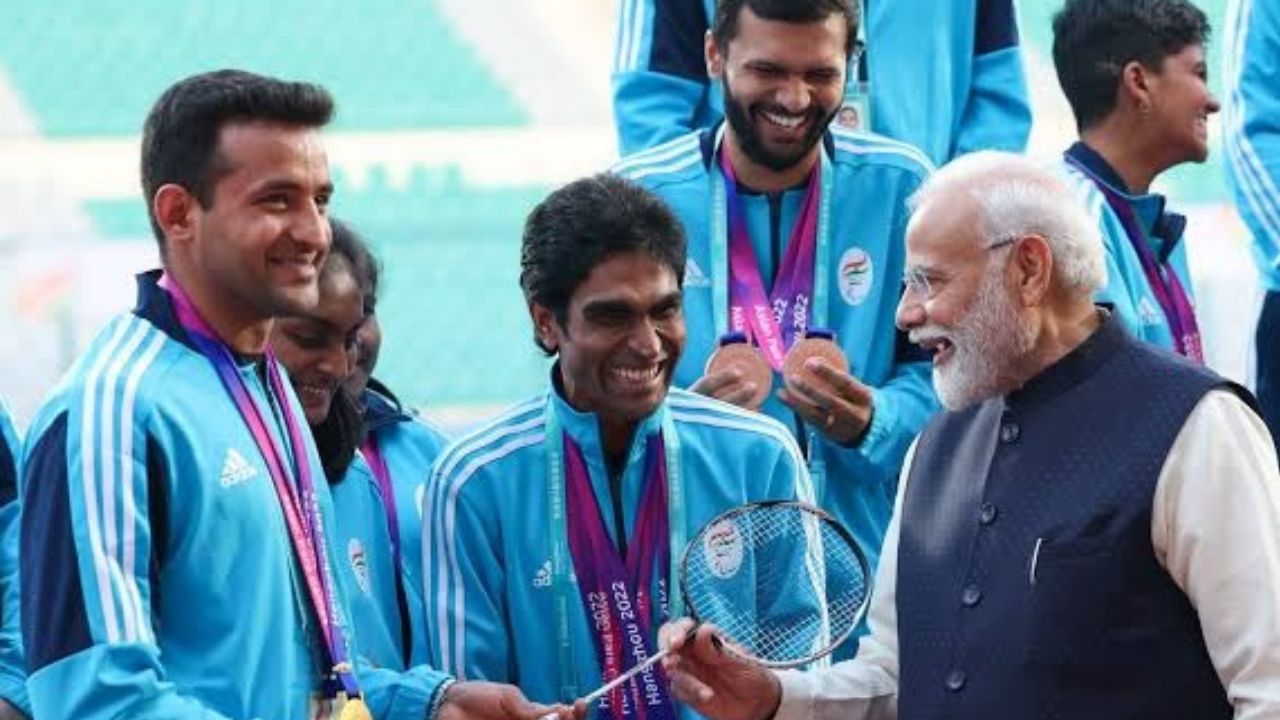
Prime Minister Narendra Modi congratulated Nishad following the long-jump triumph, recognising the significance of the performance and the athlete’s ability to excel beyond his specialist discipline. The message also highlighted the importance of his determination and sporting excellence.
With two gold medals and a new Games record, Nishad has emerged as one of India’s most successful performers in the ongoing continental competition.
Behind Nishad’s success was a structured preparation programme built around consistency, communication and attention to detail. The athlete credited the training camp and the positive atmosphere within the team for helping him approach the competition with confidence.
The preparation strategy focused on addressing doubts early rather than allowing uncertainty to affect performance on competition day. The team also followed a carefully planned schedule, ensuring that travel from the hotel, warm-up sessions and arrival at the call room were completed on time.
Nishad’s approach highlights the importance of competition-day management in elite para-athletics. Rushed preparation can create unnecessary stress and fatigue, potentially affecting an athlete’s rhythm before an event. By maintaining a measured warm-up routine, allowing adequate recovery and following established procedures, the team sought to conserve energy and ensure that the athlete remained focused.
Having achieved his immediate target at the Asian Para Games, Nishad is now looking towards next year’s World Championships. His next objective is to secure qualification and compete strongly at the global event, carrying forward the same preparation-led approach that delivered success in Japan.
India’s gold-medal momentum extended beyond Nishad’s achievements. Deepthi Jeevanji won the women’s 400-metre T20 title in 56.36 seconds, setting a new Games record and adding another major result to the country’s para-athletics campaign.
Simran secured gold in the women’s 200-metre T12 event, while Tejalben Damor claimed bronze in the same event category. Preeti Pal added silver in the women’s 200-metre T35 race, contributing to India’s medal count in track events.
In the field competitions, Pranav Soorma won gold in the men’s discus throw F51/F52/F53 category, with Ram Ratan Singh taking silver. Their podium finishes strengthened India’s presence in throwing events and added to the country’s growing collection of medals.
The combination of sprinting, middle-distance and field-event results demonstrated the breadth of India’s para-athletics programme, with athletes delivering across different classifications and technical disciplines.
One of the standout field-event results came in the men’s discus throw F43/F44/F62/F64 competition, where Devender Kumar, Rakesh and Pardeep Kumar occupied all three podium positions.
Devender secured gold with 781 Raza Points, supported by a second throw of 49.71 metres. Rakesh claimed silver with 771 points after registering 49.35 metres on his fourth attempt. Pardeep took bronze with 669 points, aided by a personal-best effort of 51.15 metres.
Because the competition brought together multiple classifications, the final positions were determined using Raza Points rather than distance alone. The scoring system enables performances across eligible classifications to be compared through a points-based framework.
The F44 and F64 classifications relate to athletes with lower-limb impairments, with F64 athletes competing with a prosthesis. The all-Indian podium was a significant achievement for the contingent, highlighting the country’s depth in para-field events.
India continued to add to its athletics tally through the throwing disciplines. Pradeep Kumar won silver in the men’s javelin throw F53/F54 event, while Ayush Verma secured bronze.
Praveen Sharma claimed bronze in the men’s shot put F11 competition. Hokato Hotozhe Sema also finished third in the men’s shot put F56/F57 final, registering 999 points with a best throw of 14.65 metres.
Fellow Indian Soman Rana finished fourth with a throw of 13.80 metres and 942 points. Although he missed the podium, his performance added to India’s participation in a competitive field-event programme.
These results reinforced para-athletics as a major contributor to India’s medal haul, with the country producing podium finishes in jumping, sprinting, middle-distance running, javelin, discus and shot put.
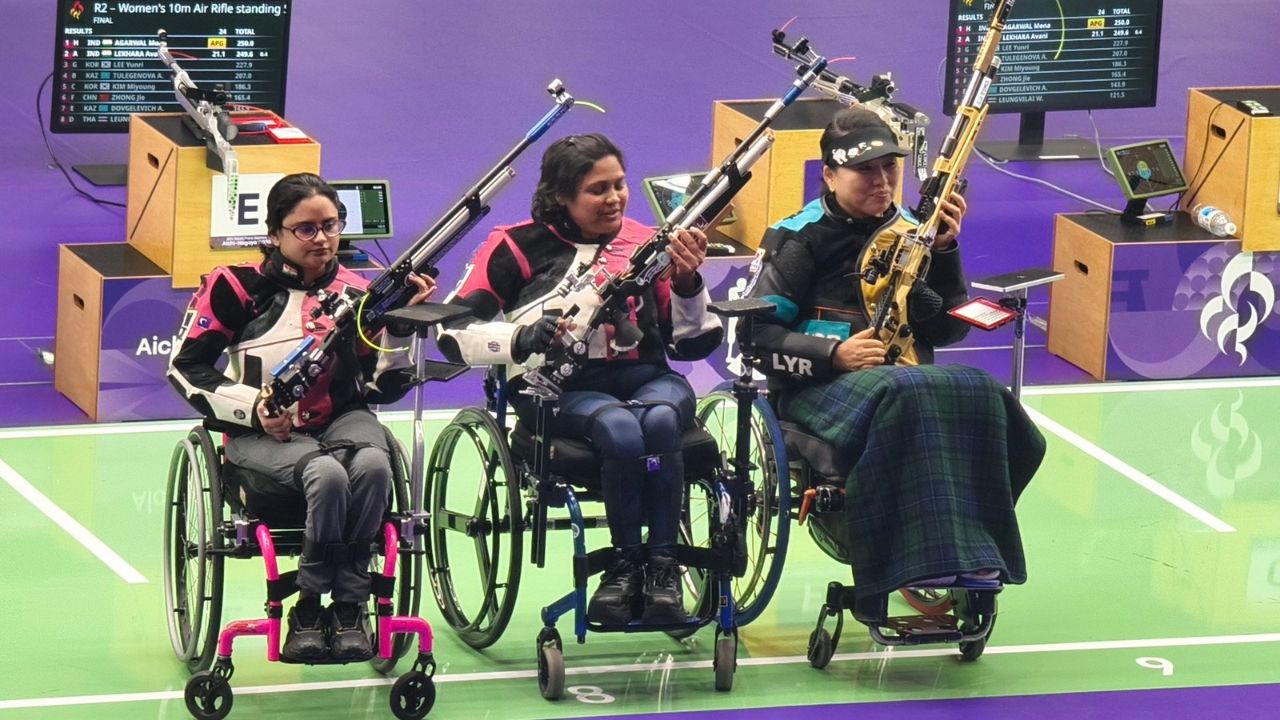
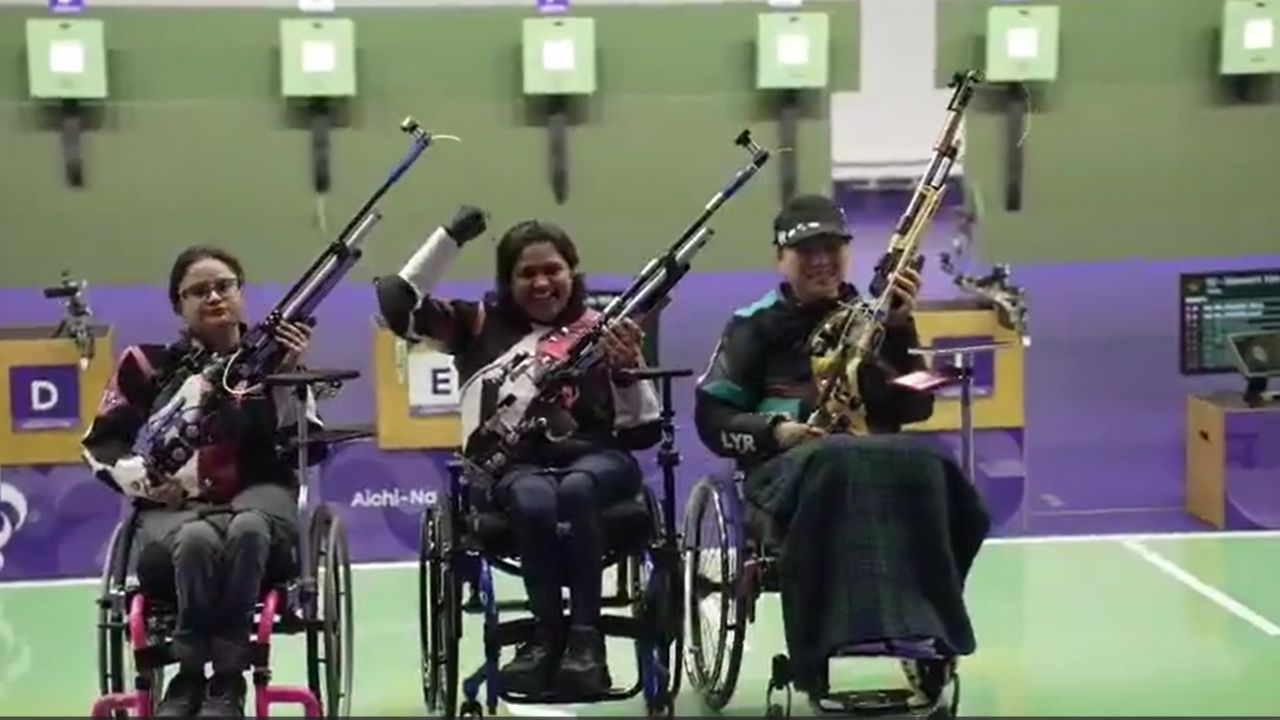
India also recorded important podium finishes outside athletics. In para-shooting, Manish Narwal won silver in the men’s 10-metre air pistol SH1 event, while Shrishti Arora secured bronze in the women’s 10-metre air pistol SH1 competition.
The results strengthened India’s presence in precision-based para-sports, where consistency, concentration and technical execution are crucial to medal contention.
In para-powerlifting, Ashok claimed silver in the men’s up-to-65kg category. His performance added another medal to India’s campaign and demonstrated the contingent’s competitiveness in strength-based events.
India also recorded multiple top-eight finishes across athletics, swimming and powerlifting, according to the available competition reports, indicating a broad level of participation beyond the medal-winning performances.
India’s para-table tennis contingent also enjoyed a productive day, with Sonalben Patel, Bhavina Patel, Prachi Pandey, Sahana Ravi and Jehan Madan recording bronze-medal finishes in their respective events.
The podium results added to India’s overall medal count and reflected the country’s participation across different classification groups. The performances also highlighted the continuing development of Indian para-table tennis at the regional level.
India’s para-swimmers contributed further to the medal tally. Himanshu Nandal secured bronze in the men’s 400-metre freestyle S11 event, while Niranjan Mukundan finished third in the men’s 200-metre individual medley SM7 competition.
Their performances extended India’s podium presence into the pool and demonstrated the breadth of the contingent’s campaign across track and field, strength sports, precision events, table tennis and swimming.
India’s medal prospects remained strong in events that had not yet concluded. In para-badminton, Nitesh Kumar, Pramod Bhagat and Sanjana Kumari advanced after winning their quarter-final matches, keeping their respective campaigns alive.
Para-archery also offered further opportunities for Indian success, with Sheetal Devi reaching the women’s individual compound final. Several Indian teams also advanced to finals or knockout rounds, setting up additional chances to improve the medal tally.
Sheetal’s progress was particularly noteworthy given her record at the previous Asian Para Games, where she won gold in both the women’s individual compound open and mixed team compound open events.
India’s reported tally of 35 medals—nine gold, 11 silver and 15 bronze—provided a strong snapshot of the contingent’s performance in Aichi-Nagoya on October 20. Para-athletics remained a key source of medals, while shooting, powerlifting, table tennis and swimming expanded the country’s podium presence.
Nishad Kumar’s double gold and record-breaking 2.04-metre clearance provided the defining storyline of Day 2. Yet the wider spread of results, including an all-Indian discus podium, multiple athletics medals and progress in badminton and archery, demonstrated that India’s campaign was not dependent on a single athlete or discipline.
With the World Championships now in Nishad’s sights and further competitions continuing across the Asian Para Games schedule, India’s athletes have established a strong platform for the remainder of the event. The next phase will test the contingent’s ability to convert advancing performances into further medals while sustaining the momentum built on Day 2.