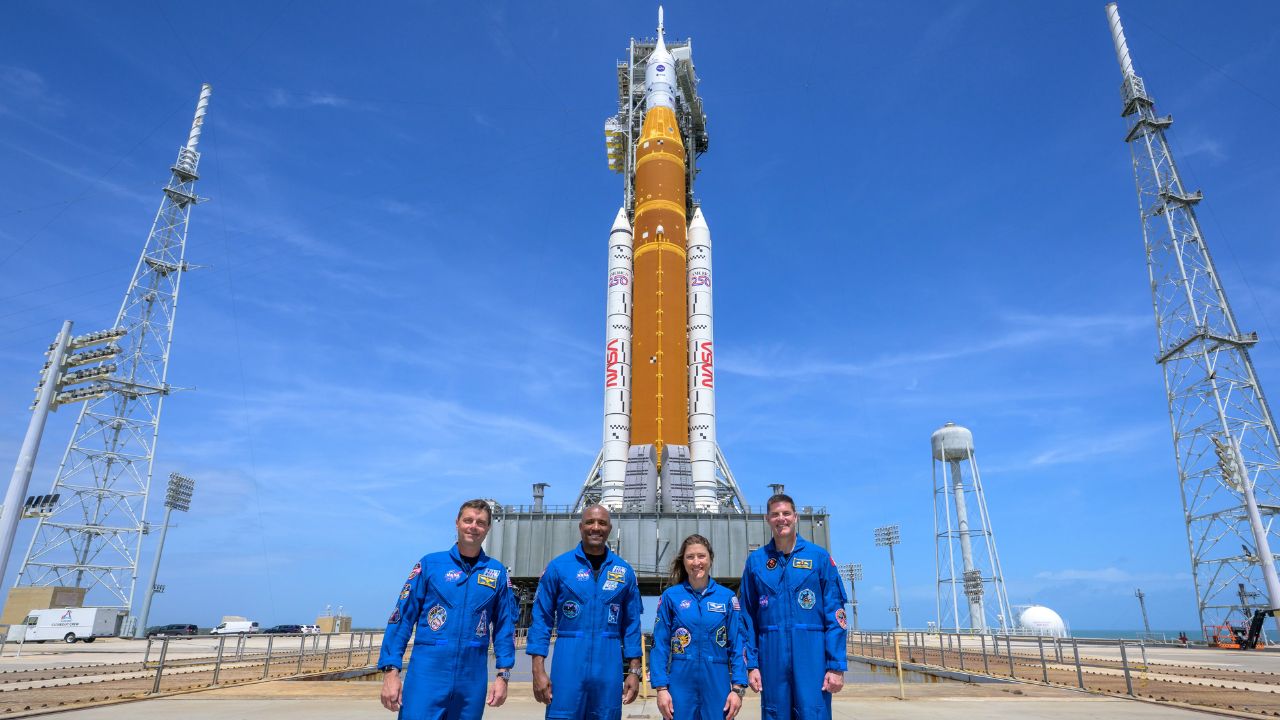
NASA Launches Historic Moon Flyby Mission (Image Source: Internet)
New Delhi: NASA's Artemis II mission launched on Thursday morning, sending four astronauts on a journey toward the Moon. This mission marks the first time since the Apollo program that humans will venture this far from Earth, reports Dynamite News correspondent.
The astronauts participating in this mission are: Reid Wiseman, Victor Glover, Christina Koch (USA), and Jeremy Hansen (Canada). Christina Koch will become the first woman to travel to the vicinity of the Moon.
This mission will not land on the Moon; instead, it will orbit the Moon once and return to Earth in approximately 10 days. This is known as a "flyby mission"—meaning it involves approaching a celestial body and returning without landing.
During the Apollo program (1960s–70s), 24 astronauts traveled to the Moon, 12 of whom set foot on its surface. However, since the Apollo 17 mission in 1972, no human has ventured beyond Low Earth Orbit (approximately 400 km). Artemis II is breaking this boundary.
The goal of the Artemis program is not merely to visit the Moon but to establish a permanent human presence there. This involves constructing a lunar base, sustaining long-duration stays, and utilizing local resources.
The astronauts aboard the Orion spacecraft will collaborate with scientists to conduct a series of experiments. They will study the far side of the Moon—the hemisphere that is never visible from Earth. This will mark the first time humans directly observe this region and gather geological data about it.
This mission serves as a preparatory step for upcoming human landing missions, which could see humans land on the Moon as early as 2028. Prior to that, several test missions will be conducted to ensure that all technical and safety parameters are fully validated.

