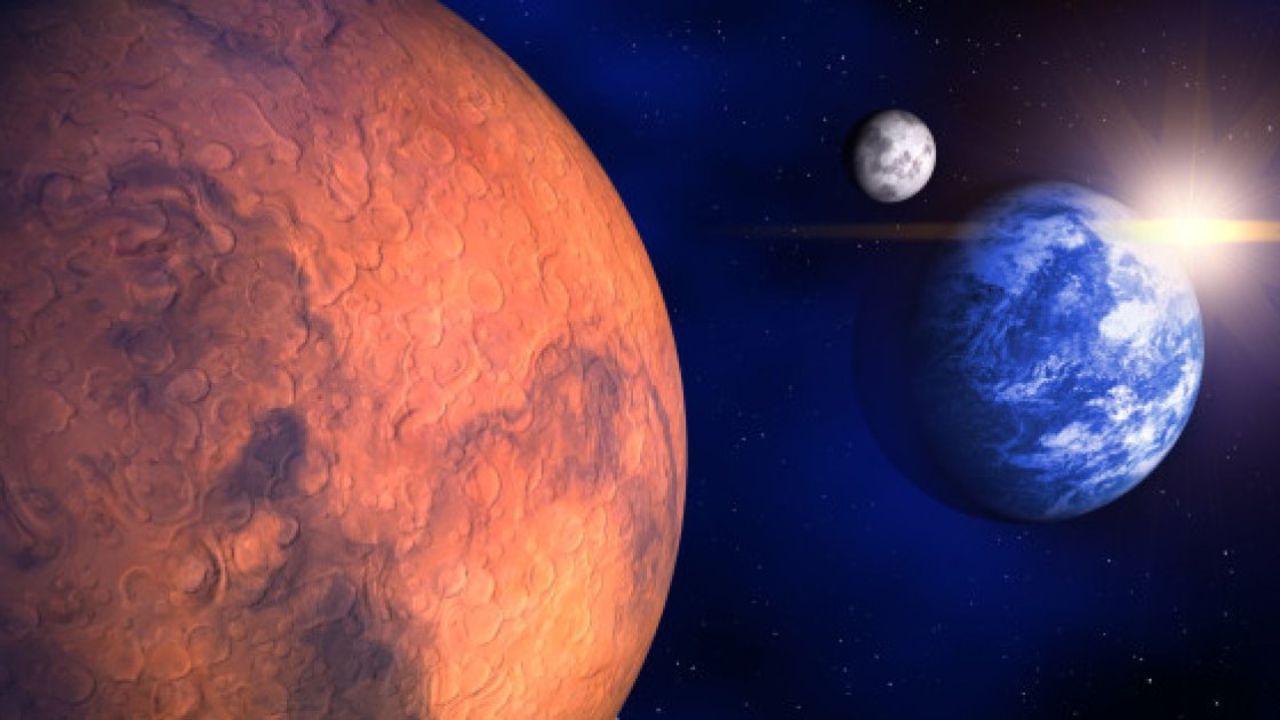
Weaker gravity speeds up Martian clocks.
New Delhi: Time does not pass at the same rate everywhere in the universe, and recent scientific work has revealed that clocks on Mars move ahead faster than those on Earth. Researchers calculated that Martian clocks gain about four hundred seventy seven microseconds each day when measured against Earth time. While the difference is small, it becomes significant for long term missions and precise space operations.
The primary reason for the faster ticking of clocks on Mars lies in its weaker gravity. According to the principles of relativity, time passes more quickly in regions with lower gravitational pull. Mars has significantly less mass than Earth, and this reduced gravity allows time to advance at a slightly higher rate on the planet surface.
In addition to gravity, Mars orbital speed and path around the Sun also influence how time behaves. Mars follows an elliptical orbit and travels at a different velocity compared to Earth. These factors create daily fluctuations in time measurement, leading to variations of about two hundred twenty six microseconds during a Martian day.
Mars will change its position twice in 6 days; These 3 zodiac signs may see good times
Time on Mars is also influenced by the gravitational pull of other planets in the solar system. These subtle interactions cause small but measurable changes in how fast clocks tick. Over longer periods, these effects accumulate and must be considered when creating reliable timekeeping systems beyond Earth.
The time discrepancy observed on Mars is notably larger than that found on the Moon. While lunar clocks also tick faster than Earth based clocks, the difference on Mars is more pronounced. This highlights the increasing complexity of time coordination as human activity moves farther into the solar system.
Precise timekeeping is critical for space missions involving navigation, communication and scientific experiments. Even a tiny mismatch in time can result in errors in spacecraft positioning or data transmission. As human missions to Mars become more realistic, synchronizing clocks between Earth and Mars will be essential for mission success.
Massive ancient structure found deep beneath Bermuda Triangle; Here’s what geologists are saying
The findings may also play a key role in building an interplanetary communication network. A future system linking Earth, Mars and other locations will rely on accurate time signals. Differences in planetary time must be accounted for to ensure smooth data flow and prevent signal delays or loss of information.
Current models still contain small uncertainties, including discrepancies of about one hundred nanoseconds per day. Over time, these errors could grow large enough to require regular corrections. Future Martian clocks may need periodic resets to remain synchronized with Earth based systems.
Beyond practical applications, the study offers another opportunity to test Einstein theory of relativity under different planetary conditions. Observing how time behaves on Mars helps scientists confirm existing models of gravity and motion while improving understanding of how time functions across the solar system.
Establishing accurate timekeeping on Mars is a step toward creating a unified solar system time framework. Such a system would support exploration, science and human presence across multiple planets. Understanding extreme environments like Mars helps scientists define what is normal and what is exceptional when it comes to time behavior in space.

