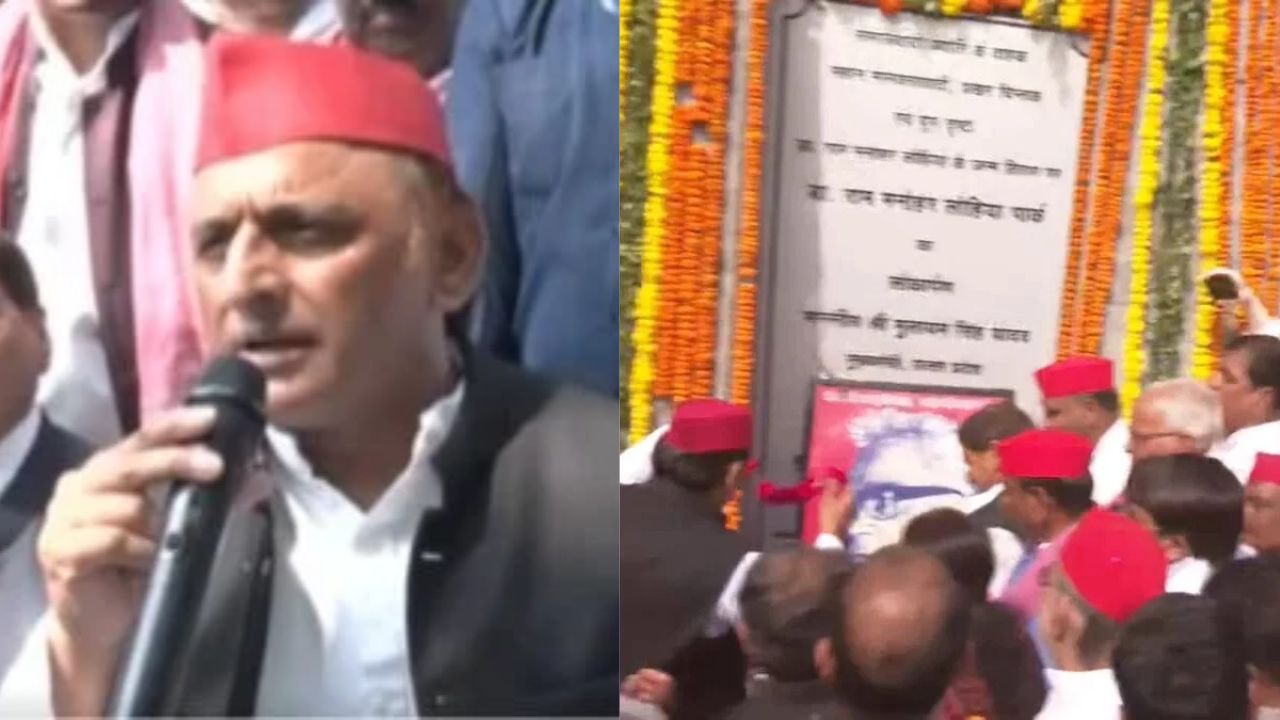
Akhilesh Yadav pays floral tribute to Ram Manohar Lohia at Lohia Park in Lucknow, invokes Lohia’s vision of social equality while renewing his criticism of the BJP over the SIR process. (Img: X)
Lucknow: Samajwadi Party chief Akhilesh Yadav paid tribute to socialist icon Ram Manohar Lohia on his death anniversary in Lucknow before launching a sharp attack on the BJP over alleged irregularities in Uttar Pradesh’s Special Intensive Revision (SIR) of electoral rolls. Yadav claimed that duplicate and allegedly fraudulent voter entries had surfaced across multiple constituencies and said his party would release details to substantiate its allegations.
Accompanied by senior SP leader Shivpal Singh Yadav and other party leaders, the former Uttar Pradesh chief minister reaffirmed his commitment to Lohia’s socialist philosophy, social justice and equality. However, the commemoration quickly turned into a political flashpoint, with electoral integrity, the functioning of the Election Commission and the state’s 403 Assembly constituencies emerging as central issues ahead of the 2027 Uttar Pradesh Assembly elections.
Akhilesh Yadav visited Ram Manohar Lohia Park in Lucknow’s Gomti Nagar and offered floral tributes at the socialist leader’s statue. Shivpal Singh Yadav, Ram Govind Chaudhary, Rajpal Kashyap and other Samajwadi Party leaders were also present.
The SP chief said the party would work to translate the ideas of Lohia and its founder, the late Mulayam Singh Yadav, into practical action. He emphasised a model of socialist development in which economic prosperity goes hand in hand with social equality, dignity and the elimination of discrimination.
Lohia, a prominent socialist thinker and freedom movement activist, challenged entrenched caste hierarchies and advocated political mobilisation, social reform and a more equitable distribution of opportunities. His political legacy continues to influence debates around social justice, affirmative action, secularism and representation in Indian politics.
Akhilesh also invoked Lohia’s concept of Sapt Kranti, or Seven Revolutions, which sought to confront multiple forms of inequality and discrimination. He linked the philosophy to the Samajwadi Party’s political emphasis on social justice and the broader ideological legacy of Lohia, Mulayam Singh Yadav and B. R. Ambedkar.
The SP chief reiterated that the party’s objective was to build a society in which caste and religion did not determine an individual’s access to rights, opportunities or public institutions.
The political focus shifted to the Special Intensive Revision of electoral rolls, with Akhilesh Yadav accusing the BJP of benefiting from alleged irregularities in the voter-list revision process.
Yadav claimed that Uttar Pradesh had lakhs of allegedly fake voter entries and that multiple names or registrations associated with the same individual had been identified in several Assembly constituencies. He maintained that his party had collected details and would make the information public.
Referring to an alleged case involving a person named Vikas Yadav, the SP chief claimed that ten voter entries existed under the same name in an Assembly constituency. He questioned how such duplication could persist through the revision exercise and alleged that the process had failed to address the problems it was intended to resolve.
Yadav further accused the BJP of attempting to exploit the alleged discrepancies across the state’s 403 constituencies. He said the Samajwadi Party would challenge the alleged irregularities and demand accountability.
These allegations have not been independently established by the information available in the reports, and the claims should not be treated as confirmed electoral fraud. The publication of the promised list and verification against official electoral records would be important steps in assessing their accuracy.
The controversy comes amid heightened political scrutiny of voter-list revision ahead of the 2027 Uttar Pradesh Assembly elections, when electoral-roll accuracy, voter eligibility and the removal of duplicate entries are likely to remain significant political and administrative issues.
Yadav also questioned the accountability of officials involved in the electoral-roll revision process. He raised allegations concerning the filling of voter-related forms in Lucknow’s Sarojini Nagar constituency and alleged irregularities involving signatures and voter deletions in Sultanpur.
According to Yadav, a person named Dashrath was allegedly made to fill more than 100 forms in Sarojini Nagar. He also alleged that signatures had been falsified in connection with the removal of votes associated with a person named Nandlal Nishad in Sultanpur.
The SP chief questioned what action, if any, had been taken against booth-level officers, sub-divisional magistrates, district magistrates or other election officials in connection with the alleged incidents.
The allegations raise questions about the safeguards governing electoral-roll revision, including the verification of applications, the authentication of signatures, the scrutiny of duplicate entries and the procedures for adding or deleting names.
Electoral-roll accuracy is fundamental to the integrity of elections. At the same time, allegations of manipulation require documentary verification and an opportunity for the relevant authorities to respond. The Election Commission’s role in ensuring transparent procedures and addressing genuine grievances remains central to public confidence in the electoral process.
Akhilesh Yadav said the Samajwadi Party would continue to oppose what it considers irregularities in the voter-list revision process, but would do so within the framework of the law.
He maintained that the party would follow a peaceful, Gandhian approach to protest, even if the police attempted to restrict its movement. His remarks came amid opposition mobilisation over the SIR process and demands for accountability from Chief Election Commissioner Gyanesh Kumar.
Opposition leaders from INDIA bloc parties were expected to participate in a march towards the Supreme Court in New Delhi on October 12 as part of their protest over alleged electoral-roll irregularities and their demand for the CEC’s removal.
Security arrangements were tightened in parts of central Delhi, with barricades and reported restrictions at selected metro stations during the planned demonstration. The developments added to the political confrontation surrounding the electoral-roll revision process.
The dispute has become part of a wider debate over the balance between electoral administration, the right to participate in peaceful demonstrations and the need to maintain public order. The allegations against the election machinery remain contested and require scrutiny through appropriate institutional procedures.
Yadav also criticised the alleged mistreatment of journalists during recent political developments in Delhi, including reports concerning a woman journalist’s arrest. He argued that inappropriate treatment of media professionals could raise concerns about press freedom and the functioning of democratic institutions.
The SP chief further alleged that some individuals associated with the BJP were operating as fake journalists. Such allegations require independent verification, and any assessment of a person’s professional status should be based on evidence rather than political affiliation alone.
The issue has added another dimension to the political debate, with press freedom, journalistic independence and the conduct of law-enforcement agencies becoming part of the broader discussion.
Yadav also raised allegations about individuals linked to the Rashtriya Swayamsevak Sangh wearing police-like uniforms during protests. He used the issue to criticise what he described as the BJP’s political methods and drew a comparison with authoritarian styles of functioning. These claims and characterisations remain attributable to Yadav and have not been independently established here.
The SP chief accused the BJP government of attempting to influence constitutional institutions and questioned the impartiality of the electoral process. He argued that the alleged voter-list discrepancies raised serious concerns about the functioning of election administration.
Yadav said the BJP’s removal from power was necessary to address what he described as a broader institutional crisis. His remarks reflect the Samajwadi Party’s effort to position electoral transparency, constitutional accountability and social justice at the centre of its political campaign ahead of the 2027 Assembly polls.
The Election Commission is responsible for administering electoral processes and maintaining accurate voter lists. Allegations of bias or manipulation, however, need to be assessed through evidence, official records and transparent investigation rather than political assertions alone. The dispute is likely to remain politically significant as parties scrutinise the revision process and seek to mobilise voters around questions of electoral fairness.
Akhilesh Yadav also raised the issue of flooding in Lucknow’s Faizullaganj area, alleging that around five lakh people had been affected and that the locality had not been formally declared disaster-affected.
He claimed that several families had been forced to leave their homes and questioned decisions concerning the opening and closing of barrage gates. Yadav alleged that inadequate flood management had added to the difficulties faced by residents.
The claims, including the estimate of affected people, require verification through official disaster-management records and local assessments. Nevertheless, the issue highlights the importance of timely flood warnings, drainage infrastructure, coordinated reservoir operations and relief measures for affected households.
Flood preparedness and urban water management remain important public-policy concerns, particularly in areas where heavy rainfall, drainage constraints and river or barrage operations can combine to increase the risk of inundation.
By raising the issue alongside the SIR controversy, the SP chief broadened his criticism of the state government from electoral administration to civic infrastructure and disaster response.
The tribute to Ram Manohar Lohia carried significance beyond its commemorative purpose. For the Samajwadi Party, Lohia’s ideas provide an ideological framework for its emphasis on social equality, secularism, representation and the political mobilisation of marginalised groups.
Akhilesh Yadav’s references to Lohia, Mulayam Singh Yadav and B. R. Ambedkar linked the party’s historical foundations with its current political messaging. His emphasis on the PDA framework—Pichhda, Dalit and Alpsankhyak, referring to backward classes, Dalits and minorities—also reflects the SP’s attempt to consolidate support among communities it describes as socially and politically underrepresented.
The BJP and the Samajwadi Party are likely to continue contesting questions of governance, social justice and electoral credibility as the state moves towards the 2027 Assembly elections. The SIR dispute could become a major political issue, particularly if parties produce documentary evidence or seek formal remedies through election authorities.
For now, the central question is whether the alleged discrepancies cited by Yadav can be substantiated through official electoral records and whether the relevant authorities respond with transparent verification.
Akhilesh Yadav’s Lohia anniversary appearance therefore combined ideological reaffirmation with an escalating political challenge over electoral integrity, institutional accountability and governance in Uttar Pradesh. The next developments will depend on the evidence the SP says it plans to release and the response of the election authorities to the allegations.

