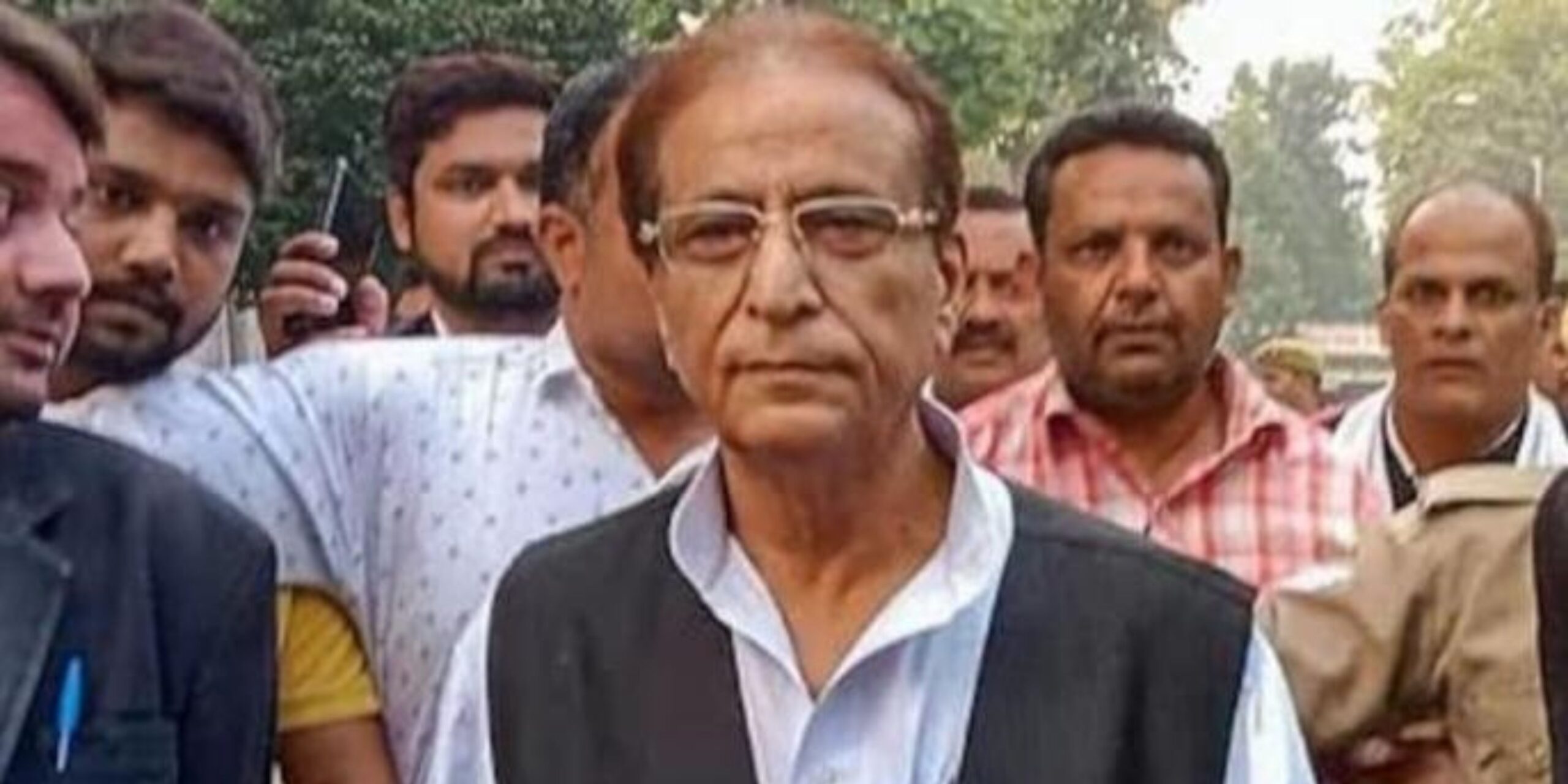
The Enforcement Directorate has provisionally attached properties linked to Mohammad Ali Jauhar University in Rampur in an alleged money laundering case involving Samajwadi Party leader Azam Khan. (Img: X)
New Delhi: The Enforcement Directorate (ED) has provisionally attached land and buildings belonging to Mohammad Ali Jauhar University in Rampur, Uttar Pradesh, in connection with an alleged money laundering case involving Samajwadi Party leader and former state cabinet minister Azam Khan. The attached properties have an estimated current market value of Rs 1,170 crore, while investigators have identified Rs 426.46 crore as alleged proceeds of crime. The probe centres on suspected diversion of government funds, construction materials and public resources for the development of the private university. The allegations remain subject to legal proceedings.
New Delhi: The Enforcement Directorate has intensified its money laundering investigation involving senior Samajwadi Party leader Azam Khan by provisionally attaching land and buildings at Mohammad Ali Jauhar University in Rampur. The action has brought the university’s funding arrangements, construction expenditure and alleged use of public resources under renewed scrutiny.
According to the central agency, the attached assets have an estimated current market value of approximately Rs 1,170 crore. The university is operated by the Maulana Mohammad Ali Jauhar Trust, which was founded and is controlled by Khan. He also serves as the institution’s honorary chancellor.
The ED’s action has been initiated under the Prevention of Money Laundering Act (PMLA), 2002. Investigators allege that government funds intended for public infrastructure projects, construction materials and other resources were diverted towards developing the private university campus.
The agency has identified Rs 426.46 crore as alleged proceeds of crime, claiming that the trust could not satisfactorily establish legitimate sources for a substantial portion of the university’s construction expenditure. The provisional attachment is linked to the alleged proceeds of crime, while the estimated market value of the affected properties stands at Rs 1,170 crore.
The financial investigation centres on the discrepancy between the assessed cost of the university campus and the expenditure that the trust could substantiate through legitimate sources.
A report prepared by the District Valuation Officer, an independent valuer, on November 10, 2023, assessed the construction cost of 59 university buildings at Rs 494.46 crore. The land, acquired through 114 sale deeds, was valued at Rs 4.63 crore. Together, the assessed cost of the campus and land stood at Rs 499.09 crore.
However, the ED found that the trust had declared capital expenditure of Rs 78.32 crore in its income tax returns. Of this amount, donations worth Rs 12.29 crore were allegedly found to be non-genuine, leaving Rs 66.03 crore as expenditure considered genuine by the agency.
The ED stated that only Rs 72.63 crore of the overall campus cost could be explained through legitimate sources. It calculated the remaining Rs 426.46 crore as alleged proceeds of crime and said the trust’s office-bearers had failed to substantiate the source of the amount.
The agency’s investigation also points to an alleged pattern in which contractors awarded government projects diverted construction materials and funds towards the university. In one instance, the managing director of a company that received Public Works Department contracts worth approximately Rs 186 crore reportedly told investigators that 30 to 40 per cent of the contract value had been used to procure construction materials for the institution.
Partners of another firm allegedly informed investigators that the company operated under Khan’s influence and had donated Rs 40 lakh to the trust. The ED has also cited donations worth Rs 6.24 crore allegedly received from two educational entities based in Meerut, claiming the transactions were linked to political influence. These findings form part of the agency’s broader investigation into the university’s funding sources and the alleged diversion of public resources.
A major aspect of the case concerns government-funded infrastructure work reportedly carried out within the university’s private campus. According to the ED, projects worth Rs 6.60 crore were executed using MLA and MLC Local Area Development funds.
The work was carried out by the Uttar Pradesh Jal Nigam, which, according to the agency, functioned under Khan’s departmental oversight when he served as the state’s Urban Development Minister during the Akhilesh Yadav government in 2015 and 2016.
The agency has also scrutinised a state government sanction of Rs 23.41 crore for the construction of a pandal, an Other Backward Classes (OBC) boys’ hostel and a hospital block on the university campus.
Of particular concern to investigators is the pandal, for which Rs 12.16 crore was sanctioned in 2015. The original government order reportedly stipulated that ownership would remain with the state Culture Department and that the structure could neither be sold nor transferred.
It also required the facility to be made available to the state government free of cost. The ED alleges that a subsequent order issued in 2016 transferred ownership of the pandal to Jauhar University and removed the condition requiring its free availability for government use.
Investigators are examining these decisions as part of the larger question of whether public expenditure and government assets were improperly channelled towards a privately operated educational institution.
The agency has further alleged that cleaning machinery purchased for the Rampur Nagar Palika was diverted to the university. It has also cited allegations that construction debris from demolished residential properties in Rampur was transported to the campus.
The money laundering investigation originated from 26 FIRs registered at Azeem Nagar police station in Rampur. These cases alleged that agricultural land belonging to farmers had been forcibly taken over for the university’s development.
The ED has also referred to an inquiry report prepared by the Rampur district administration, which alleged that 45 plots of enemy property measuring approximately 34 acres in Singhankhera village had been illegally occupied for the university.
Enemy property refers to assets associated with individuals who migrated to countries designated as enemy states under the applicable legal framework. According to the district administration’s report, the alleged occupation continued even after the Custodian of Enemy Property cancelled the trust’s lease.
The land was subsequently taken back by the Custodian of Enemy Property under the Union Home Ministry through the Rampur district administration.
The ED shared information concerning the alleged diversion of government funds and associated irregularities with the Uttar Pradesh Police under Section 66(2) of the PMLA. Following the information-sharing process, a fresh FIR was registered at Azeem Nagar police station on October 13, 2026, against Khan, the trust and others.
The case invokes provisions of the Bharatiya Nyaya Sanhita, 2023, and the Prevention of Corruption Act, 1988. The ED has also taken up 28 additional FIRs registered by the Rampur police against Khan and others, with charge sheets filed in most of these cases, according to the agency.
The ED’s investigation also refers to allegations involving the demolition of residential properties in Rampur in 2016. According to the FIRs and charge sheets cited by the agency, houses belonging to several families, many of whom were tenants of Waqf properties, were allegedly demolished using bulldozers by a group said to have acted on Khan’s instructions.
The complaints allege that occupants were assaulted, threatened with false criminal cases and deprived of cash, jewellery and cattle. The agency has also cited allegations that debris from the demolished homes was transported to the university premises.
These allegations form part of the wider body of cases being examined by the investigating agencies and should be distinguished from findings that have been conclusively established by a court.
The Income Tax Department has also reportedly revoked the trust’s registration under the Income Tax Act, 1961, according to the ED’s findings. Separately, the agency conducted searches at the university and associated premises on August 19, 2026, during which electronic devices and records described as incriminating were seized.
Azam Khan is currently in jail following convictions in multiple criminal cases. These include a 10-year sentence in a dual PAN card forgery case and a two-year sentence relating to remarks made during the 2019 election campaign.
The latest attachment marks a significant development in the financial investigation surrounding Jauhar University. With the ED examining alleged financial irregularities, public fund diversion, land acquisition disputes and construction expenditure, the case raises questions about public accountability, the use of government resources and compliance with financial regulations. Further legal proceedings and investigation will determine the outcome of the allegations.

