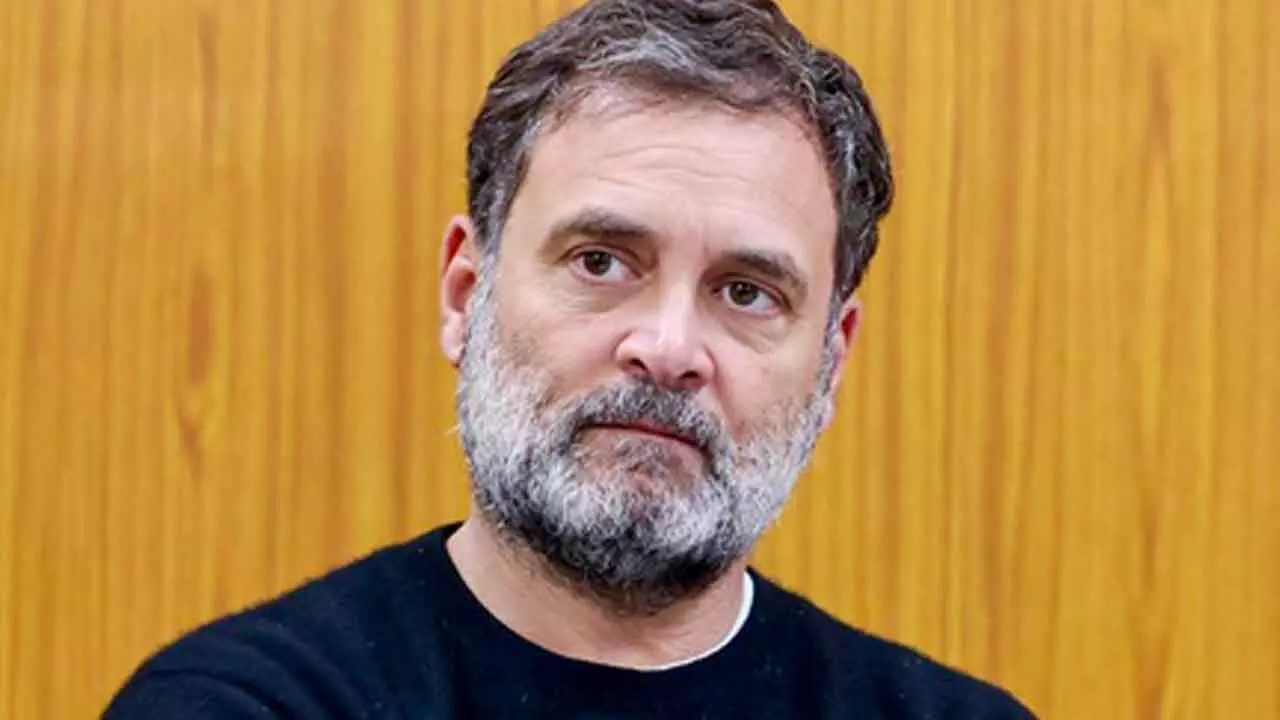
Rahul Gandhi slams Union Budget 2026-27
New Delhi: Congress leader and Leader of Opposition Rahul Gandhi on Sunday launched a sharp critique of the Union Budget 2026, accusing the Narendra Modi-led government of failing to confront India’s mounting economic and social challenges. Reacting shortly after the Budget presentation, Gandhi said the proposals ignored core issues affecting ordinary citizens and showed no willingness to correct course.
In a statement, Gandhi listed unemployment, agricultural distress, declining household savings, falling manufacturing output, and weakening investor confidence as key concerns that were left unaddressed. He also warned that global economic uncertainties had been overlooked.
Union Budget 2026-27: Defence allocation set at ₹7.85 lakh crore, up from ₹6.81 lakh crore last year
“Youth without jobs. Falling manufacturing. Investors pulling out capital. Household savings plummeting. Farmers in distress. Looming global shocks all ignored,” Gandhi said, describing the Budget as disconnected from ground realities.
Youth without jobs.
Falling manufacturing.
Investors pulling out capital.
Household savings plummeting.
Farmers in distress.
Looming global shocks - all ignored.A Budget that refuses course correction, blind to India’s real crises.
— Rahul Gandhi (@RahulGandhi) February 1, 2026
Congress president and Rajya Sabha Leader of Opposition Mallikarjun Kharge echoed similar concerns, stating that the government appeared to have run out of ideas. He said the Budget raised more questions than it answered and failed to provide relief to the poor or offer concrete steps to curb inflation.
Kharge pointed out that despite warnings in the Economic Survey about global trade uncertainty, the Budget barely addressed the issue. He also flagged the lack of measures to arrest the falling value of the rupee, revive consumer demand, or tackle rising personal debt and declining domestic savings.
Modi Govt has run out of ideas. #Budget2026 does not provide a single solution to India’s many economic, social, and political challenges.
“Mission Mode” is now “Challenge Route.”
“Reform Express” rarely stops at any "Reform" Junction.
Net result: NO policy vision, NO…
— Mallikarjun Kharge (@kharge) February 1, 2026
The Congress chief further criticised the absence of targeted support for marginalised communities, including Scheduled Castes, Scheduled Tribes, Other Backward Classes, Economically Weaker Sections and minorities. He added that the Budget did little to address growing inequality or the unemployment crisis among educated youth.
Prime Minister Narendra Modi, however, struck a sharply contrasting note, describing the Union Budget 2026 as “historic” and reform-driven. He said the Budget reflects strong women empowerment and accelerates India’s journey towards becoming a developed nation.
Budget 2026 is historic, strengthens India’s foundation with path-breaking reforms: PM Modi
Praising Finance Minister Nirmala Sitharaman for presenting her ninth consecutive Budget, Modi said the document transforms aspirations into action and provides new momentum to India’s reform agenda. He described the Budget as a “highway of opportunities” that strengthens the foundation for future growth.
Presenting the Budget in Parliament, Sitharaman announced several tax-related measures aimed at simplifying compliance and improving ease of living. These include income tax exemption on interest awarded by Motor Accident Claims Tribunals (MACT), a reduction in TCS on overseas tour packages to 2 per cent, and rationalisation of TCS rates for sellers of liquor, scrap and minerals.
The Budget also proposes higher excise duty and a new cess on tobacco products, making cigarettes and pan masala costlier. Additionally, trading in futures and options will become more expensive following an increase in the Securities Transaction Tax.

