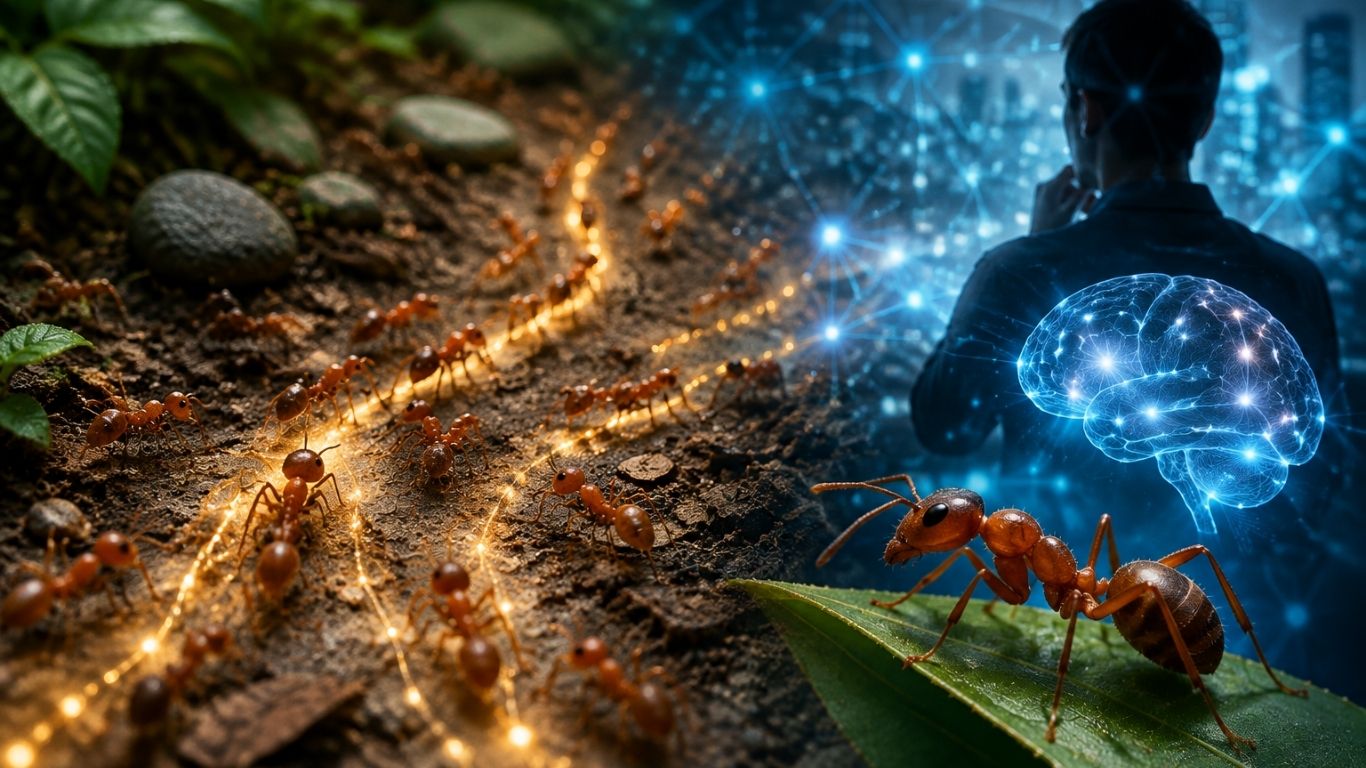
ants decision making (Img: Ai Generated)
Humans often consider themselves the most advanced species because of their ability to think, analyse and make rational decisions. However, even after extensive discussions and careful planning, people can sometimes make incorrect choices.
Interestingly, tiny insects with brains no larger than a seed can demonstrate remarkable decision-making abilities. Scientists have studied the problem-solving methods of ants and other insects to develop strategies that help humans make faster and more effective decisions in real-world situations.
The collective intelligence of ants has inspired several algorithms that are now used in fields such as artificial intelligence, transportation, communication networks and logistics.
Making the right choice becomes difficult when individuals face multiple options at the same time. This situation is known as “choice overload.”
Ant colonies face a similar challenge when they need to collectively decide where to search for food. However, many ant species have evolved a simple yet highly efficient method to overcome this problem.
When searching for food, scout ants leave their colony and explore different nearby locations. Instead of following a single route, they move randomly across multiple paths, allowing them to examine several possibilities before making a decision.
While travelling, ants leave behind a chemical trail called pheromones. These chemical signals help other ants identify and follow paths that may lead to food sources.
Pheromone trails gradually disappear over time. Because of this, ants naturally prefer routes where the chemical signal is stronger.
When an ant discovers a shorter or easier path to food, it returns to the colony quickly and reinforces that route by leaving more pheromones. Other ants then follow the stronger trail, further strengthening it.
As more ants use the same path, the pheromone concentration increases, making the route easier for the colony to identify. Meanwhile, less efficient paths lose their chemical signals and are eventually abandoned.
Through this simple process, an entire ant colony can collectively identify the most efficient route without any central leader directing the decision.
Marco Dorigo, co-director of the Artificial Intelligence Laboratory at Université Libre de Bruxelles, explains that ants demonstrate how complex decisions can be achieved without centralised control.
According to Dorigo, ants have limited individual abilities and only partial information about their surroundings, yet they can work together to solve highly complicated problems.
This approach is known as “Ant Colony Optimisation” (ACO), an algorithm inspired by the behaviour of ants. The technique has been adapted into computer science and is used to solve complex optimisation problems.
Ant Colony Optimisation has been applied in several industries, including scheduling, telecommunications, transportation management and delivery systems.
Experts have used ant-inspired algorithms for improving railway planning, optimising routes and managing large-scale networks.
Dorigo also developed a system called “AntNet,” which helps communication networks transmit information more efficiently by finding faster and more reliable paths for data movement.
The study of ants highlights an important lesson: intelligence does not always depend on the size of the brain. Even simple organisms can provide powerful ideas for solving some of the most complex challenges faced by humans.
Location : New Delhi
Published : 14 August 2026, 5:51 AM IST

