18 years of service but no permanent job security drives NHM workers protest in J&K (Dynamite News)
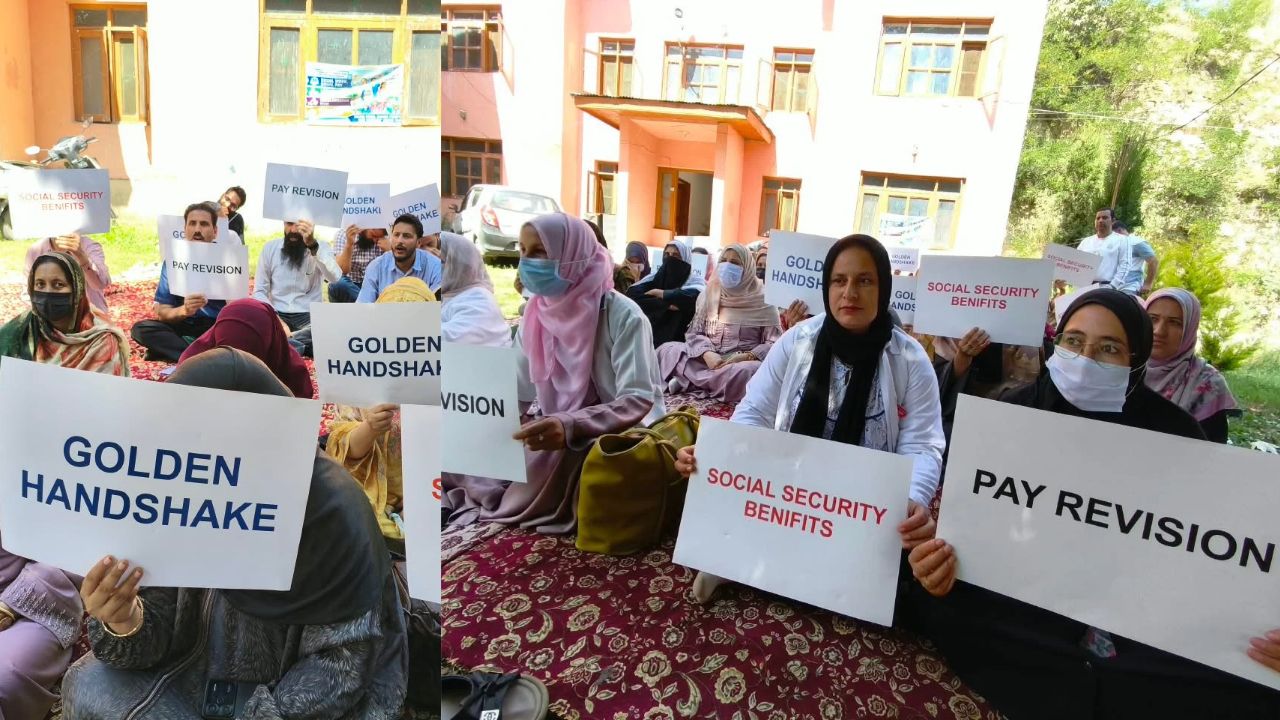
Srinagar: The employment uncertainty faced by National Health Mission workers has triggered renewed protests in North Kashmir’s Baramulla, where healthcare employees continued their agitation on Monday.
For many protesters, the issue is deeply personal. Some NHM employees say they have spent nearly two decades serving patients, supporting public health programmes and working during emergencies, yet remain without the employment security and service framework they believe should accompany such long-term service.
Their demands extend beyond a routine salary revision. The workers are seeking a comprehensive policy covering regularisation or long-term employment security, pay parity, social security and other service-related benefits.
The central message emerging from the agitation is that years of continuous service should not be followed by indefinite uncertainty over employment and family security.
The Baramulla agitation forms part of a broader protest by NHM employees across Jammu and Kashmir. The workforce is demanding a clear and time-bound policy for its future, arguing that contractual employment has continued for years despite the essential role NHM personnel play in healthcare delivery.
Employees say they are expected to remain available during emergencies and difficult circumstances while their own employment remains governed by uncertainty. This has turned regularisation and job security into the principal flashpoints of the dispute.
The latest phase of the agitation has also followed remarks attributed to Jammu and Kashmir Health and Medical Education Minister Sakeena Itoo describing NHM as a Centre-sponsored scheme.
A doctor participating in the Baramulla protest objected to the focus on the funding structure, arguing that employees are primarily seeking clarity over who will take responsibility for their long-term employment and service conditions.
For the protesters, the issue is therefore not simply about whether NHM receives central support. It is about the institutional framework governing thousands of employees who have continued working within the public healthcare system for years.
A recent Rajya Sabha response from the Union Ministry of Health and Family Welfare has added another layer to the dispute. The Ministry stated that public health and hospitals fall under the domain of State governments and Union Territory administrations, with the respective administration responsible for strengthening healthcare infrastructure and managing human resources.
It also stated that matters relating to human-resource policy and service conditions, including regularisation, absorption and pay parity of NHM personnel, are decided by the respective State or Union Territory governments. The response has consequently shifted the focus towards the J&K administration, with protesting employees seeking to know what concrete policy measures will follow.
The employees argue that their contribution to the healthcare system becomes particularly critical during emergencies, disease outbreaks and other periods of heightened pressure on public health infrastructure.
NHM personnel are involved in the implementation and delivery of various public health programmes, making them an important component of the healthcare workforce.
Protesting workers say the contrast between their operational responsibilities and their contractual employment status has become increasingly difficult to accept after years of continuous service. For them, the demand for security is closely linked to the sustainability of the healthcare workforce itself.
Regularisation remains one of the principal demands of the protesting workforce. Employees want a transparent mechanism that can address their long-term employment status, while also seeking greater parity in remuneration and service benefits.
Their demands include pay parity, social security, career progression and other employment-related protections.
The protesters maintain that salary-related concerns cannot be separated from employment security. A worker may receive remuneration for current service, but without a long-term framework, questions about continuity, retirement security and family welfare remain unresolved.
Behind the administrative and policy debate are healthcare workers who say they have built their professional lives around the public health system. Employees who have served for many years face uncertainty over future employment, benefits and career progression.
The prolonged nature of the dispute has therefore transformed the issue from a contractual employment concern into a wider question of workforce policy and institutional recognition.
For workers nearing two decades of service, another round of assurances without a defined roadmap could prolong the same uncertainty that triggered the agitation.
The J&K NHM agitation also reflects a broader challenge faced by public healthcare systems that rely extensively on contractual and mission-based personnel.
Such workers can become deeply embedded in routine healthcare delivery while their employment framework remains temporary or programme-linked. This creates difficult questions around retention, workforce stability, remuneration and institutional continuity.
In Jammu and Kashmir, the prolonged tenure of NHM employees has made these questions particularly prominent, with workers seeking a policy response that reflects their years of service.
The dispute is not limited to employment policy. Any prolonged disruption involving a significant healthcare workforce could potentially create additional operational pressure on hospitals, health centres and public health programmes.
This makes the resolution of the NHM dispute relevant not only to employees but also to healthcare administrators and patients who depend on public health services. A sustainable solution would therefore need to balance employee demands with uninterrupted healthcare delivery and long-term workforce planning.
The focus now shifts to the J&K administration and whether it will formulate a concrete framework addressing the demands raised by NHM employees. The protesters are seeking clarity on regularisation or long-term job security, pay parity, social security and other service benefits.
The key issue will be whether the government provides a defined policy and implementation timeline or whether the agitation continues. For the employees gathered in Baramulla, the question is ultimately simple but significant: after years of keeping the healthcare system running, when will their own professional future receive the security they are demanding?

