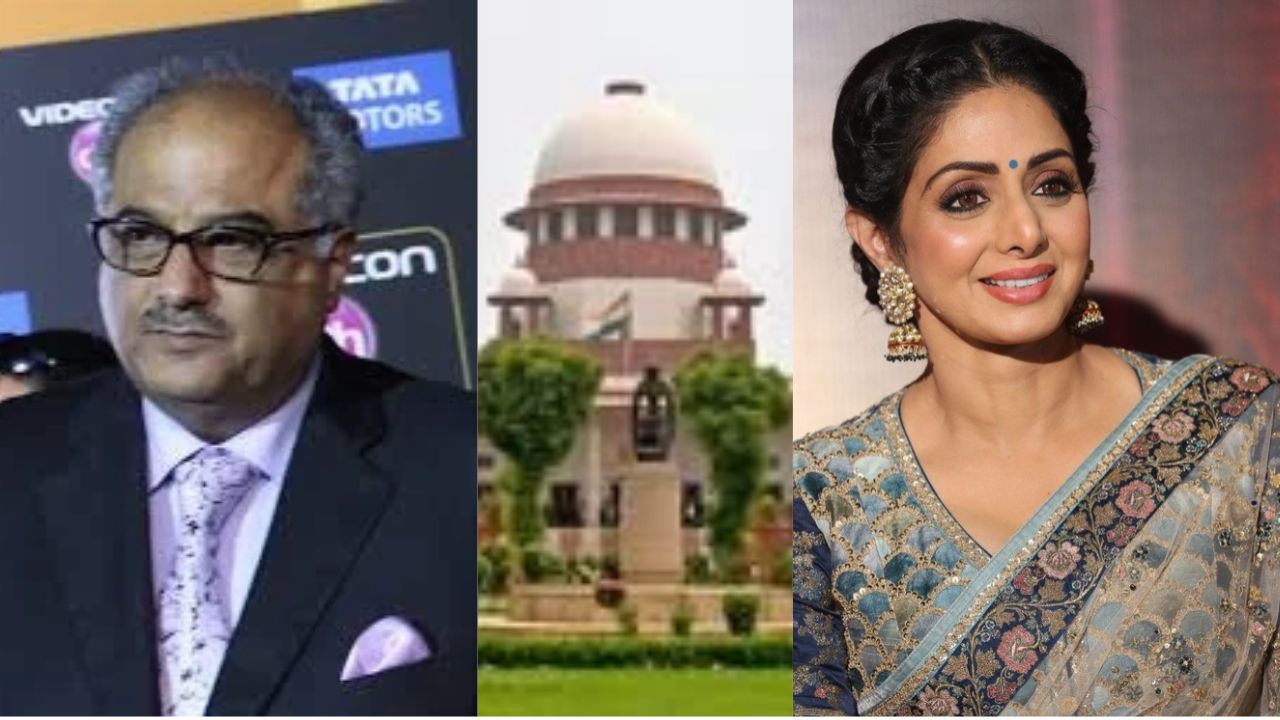
Sridevi’s 4.7-acre Chennai property dispute has reached the Supreme Court after a rival ownership claim. (Dynamite News)
New Delhi: The Supreme Court on Wednesday stepped into the long-running dispute over a 4.7-acre property near Chennai’s East Coast Road, belonging to late Bollywood actor Sridevi, ordering status quo and issuing notice to her husband Boney Kapoor, along with her daughters Janhvi Kapoor and Khushi Kapoor. The intervention comes after rival claimants challenged a Madras High Court order that had rejected their civil suit over the land.
The case has brought a decades-old property dispute back into the spotlight, with questions over ownership, ancestral rights, old sale deeds, limitation and legal standing now before the apex court.
The Bench of Justice KV Viswanathan and Justice Arun Pillai sought response from Boney, Janhvi and Khushi Kapoor on a petition challenging the Madras High Court ruling. It also directed the parties to maintain status quo concerning the disputed property until the matter is considered further.
The interim direction does not amount to a final decision on ownership. It also does not establish the rival claimants’ allegations or overturn the Madras High Court ruling at this stage. The notice gives the Kapoor family an opportunity to respond to the petition before the Supreme Court considers the matter further.
The legal battle concerns approximately 4.7 acres of land located near Chennai’s East Coast Road. MC Sivakami, MC Natarajan and their mother Chandrabhanu claim an interest in the property. Their case challenges four sale deeds through which Sridevi and her sister acquired the land.
The petitioners allege that the sale deeds were fraudulent and claim that the property originally belonged to their paternal grandfather. They are seeking legal recognition of their alleged share in the property and have asked the court to declare the disputed sale transactions invalid. At the centre of the case are competing claims over title, succession and inheritance rights.
Boney, Janhvi and Khushi Kapoor have opposed the continuation of the civil suit. The counsel appearing for them argued that the plaintiffs’ case was not legally maintainable and that the plaint should be rejected at the preliminary stage under the Code of Civil Procedure. The Kapoors also raised questions about the plaintiffs’ family history and alleged that important facts had not been disclosed before the court.
One of the key issues concerned Chandrabhanu’s marriage to MC Chandrasekaran. Kapoor argued that the marriage took place while Chandrasekaran’s first marriage was still subsisting and was therefore void under law.
The Kapoor side further contended that this fact had been suppressed in the plaint and that the alleged suppression affected the foundation of the property claim.
The dispute dates back to the four sale deeds executed in 1988 through which Sridevi and her sister acquired the property. The rival claimants later asserted that they had inherited rights in the land through their family and challenged the transactions.
The litigation subsequently became a question not only of property ownership but also of whether the plaintiffs had the legal right to pursue the case after such a long period. That issue became particularly important because the disputed transactions were several decades old.
The trial court had initially refused to reject the plaint. It found that several objections raised by Boney Kapoor involved disputed questions of fact. The court took the view that such issues could require evidence and could not necessarily be conclusively determined at the preliminary stage.
As a result, the civil suit was allowed to continue at that point. Boney Kapoor and his daughters then approached the Madras High Court challenging the trial court decision.
The Madras High Court subsequently accepted the Kapoor side’s objections and allowed the application seeking rejection of the plaint. The High Court considered the alleged suppression of material facts, the legal standing of the plaintiffs and the delay in challenging the property transactions.
It noted that the sale deeds dated back to 1988. It also questioned the claim that the plaintiffs became aware of the transactions only in 2023. The High Court further examined the question of locus standi and concluded that the plaintiffs were not Class I legal heirs of MC Chandrasekaran for the purpose of the claim being pursued.
The court also held that the challenge was barred by limitation in view of the age of the transactions. The High Court rejected the plaint instead of allowing the property dispute to proceed to a full trial.
Locus standi refers to the legal standing required by a person to bring a particular case or seek a particular remedy before a court. In this dispute, the Madras High Court considered whether the petitioners had the necessary legal status to pursue their claim over the property.
This became one of the important grounds on which the plaint was rejected. The Supreme Court will now consider the challenge to that decision and the legal questions raised by the petitioners.
The disputed sale deeds were executed in 1988, making the age of the transactions a central legal issue. The law of limitation places time limits on various legal claims. The precise limitation period can depend on the nature of the dispute, the relief sought and the facts pleaded before the court.
The Madras High Court concluded that the property challenge, filed decades after the transactions, was barred by limitation in the circumstances before it. The rival claimants are now challenging that outcome before the Supreme Court.
The status quo order is an interim judicial direction intended to preserve the existing position concerning the disputed property while the Supreme Court examines the matter.
It does not mean that the Supreme Court has declared the rival claimants to be owners. It also does not amount to a final finding in favour of Boney Kapoor, Janhvi Kapoor and Khushi Kapoor. The ownership dispute remains subject to further judicial proceedings.
The Supreme Court’s notice means the Kapoor family will now have an opportunity to present its response to the petition challenging the Madras High Court ruling.
The case has generated public interest because the disputed land is associated with Sridevi, one of Indian cinema’s most prominent actors. Sridevi acquired the property with her sister, and the current litigation involves her husband and daughters.
The dispute is also unusual because it concerns property transactions dating back nearly four decades, while the latest legal challenge has brought questions of title, inheritance and limitation before the Supreme Court.
The celebrity connection has increased public attention, but legally the matter remains a civil property dispute involving competing claims and procedural questions.
Beyond the legal terminology, the case involves a property connected to Sridevi’s family and her legacy. For the rival claimants, the litigation centres on their assertion that the land formed part of their ancestral property and that they have a legally enforceable share.
For the Kapoor family, the dispute involves defending the validity and legal position surrounding the property transactions against a claim raised decades after the sale deeds were executed. The Supreme Court will now examine the legal challenge without treating either side’s claims as finally established.
The Supreme Court notice requires Boney Kapoor, Janhvi Kapoor and Khushi Kapoor to respond to the petition challenging the Madras High Court decision. The apex court will then consider the rival submissions and the legal questions surrounding rejection of the plaint.
The status quo direction will remain relevant while the matter proceeds, subject to further orders of the Supreme Court. The latest hearing has not settled ownership of the 4.7-acre Chennai property. Instead, it has opened another chapter in a decades-old legal dispute over title, succession, sale deeds, limitation and legal standing.

