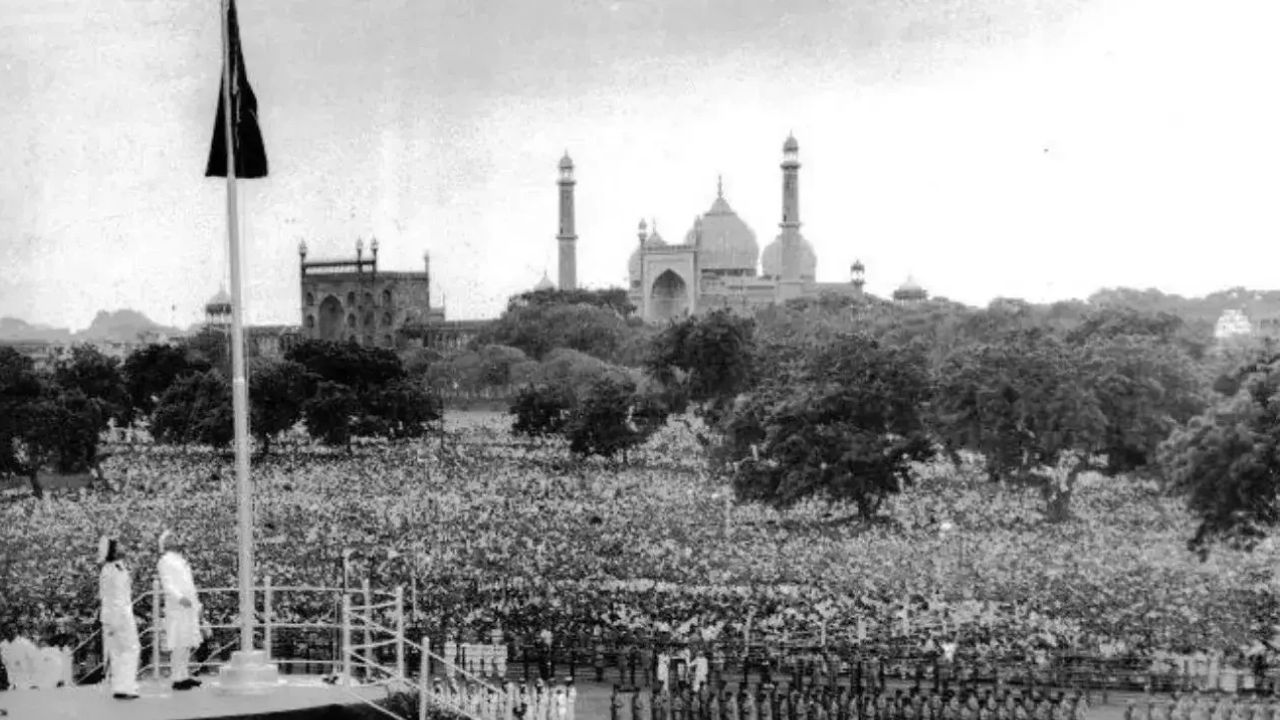
Pandit Nehru unfurls the Tricolour (Img: X)
New Delhi: A nation was born at stroke of the midnight, but the flag didn't rise over the Red Fort until a day later. This is the story of the joy, the chaos, and the grief that made up the memories of August 15, 1947.
There is a version of Independence Day that lives in our memory: a flag climbing the ramparts of the Red Fort, a Prime Minister's voice ringing out over the crowd. But that image belongs to August 16, 1947 and not the 15th. The real first morning of freedom was messier, more uncertain, and far more human than the one we picture today.
Just before the clock struck 12 on the night of August 14, Jawaharlal Nehru rose to speak. Free India's first Prime Minister told a nation that had waited for generations to witness the fulfillment moment of the old promise, which was finally honoured. While the world slept, India woke into freedom. It remains one of the most quoted openings in the country's political history, and it was delivered not in triumph alone, but with the weight of everything still unresolved hanging over it.
Because independence, that first year, did not arrive clean. It arrived alongside Partition and with Partition came riots, displacement, and grief on a scale the new nation was only beginning to reckon with.
Here is the detail most people get wrong, there was no grand flag-hoisting ceremony at the Red Fort on August 15, 1947. That iconic moment which replayed every year on television is actually happened on August 16. The first Independence Day itself unfolded elsewhere, in a quieter, more procedural setting.
According to Fauji Akhbar (today known as Sainik Samachar), India's oldest defence publication, which documented the day in a special edition. Delhi on the morning of August 15 was electric with anticipation. People streamed toward the Constituent Assembly and gathered at Princes' Park, cheering the leaders and soldiers who had assembled for the occasion.
The mood was warm and unruly in the best way as crowds pushing past thin police lines just to get closer to the armed forces standing guard, cheering wildly for both Pandit Nehru and Lord Mountbatten as he passed through the streets. It's a small, detail even as India stepped out of empire rule, cheers of support for the outgoing Viceroy rang out alongside cries for Gandhi and Nehru. Freedom, that morning, was complicated in ways textbooks rarely capture.
The actual transfer of power was a formal affair, held not at the Red Fort but at Government House, now the building known today as Rashtrapati Bhavan. Chief Justice Sir Harilal Jekisundas Kania administered the oath to Lord Mountbatten, who then swore in his ministers one by one, starting with Pandit Nehru. Only one minister was missing that was Jagjivan Ram who still was recovering in hospital after a plane crash.
Even at this moment of triumph carried echoes of the world India was leaving behind. Mountbatten was no longer Viceroy, he was now the Governor-General of a free country and yet he still read out the King's speech, and the ceremony kept much of its colonial formality intact. Freedom, it turned out, doesn't erase history overnight; it simply begins writing over it.
It was only once Lord Mountbatten gave the signal that the flag was raised over the building, greeted by a 31-gun salute as the crowds outside watched it catch the wind. When Mountbatten and his wife Edwina later left the Assembly, the cheering only grew louder. Nehru had stepped onto the terrace to watch him go and when Mountbatten looked up, he saluted the Indian flag flying above.
Amid all of it, one figure was conspicuously absent from Delhi's celebrations was Mahatma Gandhi.
While the capital rejoiced, Gandhi was in Calcutta, trying to hold back a tide of communal violence. He had arrived in Sodepur days earlier and was making his way toward Noakhali, the site of some of the worst bloodshed of Partition. For the man most responsible for getting India to this day, freedom wasn't something to celebrate from a stage. It was something to earn, city by city, through the harder work of trying to stop his countrymen from killing one another.
There's something quietly devastating in that image of the nation cheering in Delhi while its conscience knelt beside the wounded in Bengal. It's a reminder that August 15, 1947 was never one story. It was joy and mourning, unity and rupture, happening at the very same hour, in the very same country.
Nearly eight decades on, it's worth remembering that the Independence Day we celebrate today — flags at the Red Fort, a Prime Minister's address, a nation pausing as one — is a tradition that took shape only in the days after freedom itself arrived. The first morning was rawer than that: half celebration, half reckoning, entirely unfinished. And perhaps that's the more honest way to remember it.

