English
 English

India's fight against drug trafficking
New Delhi: With a view to make India “drug-free” by 2029, the Government has asked all concerned stakeholders to prepare a three-year (2026–2029) roadmap, duly incorporating a time-bound review mechanism for its effective implementation. The plan adopts a whole-of-government approach to dismantle the entire drug network, from source to distribution, while also tackling drug abuse.
Various steps have been taken by the Government to increase the conviction rate in drug-trafficking-related cases and to track digital payments, Nityanand Rai, Minister of State (Home Affairs), said in a written reply to a question in the Rajya Sabha today.
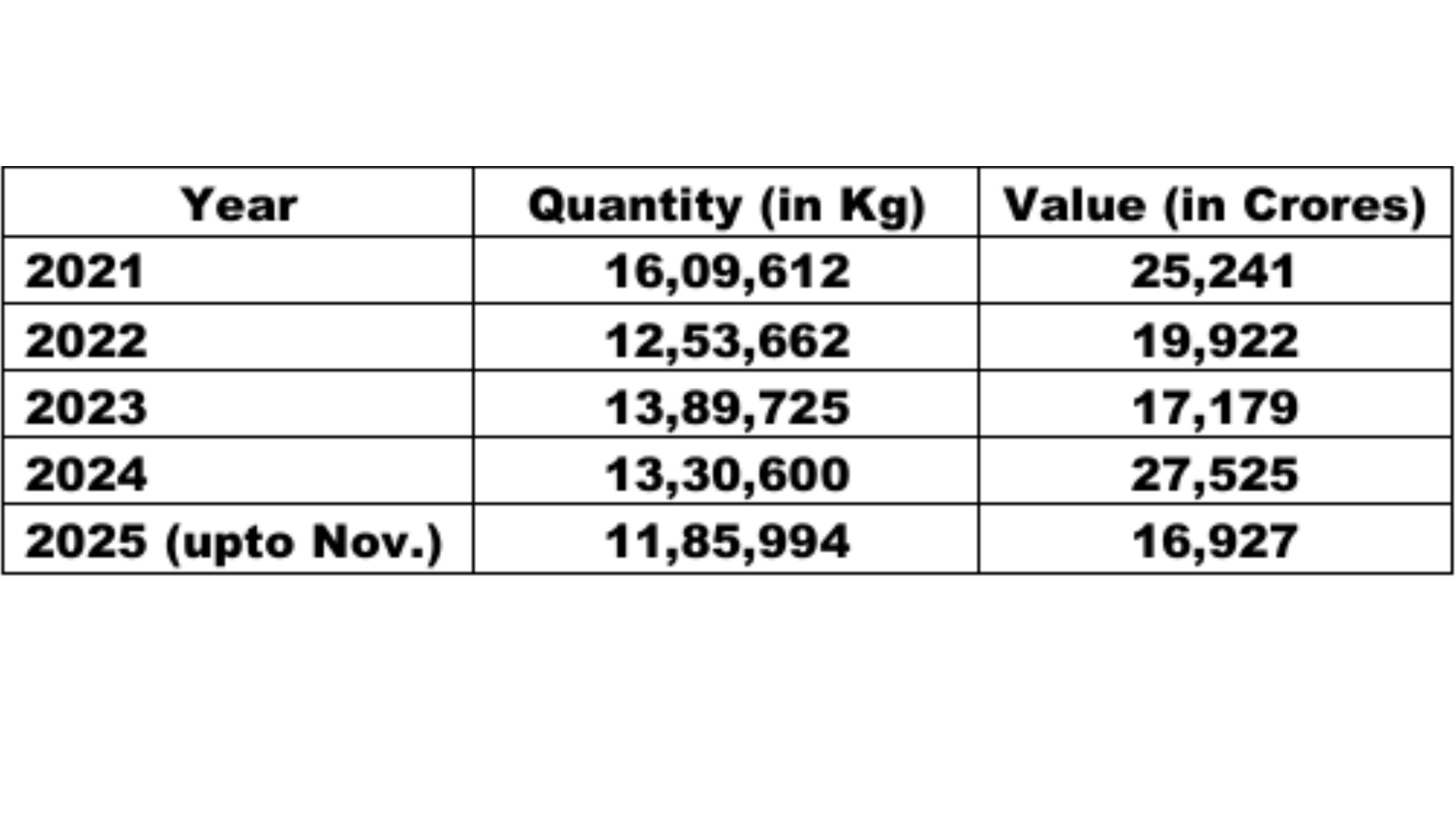
The quantum of drugs seized during 2021 to 2025 (up to November), as reported by various Drug Law Enforcement Agencies to the Narcotics Control Bureau (NCB), and their value is as under:
The Minister informed that the e-Sakshya portal has been designed to assist police in recording and managing evidence in criminal cases. The portal aligns with new criminal laws aimed at modernizing the justice system. It allows police officers to record the scene of a crime, including search and seizure activities, directly from their mobile phones. e-Sakshya plays a crucial role in ensuring uniformity in investigations across states, which is expected to enhance the conviction rate.
The Government has also set up the Crime and Criminal Tracking Network System (CCTNS), which aims to interlink all police stations under a common application software for the purpose of investigation, data analytics, research, policymaking, tracking of complaints, and requests for antecedent verifications.
Apart from this, the National Intelligence Grid (NATGRID) has been introduced by the Ministry of Home Affairs. It allows authorized access to financial records, including tax data, bank accounts, and suspicious transaction reports from the Financial Intelligence Unit (FIU), enabling investigating officers to trace money flow.
The National Forensic Sciences University (NFSU), Gandhinagar, Gujarat, has entered into a MoU with the NCB to strengthen India’s fight against narcotics, including darknet-enabled trafficking, through advanced forensic and cyber-forensic support. This collaboration includes research on New Psychoactive Substances (NPS), drug profiling, AI- and drone-based forensics, as well as structured training, capacity building, and internship programmes.