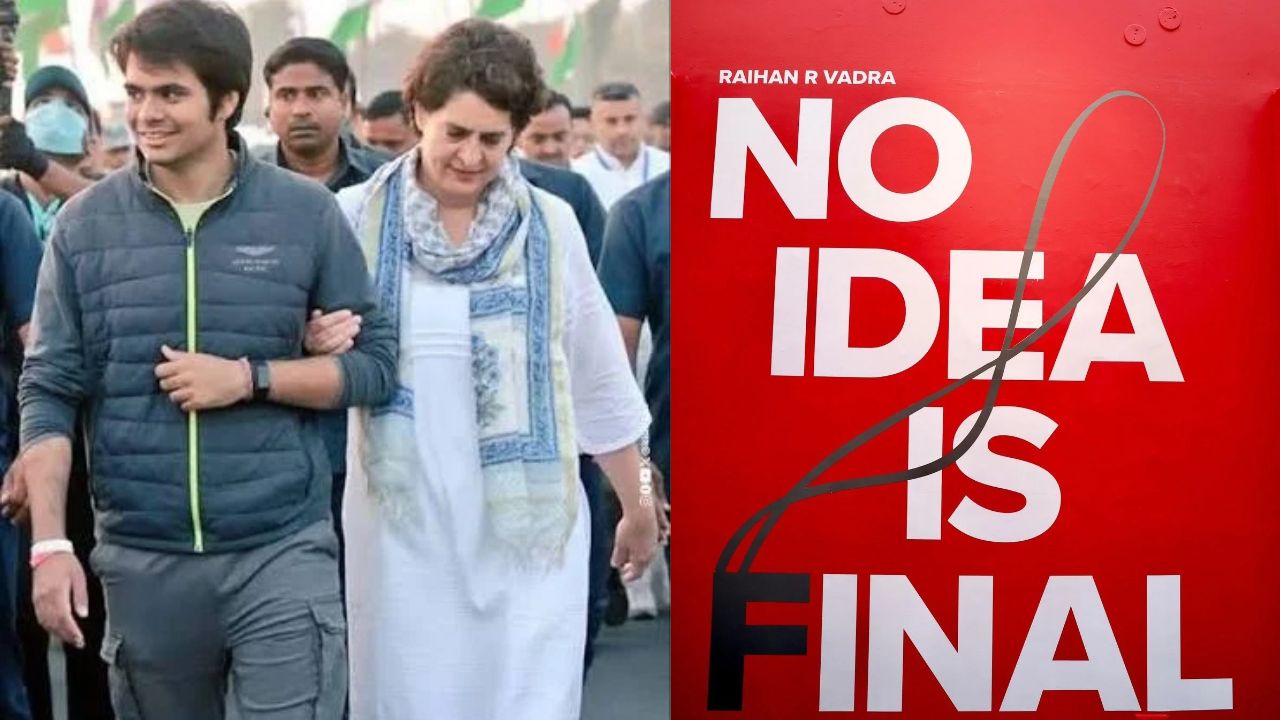
Artist and photographer Raihan Vadra has challenged the removal of photographs from his exhibition ahead of its opening. Priyanka Gandhi Vadra publicly backs her son. (Img: X)
New Delhi: Artist and photographer Raihan Vadra on Wednesday criticised the removal of dozens of photographs from his exhibition at Delhi’s Bikaner House, arguing that restricting artistic expression undermines the role of cultural institutions. The controversy erupted just hours before his solo exhibition, 'No Idea is Final,' was scheduled to open, after the venue’s management reportedly objected to photographs documenting protests and youth movements.
Vadra, the son of Congress MP Priyanka Gandhi Vadra and businessman Robert Vadra, said the Bikaner House administration had described some of the photographs as political and therefore contrary to its policy. He maintained that removing a large collection of images simply because they could be considered objectionable was unacceptable.
Speaking to a leading news portal, Vadra said he could understand restrictions in cases involving explicitly political slogans or graphic nudity, but argued that removing dozens of photographs without a clear, documented justification was incompatible with the responsibilities of a cultural institution. He said such decisions raised serious questions about freedom of expression and the ability of artists to document contemporary events.
The dispute centres on No Idea is Final, a solo exhibition featuring more than 100 photographs spanning wildlife, abstract imagery and street photography. The collection also includes images documenting protests and youth movements in Delhi over the past several months, alongside broader scenes of everyday urban life.
Vadra said two rooms on the first floor of Bikaner House’s CCA building were intended to display a substantial collection of photographs documenting demonstrations at Jantar Mantar, recent protests in the national capital and other street scenes. According to him, the photographs represented nearly three years of his work, rather than an exhibition devoted exclusively to political demonstrations.
He alleged that the venue’s management raised objections shortly before the opening despite having received the exhibition proposal and layout in advance. Vadra said he was informed at approximately 3.30 pm on Wednesday that the disputed photographs had to be removed by 5 pm or the entire exhibition could be cancelled.
The artist said the management’s explanation was linked to the prevailing political climate and the timing of the exhibition. According to Vadra, the Principal Resident Commissioner overseeing Bikaner House indicated that the photographs could be considered political in nature because of the circumstances in Delhi and across the country.
Vadra questioned why the concerns had not been raised earlier, given that the organisers had shared the proposed layout with the venue’s management well before the exhibition was due to open.
One of the most contentious aspects of the dispute concerns photographs of the Indian national flag. Vadra alleged that the management objected to two photographs featuring only the Tricolour, without any additional subjects or political messaging.
He said he challenged the objection and asked the administration to provide its demand for the removal of the photographs in writing. According to him, no written explanation was provided for taking down those particular images.
Vadra also maintained that he had voluntarily avoided displaying overt political placards and banners in response to the initial objections. He said that, at first, he complied by turning the disputed photographs around, but the administration subsequently insisted that the images be removed altogether and placed in storage.
The artist argued that the photographs were intended to document events and public demonstrations rather than promote a particular political position. He also questioned the distinction between political and non-political art, suggesting that artistic expression cannot always be separated from the social and political circumstances in which it is created.
The removal of the photographs has therefore brought questions of curatorial discretion, institutional policies and artistic freedom into focus. The Bikaner House administration had not issued a detailed public response to the controversy in the reports available at the time of publication.
Congress MP Priyanka Gandhi Vadra publicly supported her son following the controversy, sharing a message on social media platform X. She argued that when people in positions of power become fearful of another person’s expression, they risk undermining the very authority they seek to protect.
Priyanka Gandhi encouraged her son to stand by what he believed to be true and expressed pride in his work. Her message added a political dimension to a dispute that had already drawn attention to the relationship between artistic expression and institutional restrictions.
Speaking to PTI, Priyanka Gandhi described the removal of the photographs as unreasonable and expressed concern that restricting the work of a young artist could amount to suppressing the voices of young people. She maintained that the images were visual documentation of protests and did not contain commentary or material derogatory towards any individual.
She also warned that a similar situation could affect other artists in the future, raising concerns about the broader implications for creative freedom.
Robert Vadra, Raihan’s father, also shared his son’s social media post concerning the removal of the photographs, expressing support for his position.
Despite the dispute, No Idea is Final was scheduled to proceed at Bikaner House. Reports indicated that approximately 40 photographs remained on display, while more than 70 had been removed from the exhibition.
Vadra described the decision as deeply disappointing, emphasising that the collection represented years of artistic work and was not limited to images of political demonstrations. He argued that cultural institutions should provide space for artistic engagement with contemporary society rather than subject exhibitions to changing political preferences.
The controversy has also raised questions about transparency in exhibition approval processes, particularly when organisers submit proposals and layouts in advance but face objections shortly before an event opens.
Vadra’s exhibition is scheduled to continue in a limited form in Delhi through Sunday, with a further presentation planned in Bengaluru next month. The dispute has placed the spotlight on how cultural venues balance their internal policies with the role of art in documenting public life, protest movements and changing social realities.

